




 For all latest news, follow the Daily Sun's Google News channel.


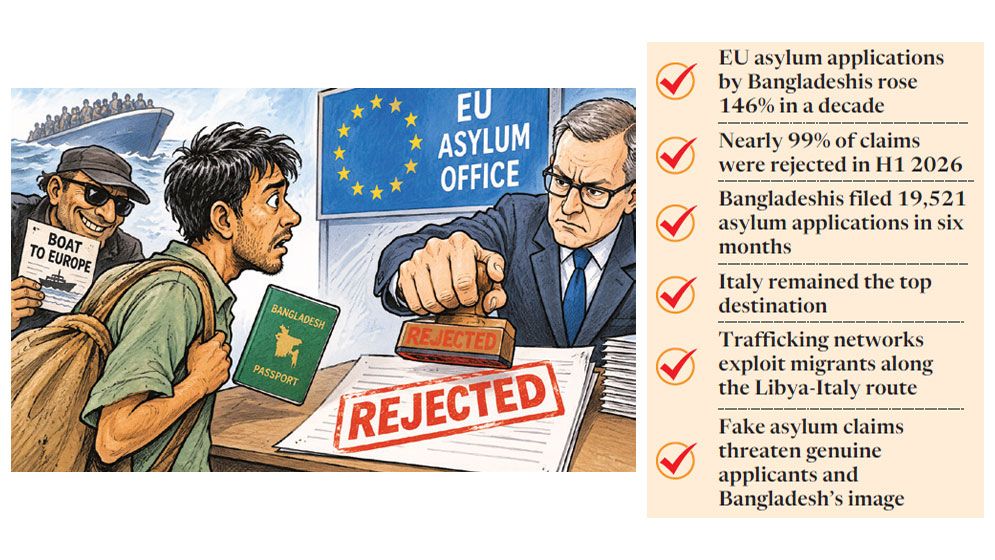
The number of Bangladeshis seeking asylum in European Union (EU) countries has more than doubled over the past decade, but an overwhelming majority are being denied protection, exposing growing numbers of migrants to irregular migration, human trafficking and exploitation by organised criminal networks.
Nearly 99% of asylum applications filed by Bangladeshis were rejected in the first half of 2026, compared with a rejection rate of 94% in 2016, according to data from the European Union Agency for Asylum (EUAA).
Migration experts warn that economic hardship, limited legal migration opportunities and organised trafficking networks are pushing more Bangladeshis towards dangerous routes to Europe, often on false promises of jobs, asylum and legal residency.
Shakirul Islam, chairperson of the Ovibashi Karmi Unnayan Program (OKUP), said an organised international trafficking network was operating from villages in Bangladesh to Libya and Italy, exploiting people seeking better economic opportunities.
Citing an OKUP field survey in Madaripur, he said 402 of the 699 households surveyed had reported irregular migration to European countries, mainly Italy, through the Libya route.
“The network involves Bangladeshi operatives at different stages of the journey, while local militias control parts of the trafficking operations in Libya,” he said.
Traffickers also mislead prospective migrants into believing that reaching Europe through irregular routes would automatically make them eligible for asylum, he added.
EUAA statistics show that around 15,000 Bangladeshis applied for asylum in EU countries in 2016. The figure rose to 36,901 in 2025, while another 19,521 applications were lodged in the first six months of 2026.
Bangladeshis accounted for around four% of all asylum applications in EU+ countries in 2025, making Bangladesh the fourth-largest country of origin for asylum seekers after Afghanistan, Venezuela and Syria.
Applications increased to 18,865 in 2017 before falling to 13,740 in 2018. They rose again to 15,843 in 2019 before dropping to 11,570 in 2020 amid the Covid-19 pandemic.
The upward trend resumed in 2021, with 20,110 applications, followed by 33,729 in 2022 and 40,332 in 2023. Applications reached a decade-high of 43,236 in 2024 before declining to 36,901 in 2025, reflecting a broader fall in asylum applications across Europe.
Italy remained the leading destination for Bangladeshi asylum seekers for three consecutive years from 2023 to 2025, followed by France and Greece.
European authorities have also accelerated the processing of applications to clear backlogs. They disposed of 43,523 Bangladeshi asylum applications in 2025, exceeding the number of new claims lodged that year. Consequently, the pending caseload fell from 47,778 in 2024 to 41,692 in 2025.
While the overall recognition rate for asylum applications in EU+ countries stood at 29% in 2025, the rejection rate among Bangladeshi applicants reached nearly 99% in the first half of 2026.
Experts attribute the growing number of applications to limited employment opportunities at home, declining agricultural incomes partly due to climate change, shrinking legal migration channels and the expanding operations of human trafficking networks.
Shakirul said the Italian embassy viewed the growing number of asylum applications from Bangladeshis as a clear misuse of the asylum system.
The US State Department’s 2026 Trafficking in Persons (TIP) Report has also highlighted persistent shortcomings in Bangladesh’s efforts to combat human trafficking.
Bangladesh retained its Tier 2 status for the seventh consecutive year, indicating that the government has made significant efforts to combat trafficking but has yet to meet the minimum standards fully.
The report acknowledged progress in investigations and prosecutions, the enactment of the Human Trafficking and Migrant Smuggling Prevention Ordinance 2026, updated victim identification guidelines and pilot initiatives to introduce a digital National Referral Mechanism.
However, it pointed to weaknesses in judicial proceedings, victim protection, efforts to prevent domestic trafficking and safeguards for migrant workers.
Migration expert Asif Munier stressed the need for stronger coordination among government agencies to curb irregular migration and prevent the misuse of asylum procedures.
“Some people are being encouraged to submit fraudulent asylum applications using fabricated documents and allegations of political persecution or homosexuality, without understanding the legal consequences. The exceptionally high rejection rate could damage Bangladesh’s international image and undermine the rights of genuine asylum seekers,” he said.
He alleged that some expatriates and local immigration lawyers were facilitating questionable applications, while government monitoring remained inadequate.
Asif called on Bangladesh’s diplomatic missions to raise awareness among expatriates and legal practitioners about the consequences of submitting false asylum claims.
He also recommended awareness campaigns through social media and embassy websites, alongside stronger coordination among the ministries of home affairs and foreign affairs and the Department of Immigration and Passports to monitor risky migration routes and dismantle trafficking networks.