



 For all latest news, follow the Daily Sun's Google News channel.


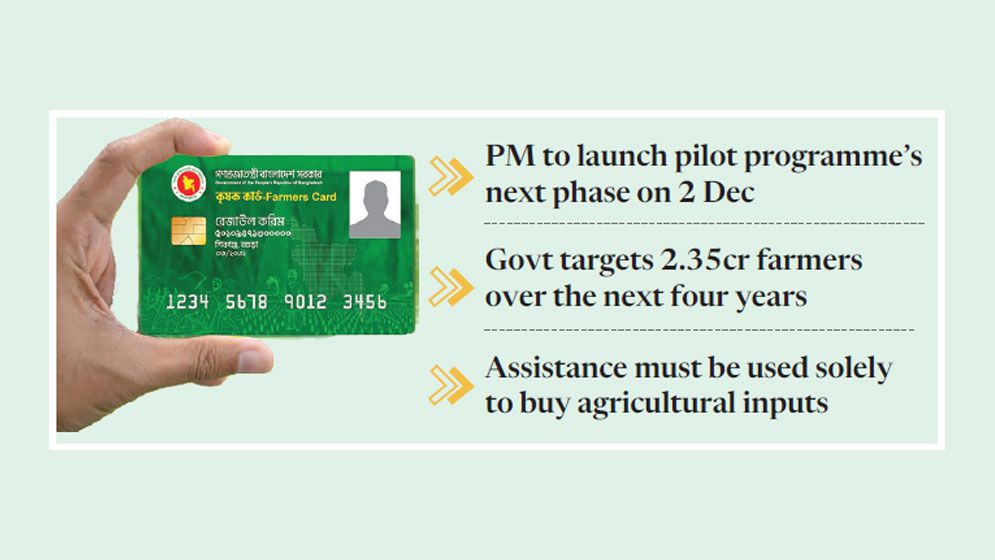
More than 4.43 lakh farmers in Khulna, Dhaka and Rangpur divisions are set to come under the government’s Farmer Card programme in December, with over Tk101.64 crore earmarked for direct agricultural input assistance.
Of the 443,484 farmers covered, 406,591 landless, marginal and small farmers will receive Tk2,500 each annually through bank accounts.
Prime Minister Tarique Rahman is scheduled to inaugurate the pilot programme’s second phase in Kushtia Sadar upazila on 2 December, when Tk67.20 crore will go to 268,836 eligible farmers in Khulna and Dhaka divisions. On 5 December, he will launch it in Gaibandha’s Gobindaganj upazila, with Tk34.43 crore for 137,755 farmers in Rangpur division, according to the Agriculture Ministry’s latest programme summary.
Initially, 2,850 farmers from two agricultural blocks in Kushtia Sadar will receive cards, as will 1,990 from one block in Gobindaganj through Sonali Bank PLC. All eligible farmers will receive the money in their accounts, even without physical cards.
Beneficiaries can withdraw it from designated bank branches exclusively to buy agricultural inputs. They must then report purchases to the upazila agriculture office or sub-assistant agriculture officer for recording. The ministry has instructed upazila offices to help farmers withdraw and properly use the assistance.
The government aims to cover about 2.35 crore farmers over four years across 64 districts, 503 upazilas, 16 metropolitan areas and 14,180 agricultural blocks. For fiscal year 2026-27, it targets distributing cards to about 43 lakh farmers and providing some Tk970 crore to 39 lakh landless, marginal and small farmers.
As of 26 November, information on about 26.98 lakh farmers had been collected, according to ministry data. Relevant committees had approved 19.02 lakh records, bank accounts had been opened for about 16.52 lakh farmers, and iBAS had verified some 15.32 lakh accounts or farmer records.
About 7,200 sub-assistant agriculture officers are collecting and verifying information, including national identity cards, mobile numbers, land ownership or cultivation details and other agricultural data. The checks are intended to include genuine farmers and exclude ineligible individuals.
Agriculture Minister Mohammed Aminur Rashid said the government was working to modernise agriculture and make it technology-driven, so that it could become a major economic pillar. The programme aimed to expand modern farming methods and technology and establish demand-based production, he said, adding that cardholders would have access to services including support for fair produce prices.
Agriculture Secretary Md Selim Khan said the programme was creating a comprehensive farmer database covering cultivable land, crop diversity, product demand and soil health, enabling modern, information-based and planned management. The card was more than an identity document, he said, as it would elevate farmers’ dignity and help establish agriculture as a respected profession.
The ministry says cardholders will gradually receive subsidies, incentives, fairly priced inputs, irrigation, easier agricultural loans and subsidised machinery. Planned services include mobile-based pest advice, training, weather forecasts, market information, agricultural insurance and fair-price sales opportunities.
The government expects the system to reduce intermediaries’ role and improve transparency in identifying beneficiaries. Data, including production and market demand, should also help policymakers plan more effectively.
A pre-pilot began on 14 April 2026, Bengali New Year’s Day, in Tangail Sadar. It gave cards to 20,832 farmers from 11 blocks in 11 upazilas across 10 districts in all eight divisions. The next phase began on 1 October in Feni’s Fulgazi upazila, transferring assistance to about 100,000 farmers in 77 upazilas.
Bangladesh Krishi Bank, Sonali Bank and Janata Bank, all state-owned, have initially been engaged to handle transactions and assistance distribution.
Market insiders said accurate beneficiary identification and timely delivery would be crucial to the programme’s success.