



 For all latest news, follow the Daily Sun's Google News channel.


Legalising electric rickshaws through safety requirements for registration poses significant challenges for the government, as fees under the recently passed regulation may raise production costs.
Besides, licensing under the guideline may shift 42 backward-linkage businesses, including manufacturing, charging and parking, entirely from informal workers to big companies.
Experts warned that swiftly phasing out existing charging stations, parking and other facilities could trigger strong resistance from rickshaw pullers, owners and mechanics, as happened in the past, forcing the government to backtrack. They suggested phased implementation to avoid major clashes of interest and ensure a just transition.
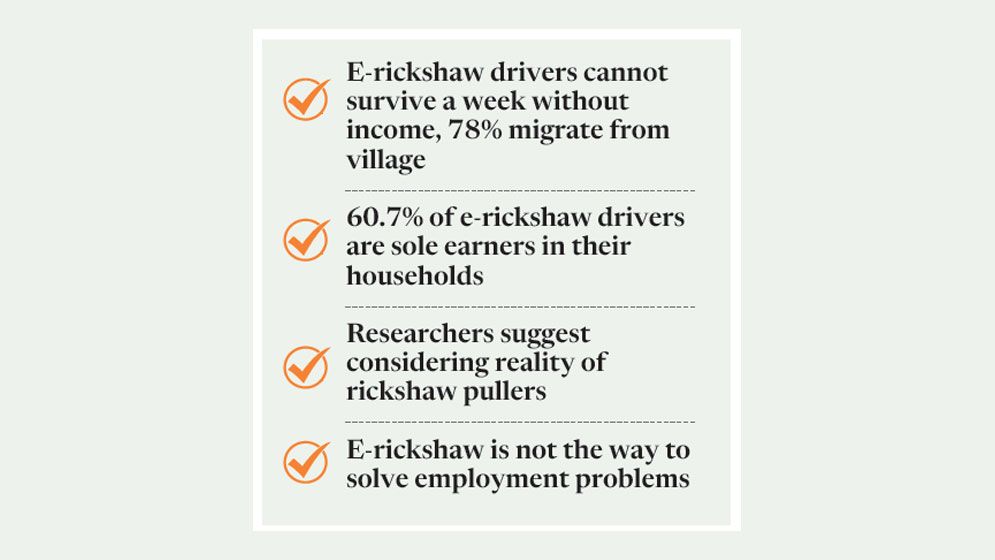
A recent study by the BRAC Institute of Governance and Development (BIGD) in Dhaka and Barishal found that 62.9% of e-rickshaw drivers cannot survive a week on their income, while 38.6% do not own rickshaws and rent them for a few hours.
The study found that 69.1% of drivers have primary education or less, 60.7% are sole earners in their households and 15.3% are covered by social safety net programmes.
Researchers estimated that the country has 50-60 lakh e-rickshaws, including 20 lakh in Dhaka. BIGD surveyed 352 renter-drivers from 21 June to 30 July. They earn an average of Tk18,000 a month and pay Tk10,323 in monthly rent, equivalent to 38.6% of their gross income.
Nearly half the respondents (45.8%) previously drove pedal rickshaws or vans, while 20.7% came from informal wage labour. Economic migration is particularly significant in Dhaka: 78.3% of respondents there came from other districts, and 84.2% of these migrants had limited income or work opportunities in their places of origin.
Presenting the findings on Tuesday, BIGD operations director Mehnaz Rabbani said sudden regulatory decisions usually trigger strong resistance and force the government to backtrack. She said the government should therefore consider the drivers' employment.
Dhaka South City Corporation (DSCC) Administrator Md Abdus Salam described the city's transport situation as a total collapse.
He said, “This thing cannot go this way. It is a total collapse. There are two reasons: one is e-rickshaws, and the other is hawkers. E-rickshaws are not the way to solve our employment problems, but they have to be considered as a mode of transport.”
He added, “Residents have the right to move around freely; pedal rickshaw pullers also have the right to earn a living and work. However, ensuring adequate civic amenities would become increasingly difficult if everyone continued to migrate to Dhaka as e-rickshaw drivers.”
Dhaka North City Corporation Administrator Md Safiqul Islam Khan Milton said the authorities were not against auto-rickshaws or their drivers, but unregulated operation posed security and safety risks.
“We want to allow the vehicles in eight zones in Dhaka which will be indicated with different colour codes. E-rickshaws with one colour code will not be allowed in other areas.”
Joint Commissioner of Dhaka Metropolitan Police Mohammad Shafioul Alam highlighted implementation challenges, saying, “If we want to implement the color-coded zone-wise operation of the vehicle, then we have to designate changing points of the vehicles, which is tough. There is adequate space in Dhaka. A passenger will not be willing to change rickshaws when they are going to drop their children at school or go to the office midway through their journey.”