


 For all latest news, follow the Daily Sun's Google News channel.


Drug-resistant bacteria leave ICUs with few treatment options
Daily Sun Report, Dhaka
Published: 26 Nov 2026, 12:00 AM
Commonly used antibiotics are losing effectiveness in the country as multidrug-resistant bacteria spread, with intensive care units (ICUs) worst affected, according to a national surveillance report released in Dhaka on Wednesday.
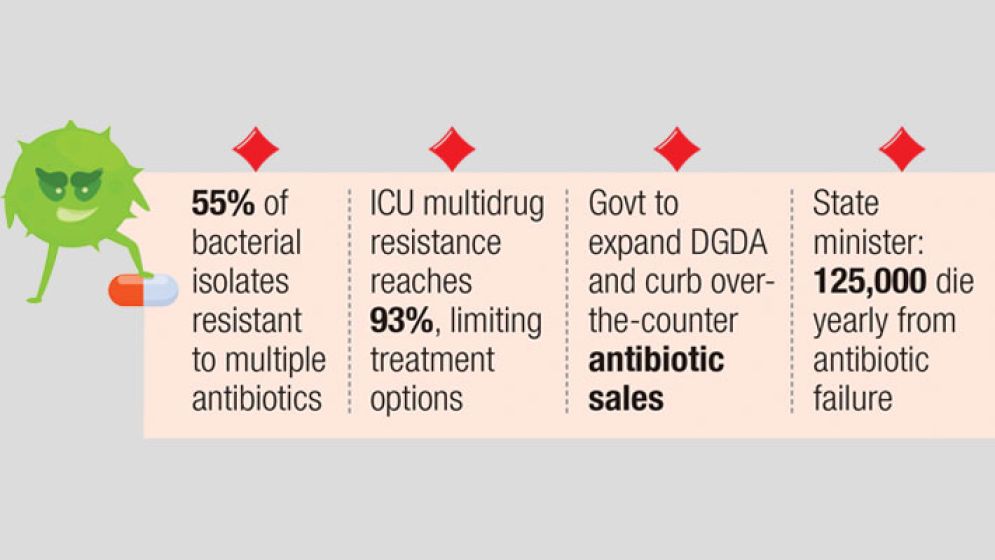
The report found that 55% of bacterial isolates were resistant to multiple antibiotics. In ICUs, the figure was 93%.
Speaking at the release at the Institute of Epidemiology, Disease Control and Research (IEDCR), Health and Family Welfare State Minister Dr MA Muhit said the government would strengthen the Directorate General of Drug Administration (DGDA), expand its workforce and tighten controls on over-the-counter sales of antibiotics. He said the DGDA was being restructured with support from the World Health Organization (WHO).
The report analysed 99,867 samples from eight divisions between July 2025 and June 2026, yielding 85,520 culture-positive isolates. About 78% of the bacteria identified were Gram-negative, including E. coli (33%) and Klebsiella pneumoniae (21%).
Of 1,118 bacteria-antibiotic combinations assessed across 14 antibiotics, 795 (71%) showed susceptibility of 60% or below. In ICUs, 90% of findings from blood samples fell in the "red zone", denoting critically low effectiveness. No tested antibiotic reached the "green zone" against Acinetobacter infections in ICUs. Resistance to carbapenems, notably imipenem and meropenem, was a major concern among Gram-negative bacteria in intensive care.
Between January and June 2026, about 95% of Acinetobacter isolates and 82% of Enterococcus faecium isolates were multidrug-resistant, as were 69% of both E. coli and Klebsiella pneumoniae isolates. Resistance among these bacteria had risen from the previous year.
Dr Muhit said about 125,000 people die in Bangladesh every year from antibiotic failure, calling it a major public health threat that could not be solved overnight. He said infection control and rational antibiotic use were being added to medical, nursing, midwifery and pharmacy curricula, and that planned 150-bed upazila hospitals would prioritise waste management and infection control. Electronic health records and digital prescriptions would allow prescriptions to be audited centrally, he added.
Citing the One Health approach, he said antibiotics were also given to livestock and poultry without veterinary advice, and urged joint action by the health, agriculture, fisheries and livestock, and environment ministries. He asked senior doctors to lead on antimicrobial stewardship, wanted the IEDCR surveillance programme made
permanent, and warned against taking antibiotics for flu and colds without a prescription. The report said most laboratories cannot run Minimum Inhibitory Concentration (MIC) tests needed to gauge the effectiveness of critical antibiotics such as colistin and vancomycin. It recommended expanding laboratory capacity, strengthening hospital infection control, improving stewardship and updating treatment guidelines regularly using surveillance data. It also warned that Acinetobacter and Burkholderia cepacia can survive in hospital environments and spread infections.
IEDCR Director Prof Dr Kazi Ahmed Zaki chaired the programme, which was also addressed by WHO representative Dr Anthony S Essofoni and senior health directorate officials.