


 For all latest news, follow the Daily Sun's Google News channel.


16-day activism launched aiming to prevent violence against women
Daily Sun Report, Dhaka
Published: 25 Nov 2026, 10:07 PM
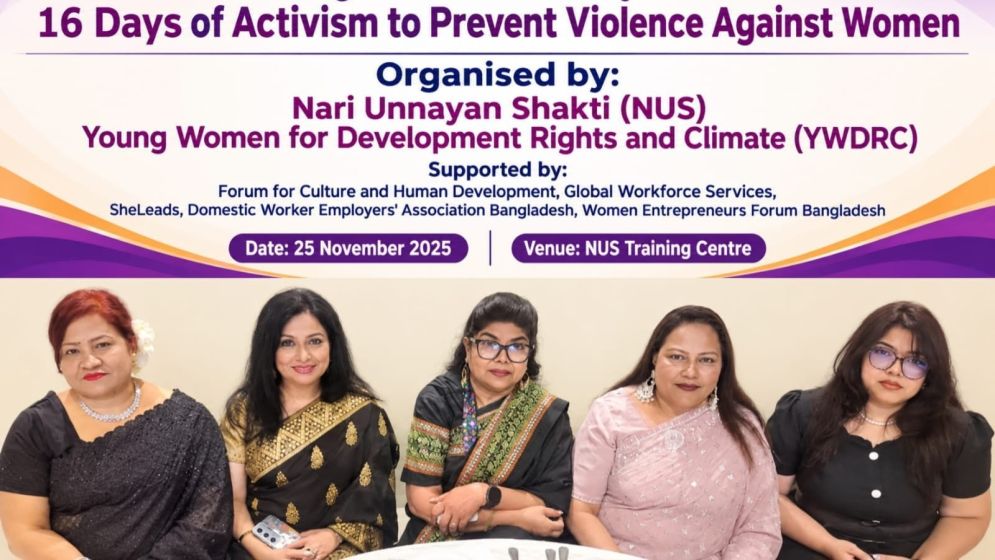
Photo: Courtesy
Multiple rights groups launched a 16-day activism on Wednesday to counter violence against women and girls at a formal event held at the NUS Training Centre in Dhaka.
The event was jointly organised by Nari Unnayan Shakti (NUS) and Young Women for Development Rights and Climate (YWDRC), with support from Forum for Culture and Human Development, Global Workforce Services, SheLeads, Domestic Worker Employers' Association Bangladesh, and Women Entrepreneurs Forum Bangladesh.
The event was chaired by Dr Afroja Pravin, executive
director of Nari Unnayan Shakti (NUS). The keynote presentation, titled “The
Current Situation of Violence Against Women in Bangladesh and Ways Forward for
Prevention and Redress,” was delivered by Nusrat Sultana Afroj, executive
chairperson of Young Women for Development Rights and Climate (YWDRC).
Other speakers included Selina Akhter, joint secretary of
SheLeads; music artiste Sompi Zaman; Dr Sultan Muhammad Razzak, executive
director of Forum for Culture and Human Development; Abdul Momin, manager of
Global Workforce Services and publicity secretary of Domestic Worker Employers'
Association Bangladesh; along with representatives of various women's rights,
human rights, development and social organisations.
The speakers emphasised that violence against women is not
merely a social problem; it is a direct violation of women's fundamental human
rights, dignity, safety and equality. They highlighted that preventing rape,
sexual harassment, domestic violence, child marriage, dowry-related violence,
human trafficking, workplace abuse and technology-facilitated gender-based
violence requires coordinated action by families, communities, the government,
law enforcement agencies and civil society.
They further stressed that legislation alone cannot
eliminate violence against women. Effective enforcement of existing laws,
prompt investigation and prosecution, protection of survivors, access to
healthcare, psychosocial support, legal assistance and accountability of
perpetrators are essential. They also underscored the urgent need to challenge
the culture of silence and social tolerance that allows violence against women
and girls to persist.
10 recommendations to government
1. Ensure Prompt Registration and Impartial Investigation of
All Complaints of Violence Against Women. All complaints involving violence
against women and children must be received and addressed without delay.
Negligence, harassment or reluctance on the part of law enforcement personnel
in registering such complaints must not be tolerated.
2. Ensure Expedited Investigation and Justice in Cases of
Rape and Sexual Violence. Medical examinations, DNA testing and other
scientific and forensic evidence must be collected and preserved promptly.
Appropriate measures must be taken to reduce delays throughout the judicial
process.
3. Establish a Comprehensive, Survivor-Centred Protection
System for Women and Girls. Survivors must have access to safe shelters,
medical care, legal assistance, mental health and psychosocial support, and
comprehensive rehabilitation services through an integrated support mechanism.
4. Introduce an Effective Case Monitoring System for
Violence Against Women and Children. The progress of investigations, submission
of charge sheets, court proceedings and final judgments must be regularly
monitored. Special initiatives should be undertaken to expedite the resolution
of long-pending cases.
5. Provide Gender-Sensitive and Survivor-Centred Training to
Law Enforcement and Judicial Officials. Relevant officials must be equipped
with the knowledge and skills to handle cases of violence against women with
sensitivity, professionalism and respect for survivors' dignity, privacy and
safety, without victim-blaming or discriminatory treatment.
6. Strengthen and Expand Public Awareness of the National
Helpline 109 and Other Support Services. The accessibility, effectiveness and
public visibility of the national helpline 109 and other support services for
women and children must be enhanced. Nationwide awareness campaigns should
ensure that women and girls in both rural and urban areas know where and how to
seek assistance.
7. Take Effective Measures to Prevent Sexual Harassment in
Workplaces, Educational Institutions, Public Transport and Public Spaces. Every
institution must establish functional mechanisms for receiving complaints,
conducting investigations and providing appropriate remedies. Perpetrators must
be held accountable through appropriate disciplinary and legal action.
8. Strengthen Measures to Prevent Online and
Technology-Facilitated Violence Against Women. Effective mechanisms must be
established for promptly receiving complaints and providing remedies against
cyberstalking, online sexual harassment, the non-consensual circulation of
intimate images or videos, blackmail and other forms of digital violence.
9. Implement Long-Term Social and Educational Programmes to
Address the Root Causes of Violence Against Women. Comprehensive initiatives
must address child marriage, dowry, gender discrimination, the normalisation of
violence and harmful social norms. Schools, families, religious and community
institutions, as well as men and boys, must be actively engaged in transforming
discriminatory attitudes and behaviours.
10. Establish a Strong Coordination Mechanism Among the
Government, Civil Society and Women's Organisations. The experience, expertise
and grassroots capacities of women's rights organisations and civil society
must be effectively utilised to strengthen data collection, monitoring, service
referrals, policy advocacy and accountability mechanisms for preventing
violence against women.