


 For all latest news, follow the Daily Sun's Google News channel.


Development partners see gender-based violence as critical barrier to Bangladesh's progress
UNB, Dhaka
Published: 25 Nov 2026, 07:38 PM
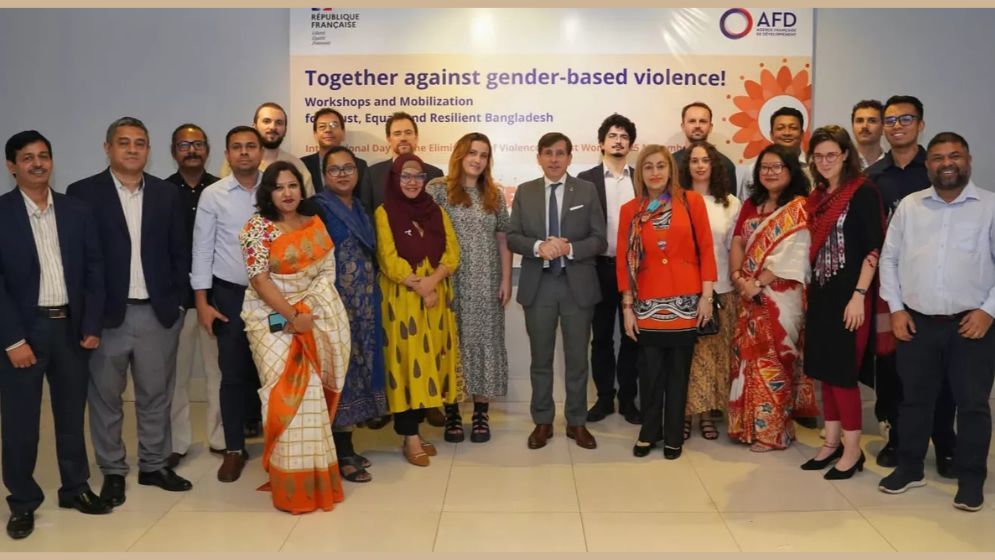
Photo: Courtesy
Development partners on Wednesday said gender-based violence (GBV) remains a critical barrier to development in Bangladesh, as they marked the International Day for the Elimination of Violence against Women.
Citing government data showing that 76% of ever-married women have experienced intimate partner violence during their lifetime, they said the insecurity faced by women and girls prevents them from fully participating in the country's economic and social development.
The French Development Agency (AFD) brought together around 100 participants, including representatives of 10 partner organisations, government institutions, development partners, civil society organisations and artists, at the Alliance Française de Dhaka for a day-long programme featuring dialogue, art and peer learning on gender-based violence.
The event marked the beginning of the 16 Days of Activism against Gender-Based Violence (25 November-10 December), with the central message that eliminating GBV is a prerequisite for building just, equal and resilient societies.
AFD and its partners also highlighted their ongoing efforts to address the issue in Bangladesh.
The programme was organised as part of French Week, an initiative of the Embassy of France in Bangladesh.
Under its feminist foreign policy, France is committed to supporting efforts to eliminate gender-based violence by 2030, with AFD playing a leading role in translating this ambition into action.
AFD supports women's triple autonomy - physical, economic and political - and allocates, on average, 55 percent of its project financing to projects with gender equality as a significant or principal objective, contributing to the elimination of gender-based violence by 2030 in line with Sustainable Development Goal 5.
"Our conviction is simple: there can be no development, no peace and no justice without women's autonomy - physical, economic and political," French Ambassador to Bangladesh Jean-Marc Séré-Charlet said.
"Within the framework of France's feminist foreign policy, renewed through the International Strategy for Feminist Foreign Policy (2025–2030), AFD promotes gender equality by supporting the three dimensions of women's and girls' autonomy: physical, economic and political," said Cynthia Mela, AFD Country Director.
The 2024 Violence Against Women Survey, conducted by the Bangladesh Bureau of Statistics in collaboration with UNFPA, also highlighted the link between gender-based violence and the climate crisis.
According to the survey, women living in disaster-prone areas face a higher prevalence of non-partner violence, while disasters, displacement and resource scarcity exacerbate inequalities and increase women's vulnerability to violence.
During the programme, NGOs shared examples of how climate change affects women and girls. Families facing economic hardship due to climate-related impacts may resort to child marriage, while women and girls have reported feeling unsafe in shelters during cyclones.
The 10 AFD-financed projects showcased at the event are addressing these challenges. They include projects by UN Women and the Local Government Engineering Department (LGED) under the Bangladesh Climate Change and Gender Action Plan, as well as initiatives by CREA, CARE, Jago Nari, the Dhaka Women Chamber of Commerce and Industry (DWCCI) and Friendship, supported, among others, by the Support Fund for Feminist Organisations.
The day-long programme also featured two exhibitions. An exhibition by CCDB highlighted the individual stories of survivors of gender-based violence, including women who had secured employment and achieved economic autonomy, as well as those whose voices and opinions were heard in their communities for the first time.
Two workshops, facilitated by CARE and CREA, encouraged participants to challenge traditional gender roles and reflect on what it means to be an ally of feminism.
"While Bangladesh has strong political frameworks to ensure women's rights and tackle GBV, we need to bridge the gap between the promise of the law and its implementation. We must invest in changing the norms and unequal power relations that allow it to persist, as well as support the movements that have always led that change," said Navanita Sinha, Deputy Country Representative of UN Women.
"Women's participation is no longer enough. We need to ensure that women feel safe in our projects and have the power to make their voices heard and influence project decisions," said Bipasha Hossain, IUCN Country Representative.