


 For all latest news, follow the Daily Sun's Google News channel.


PM directs third-party price assessment for checking costly procurement
BSS, Dhaka
Published: 25 Nov 2026, 06:13 PM
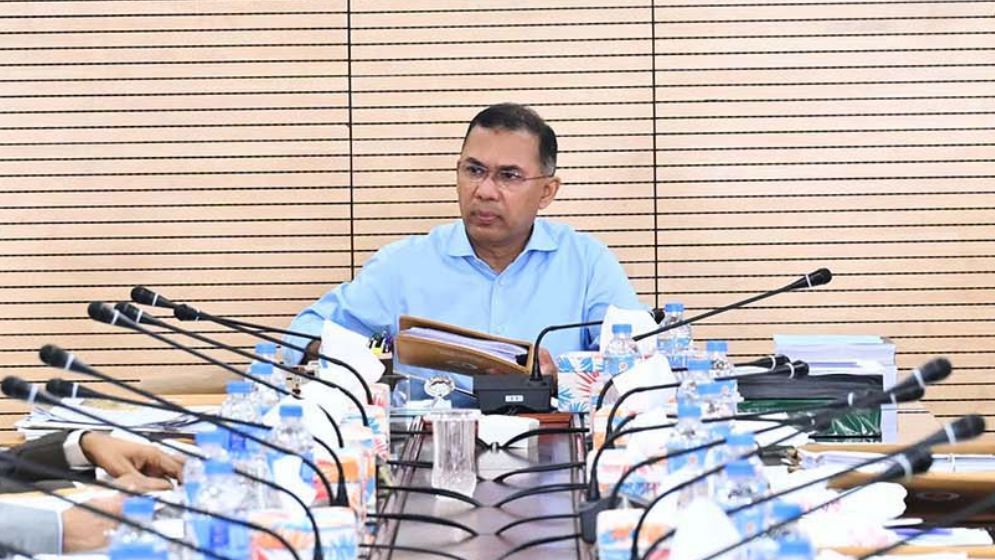
Photo: PID
Prime Minister Tarique Rahman has directed the authorities concerned to engage independent price assessment companies to scrutinise the procurement costs of major development projects, strengthen manpower planning and promote sustainable construction materials.
State Minister for Planning Md Zonayed Abdur Rahim Saki disclosed the
directives while briefing journalists on Wednesday at the NEC conference room
after the eighth meeting of the Executive Committee of the National Economic
Council (ECNEC) in this fiscal year (FY27) chaired by the Prime Minister at the
Bangladesh Secretariat.
Saki said the Prime Minister approved a proposal to involve domestic or
foreign price assessment companies in examining the costs of expensive
equipment and specialised procurement items.
“Where the expenditure involves a substantial amount, we should appoint
price assessment companies to verify the costs. This will introduce independent
third-party scrutiny and establish an institutional system of checks and
balances,” he said.
The state minister said the Planning Commission had already introduced
measures to involve relevant specialists in examining equipment and procurement
costs that do not fall under the approved rate schedule.
He said the government was also developing software that would use
artificial intelligence (AI) to check whether project expenditure follows the
approved rate schedule.
“Individual officials or project authorities may not always have the
technical expertise to assess highly specialised equipment. We need an
independent verification process so that project costs remain justified and
excessive expenditure does not take place,” Saki said.
He said the Prime Minister specifically directed the authorities to apply
the price assessment mechanism during the tender document preparation and
procurement processes for the projects involving the construction of medical
college hospitals and the expansion of the National Institute of
Gastroenterology Hospital.
Manpower planning in
health projects
The Prime Minister also instructed the authorities to determine the
required number of doctors, nurses, technicians and other skilled personnel at
the initial stage of healthcare projects.
Saki said the government would no longer wait until projects approach
completion to seek manpower approval, a practice that often delays the
operation of newly constructed hospitals and leaves expensive equipment unused.
“Manpower approval must come alongside project implementation. The authorities must secure the necessary approval from the Ministry of Public Administration and the Ministry of Finance at the beginning and complete the required training before the project ends,” he said, quoting the Prime Minister’s direction.
He said the government would also incorporate training requirements into
procurement conditions so that equipment suppliers could provide specialised
training to medical personnel.
The state minister added that the government planned to increase investment in health education to develop doctors and technicians with the necessary specialised skills.
Review of GO-NGO
collaboration
Saki said the meeting also discussed delays in implementing projects
under government-non-government organisation (GO-NGO) partnerships.
He cited a healthcare centre project in Char Fasson upazila of Bhola
district, which faced repeated delays because the partner NGO could not provide
its committed 20% share of the project cost, while the government was supposed
to provide the remaining 80%.
The project received approval for its fourth revision, including a
six-month extension.
He said the Planning Ministry had prepared proposals to revise the
existing GO-NGO collaboration framework.
“We need to examine how government-NGO partnerships should operate and
establish clearer guidelines. The Planning Ministry will discuss the proposals
with the relevant ministries before placing the issue at the next National
Economic Council meeting,” he said.
Gradual shift towards
uniblock roads
The Prime Minister also directed the authorities to gradually increase
the use of uniblock materials in rural road construction under the Herringbone
Bond (HB) road development programme.
Saki said the government planned to reduce dependence on traditional
brick roads because uniblock roads offer greater durability and can help reduce
environmental damage caused by brick kilns.
Under the proposed approach, authorities will use 50% uniblocks and 50%
bricks in the first year, 60% uniblocks and 40% bricks in the second year, and
70% uniblocks and 30% bricks in the third year if the programme continues.
“Although uniblock roads may initially cost more, they offer greater
durability and provide better convenience for people. We also want to reduce
the environmental damage associated with the expansion of brick kilns,” he
said.
The HB road programme mainly covers rural roads that have not yet
received official identification and therefore do not fall under the regular
road maintenance responsibilities of the relevant agencies.
Saki said the government wanted to accelerate rural infrastructure
development by revising ongoing projects and incorporating additional
components rather than spending time preparing entirely new projects.