



 For all latest news, follow the Daily Sun's Google News channel.


Women migrant workers face torture, receive less compensation
97% suffered mental torture, 77% physical abuse and 89% confinement
Daily Sun Report, Dhaka
Published: 25 Nov 2026, 02:39 PM
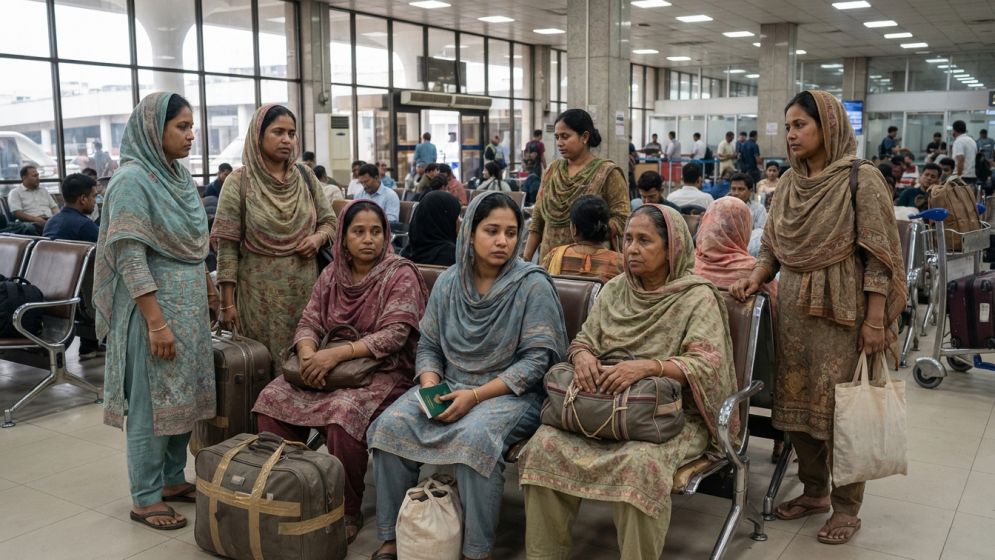
AI Generated Representational Image
Female migrant workers face significantly higher levels of physical and mental abuse, intimidation and confinement abroad than their male counterparts, but receive less compensation for their suffering and financial losses when they seek justice at home.
The unexpected scenario was revealed in a new study, titled “Justice by Procedure? A Legal and Institutional Audit of BMET Arbitration for Migrant Workers in Bangladesh”, conducted by the Ovibashi Karmi Unnayan Program (OKUP), at a hotel in the capital on Wednesday.
It reveals that 97% of female migrant workers covered by the research experienced mental torture, while 77% faced physical torture and 89% suffered movement restrictions, confinement or isolation.
Despite these severe violations, 71% of female workers who received compensation through the Bureau of Manpower, Employment and Training (BMET) arbitration process got less than Tk30,000.
The corresponding findings for male workers show that 82% experienced mental torture, 20% physical torture and 48% movement restrictions, confinement or isolation.
The research tracked 85 complaints filed by migrant workers, including 50 men and 35 women, between November 2024 and June 2026.
It found that female workers were also more exposed to other forms of workplace abuse. Around 77% reported threats or intimidation, 83% did not receive treatment for workplace injuries or accidents, and 80% complained of inadequate food.
Moreover, 66% reported improper accommodation.
Economic exploitation was particularly widespread among women. All 35 female workers covered by the study reported wage exploitation, while 86% said they had been deceived about their promised salaries.
Some 54% were denied work permits after arriving in destination countries, and 83% did not receive written employment contracts.
The compensation findings expose another layer of inequality in the country's migrant workers' grievance redress system.
Of the 28 complaints resolved through BMET arbitration, 14 male and two female workers received compensation ranging from Tk30,000 to Tk50,000. However, five of the eight female workers who received compensation got between Tk15,000 and Tk30,000.
Only one female migrant worker received compensation exceeding Tk100,000, with the highest settlement amounting to Tk145,000.
On average, compensation received by female migrants covered only around 12% of their migration costs, compared with 15% for male workers.
The amounts were far below their actual financial and personal losses, including recruitment fees, debt, unpaid wages, premature return and abuse.
The study found that the existing arbitration mechanism often prioritises settlement and administrative case disposal over effective justice. Workers frequently face pressure, harassment and disrespectful treatment during mediation, while recruiting agencies sometimes deny responsibility or fail to attend hearings.
Of the 85 complaints examined, 28 were resolved, 52 remained pending and five were discontinued. Among the resolved cases, eight involved female workers and 20 involved male workers.
The study also identified weak investigation, procedural delays, unequal participation and inadequate enforcement of compensation agreements as major obstacles to justice. No separately documented investigation was identified across the 85 tracked complaints.
Although the Overseas Employment and Migrants Act 2013 provides legal provisions for addressing recruitment fraud and deception, the arbitration process lacks a separate, structured framework for determining compensation based on actual losses.
The researchers recommended introducing a standardised Loss Assessment Matrix to calculate compensation by considering recruitment expenses, debt-related costs, unpaid wages, repatriation expenses and other demonstrable losses.
They also called for separating investigation from mediation, establishing a dedicated BMET arbitration wing and eventually setting up an independent specialised tribunal to adjudicate migrant workers' complaints and enforce compensation decisions.
The findings underline how women migrant workers, despite facing more severe forms of abuse abroad, remain disadvantaged when seeking financial redress and justice after returning home.