


 For all latest news, follow the Daily Sun's Google News channel.


BRAC-BIGD study calls for phased transition to regulate battery-run rickshaws
Daily Sun Report, Dhaka
Published: 24 Nov 2026, 09:11 PM
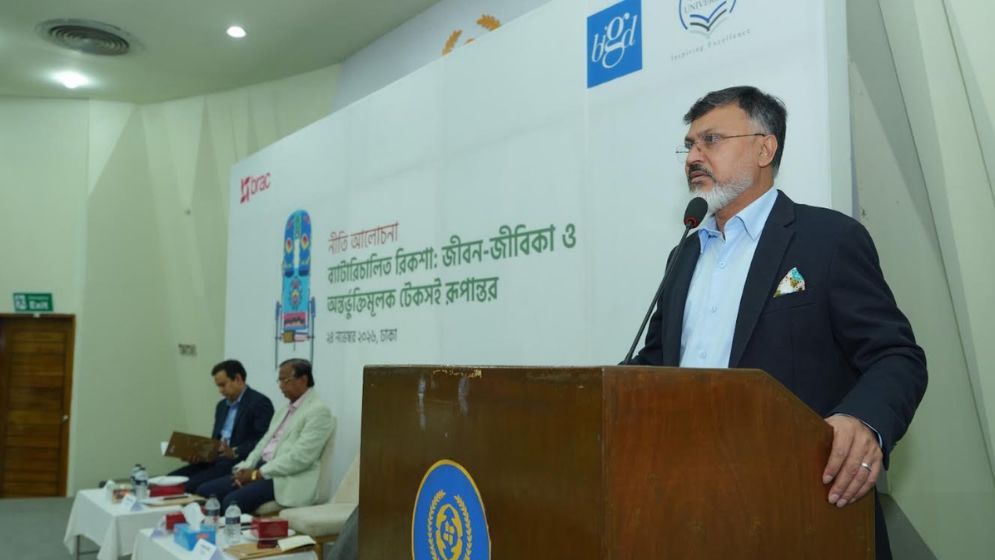
A BRAC-BIGD study has called for a gradual and inclusive transition to regulate battery-powered rickshaws, stressing that road safety and environmental concerns must be addressed without jeopardising the livelihoods of hundreds of thousands of people dependent on the sector.
The study found
that 95.6% of surveyed battery-run rickshaw drivers had no licence or permit,
while 26.7% had experienced at least one road accident in the month preceding
the survey.
The findings were
presented at a policy dialogue titled 'Battery-run Rickshaws: Livelihoods and
Inclusive Sustainable Transition' at the CIRDAP Auditorium in Dhaka on Tuesday.
The research,
titled 'Understanding the Political Ecology of Battery Rickshaws in
Bangladesh', was jointly conducted by BRAC and the BRAC Institute of Governance
and Development (BIGD).
Speaking at the
event, BRAC Executive Director Asif Saleh called for a three-to-four-year
transition plan involving all relevant stakeholders to ensure gradual reforms
while protecting the livelihoods of drivers and their families.
He said the challenges surrounding battery-powered rickshaws, including road safety, traffic management and regulation, must be addressed by considering the realities of people working in the informal sector.
Saleh said informal
workers, including rickshaw drivers and street hawkers, effectively paid an
invisible tax through fines, extortion and informal payments, with the money
going to vested interest groups rather than the state treasury.
He said the study found that 96% of battery-run rickshaw drivers had no licence or permit, while around two-thirds had experienced fines or harassment.
-6b05a925c563c.jpg)
The research also
found that 78% of battery-run rickshaw drivers in Dhaka had migrated from other
districts, with 84% citing a lack of employment opportunities in rural areas as
the reason.
Saleh said banning
battery-run rickshaws would not address the underlying causes of migration and
could instead push hundreds of thousands of families into greater economic
uncertainty.
He called for a
coordinated government approach involving the ministries responsible for road
transport, local government, power, environment, labour and agriculture to
ensure that policies addressed urban transport, workers' livelihoods and rural
economic conditions together.
Md Abdus Salam,
administrator of Dhaka South City Corporation, said urban challenges such as
traffic congestion, air pollution, waterlogging, mosquito problems and waste
management were interconnected and required an integrated approach.
He said rickshaw
drivers had the right to earn a living, just as city residents had the right to
move around freely, and stressed the need for a comprehensive plan involving
all stakeholders.
Md Safiqul Islam
Khan Milton, administrator of Dhaka North City Corporation, said the
authorities were not against auto-rickshaws or their drivers and recognised
their right to livelihoods.
However, bringing
the sector under a regulatory framework would establish accountability and
enable authorities to provide better support, he said, adding that initiatives
had been taken to bring the currently unregulated sector under a formal legal
framework.
Dr Imran Matin,
executive director of BIGD, said rickshaw drivers depended on highly vulnerable
livelihoods, where a single accident or instance of harassment could push them
back into poverty.
He stressed that
any transition must be fair and straightforward, taking into account the rights
and safety of both pedestrians and drivers.
According to the
study, 78.2% of surveyed drivers rented the rickshaws they operated and spent
an average of 38.6% of their income on rental payments. If their earnings
stopped, 62.9% would be unable to support their families for even a week.
The research also
highlighted the role of garages in the sector, providing vehicle rentals,
charging, battery replacement, repairs, financial assistance and support in
cases involving accidents or fines.
However,
unregulated electricity consumption, the operation of garages on public land
and informal production and recycling of lead-acid batteries have raised
environmental and public health concerns.
The study noted
that the Three-wheeled Low-speed Battery-powered Rickshaw (E-rickshaw)
Operation Rules 2026, formulated by the Local Government Division, marked an
important step towards recognising and regulating the sector. However,
effective implementation remains a major challenge.
Among its
recommendations, the study called for a realistic, phased roadmap for
formalising the sector, minimum vehicle safety standards, designated operating
zones and clear road-use guidelines.
It also stressed
keeping the costs of vehicle conversion or replacement, battery upgrades,
charging, insurance and licensing affordable to prevent drivers and owners from
losing their livelihoods and avoid significant increases in passenger fares.
The study further
recommended integrating existing garages and service networks into the regulatory
framework through appropriate support and incentives, promoting environmentally
friendly charging systems and establishing effective mechanisms for collecting,
disposing of and recycling used batteries.
The research was
based on a survey of 450 active battery-powered rickshaw drivers, including 300
in Dhaka and 150 in Barishal. Data were collected between 11 June and 30 July
2026.
Nafiul Hasan,
director of advocacy and regulatory affairs at BRAC, moderated a panel
discussion featuring representatives from government agencies, academic
institutions, law enforcement, the private sector, civil society and the media.
Other speakers
included former Accident Research Institute director Md Shamsul Hoque, Prothom
Alo Executive Editor Sajjad Sharif, Jahangirnagar University professor Dr Akter
Mahmud and representatives of Dhaka Metropolitan Police, the Local Government
Division and the battery-powered rickshaw sector.