


 For all latest news, follow the Daily Sun's Google News channel.


Curriculum update, more internships proposed to boost academia-industry ties
Daily Sun Report, Dhaka
Published: 22 Nov 2026, 07:42 PM
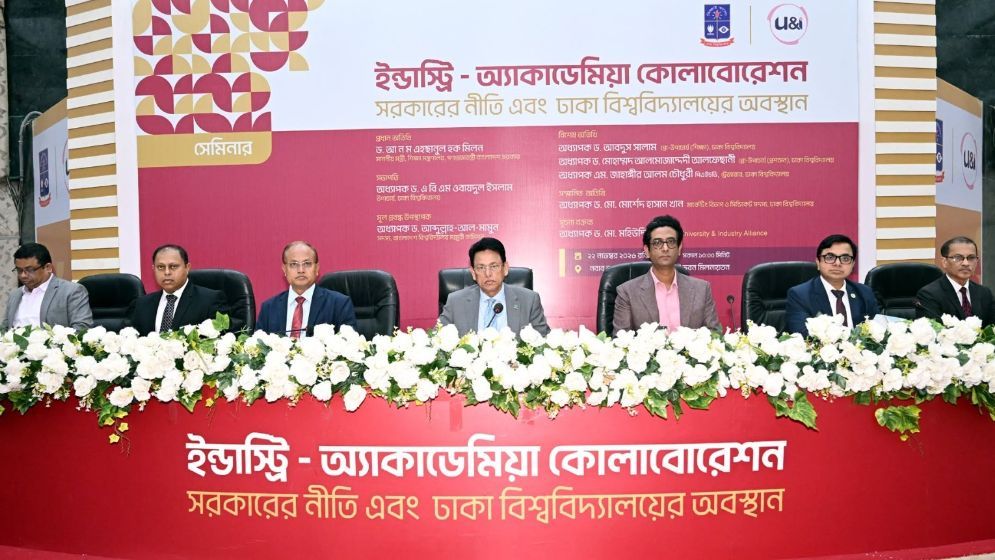
Photo: Daily Sun
Universities should regularly update their curricula to meet industry needs, expand internship and job placement opportunities, and collaborate with industries on joint research and innovation to make higher education more skills-based and career-oriented.
The proposals were made at a seminar titled ‘Industry-Academia Collaboration: Government Policy and the Position of Dhaka University’, jointly organised by Dhaka University and the University and Industry Alliance at the Nabab Nawab Ali Chowdhury Senate Bhaban auditorium on Sunday.
Speakers also called for bringing industry professionals into classrooms, encouraging businesses to invest in university research through corporate social responsibility (CSR) funds, and providing students with seed funding, incubation facilities and science parks to help them turn their ideas into businesses.
Attending the programme as the chief guest, Education Minister ANM Ehsanul Hoque Milon said research and innovation are essential to building a knowledge-based economy. Research findings must be commercialised to benefit society and the economy, he added.
The minister said Dhaka University has an adequate budget for research, which should be utilised properly. He also called on the authorities concerned to take effective measures to reduce session jams.
Dhaka University Vice-Chancellor Prof ABM Obaidul Islam said new knowledge must be generated through basic and applied research, and research findings should be transformed into innovative ventures.
The university's knowledge and capabilities should be utilised to address real-world problems facing the state, industries, society and the economy, he said, expressing hope that Dhaka University would become a role model for industry-academia collaboration in building a knowledge-based economy.
DU Pro-VC (Academic) Prof Abdus Salam called for providing the university with opportunities to contribute to global research rather than limiting it to its position as the country's leading institution.
He proposed giving Dhaka University special funding priority, similar to that enjoyed by leading universities in Japan and the United States.
He also stressed advancing the university's research and innovation activities through collaboration among industries, the government and the university.
DU Pro-VC (Administration) Prof Mohammed Almujaddade Alfasane said industrialists should be encouraged to invest in university research through CSR funds to strengthen research collaboration between universities and industries.
He proposed establishing centres of excellence or research cells at every university and creating opportunities for joint research with industrial establishments.
He also called for inviting industry representatives to classrooms, arranging factory visits for teachers and researchers, and ensuring internship opportunities for students.
He stressed aligning curricula and research with industry demands and introducing seed funding for joint research projects.
Md Mohiuddin, professor of IBA at DU and president of the University and Industry Alliance, proposed five measures to strengthen university-industry collaboration.
He called for updating curricula based on industry needs, linking internships with job opportunities, and promoting joint research to solve industrial problems and commercialise innovations.
He also proposed involving industry professionals in teaching, giving university teachers opportunities to work in industries, and supporting student entrepreneurship through seed funding, grants, science parks and incubation facilities.
He said the competitive funding facility under the HEAT project could support joint research.
Prof Mohiuddin said improved curricula would make internships more meaningful, generating new research questions. Research, in turn, would lead to innovation, which would create new ventures and employment opportunities.
None of the initiatives could be sustainable without the others, he added.
Presenting the keynote paper, UGC member Abdullah Al Mamun highlighted challenges such as unemployment, the academia-industry skills gap, weak research commercialisation, AI-driven changes in the service sector, and a lack of innovation and entrepreneurship.
He proposed stronger industry-academia collaboration, industry-oriented curricula, increased research investment and coordinated policy initiatives to address these challenges.