



 For all latest news, follow the Daily Sun's Google News channel.


Armed forces soldiers get 138pc pay hike under new salary structure
Daily Sun Report, Dhaka
Published: 22 Nov 2026, 02:06 PM
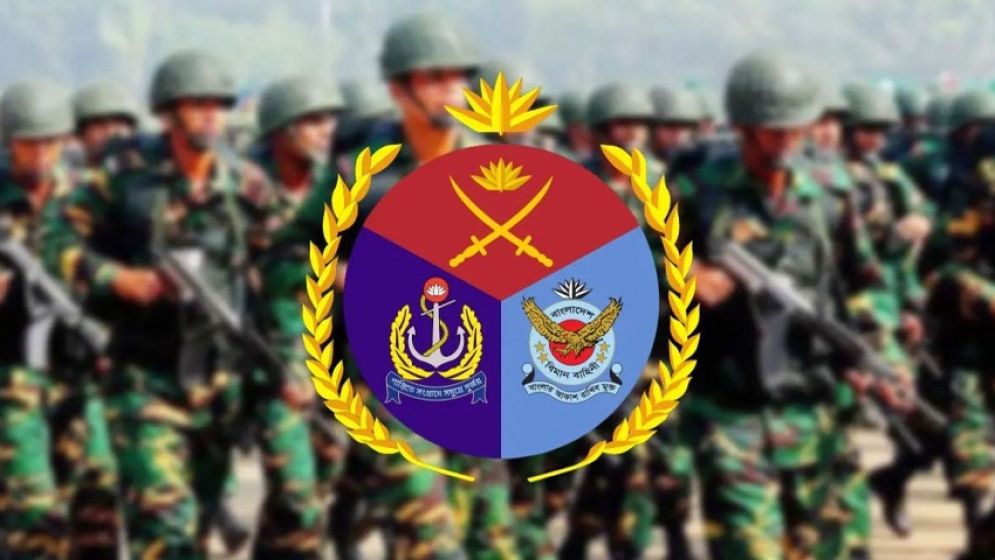
Armed forces soldiers get 138pc pay hike under new salary structure. Photo: Collected
The basic salary of Bangladesh's armed forces personnel at the lowest rank has risen by nearly 138 per cent, from Tk9,000 to Tk21,400, under a new pay structure issued through Joint Services Instruction 01/2026 on November 15 following the implementation of the National Pay Scale.
The revised structure allows a soldier's basic salary to rise to Tk51,900 through annual increments, while the basic pay of the chiefs of the armed forces has doubled to Tk1,72,000 from Tk86,000.
The new structure largely follows the previous system introduced in 2016. It also gives soldiers and sergeants a higher initial implementation rate than senior officers, with 50 per cent of the revised pay introduced for the former, compared with 40 per cent for the latter.
Under the new scale, the starting salaries of lance corporals and corporals have been set at Tk23,500 and Tk28,000 respectively. Warrant officers, senior warrant officers and master warrant officers will receive Tk44,000, Tk44,500 and Tk45,500 respectively. The salary of a master warrant officer has more than doubled, rising 102.22 per cent from Tk22,500.
The basic salaries of honorary lieutenants and honorary captains have been fixed at Tk76,960 and Tk85,750 respectively.
People concerned say some quarters are circulating misleading information on social media and in certain media outlets, portraying the new structure as discrimination between officers and soldiers. They maintain that the revised scale preserves the previous structure, while the percentage increase for ordinary soldiers is actually higher than that for senior officers and service chiefs.
Four new allowances have also been introduced, while benefits for retired personnel have been revised. The minimum net pension has been set at Tk10,000, with medical allowances ranging from Tk3,000 to Tk4,000 depending on age.
However, longstanding concerns remain over horizontal and vertical pay scales and promotion opportunities for soldiers and junior commissioned officers. Unlike the civil administration's 20-grade system, promotions in the armed forces depend on vacancies and structural requirements. Those who remain in the same rank rely on 19 to 20 annual increments, which can leave long-serving personnel financially disadvantaged, according to sources.
A military officer said the armed forces had a different career and command structure from the civil administration, with promotions based on vacancies and qualifications. The annual increments were designed to ensure that salaries did not stagnate even when personnel were not promoted.
The Armed Forces Pay Committee has reportedly recommended introducing vertical pay scales at all levels to address these longstanding disparities. It has also suggested forming a service commission to review inconsistencies in the existing structure and consider the demands of armed forces personnel.
Meanwhile, the government's recommendation committee has submitted proposals for a uniform classification system after receiving reports from the National Pay Commission-2025 and the Armed Forces Pay Committee-2025. The proposals are currently under review.