


 For all latest news, follow the Daily Sun's Google News channel.


PM: No one can make Bangladesh subservient
Daily Sun Report, Dhaka
Published: 22 Nov 2026, 12:00 AM
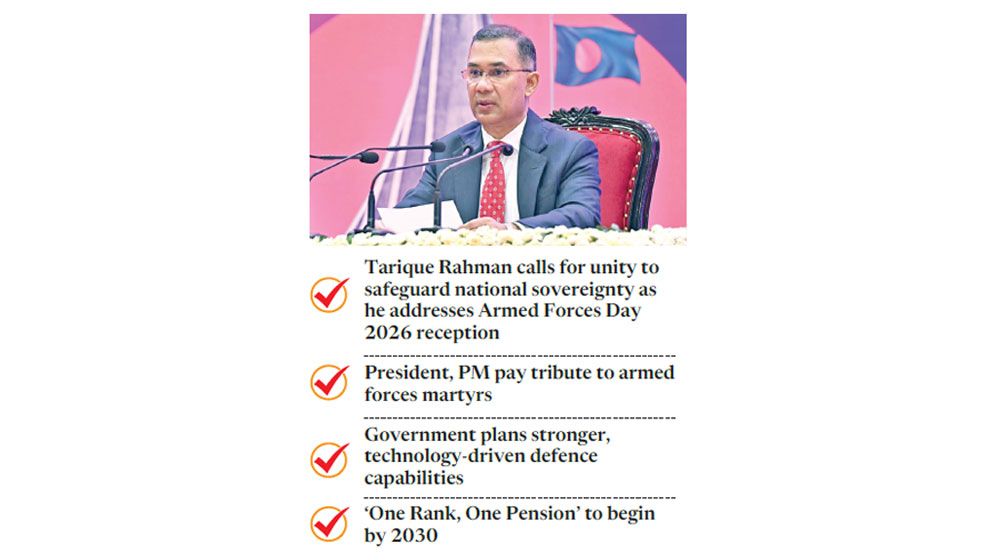
Prime Minister Tarique Rahman said on Saturday that no one will dare turn Bangladesh into a subservient state if patriotic citizens, a democratic government accountable to the people and the armed forces remain united under the principle of “Bangladesh First”.
He made the remarks while addressing a reception at Senakunja in Dhaka Cantonment in the afternoon, marking Armed Forces Day 2026.
“Deep conspiracies were hatched in the past to trample Bangladesh’s independence and sovereignty and tarnish the image of the armed forces. But the armed forces have always played an important role in safeguarding the country’s independence and protecting the interests of its people,” he said.
The prime minister said the armed forces had played a significant role at several crucial moments in the country’s history, including the Liberation War in 1971, the soldiers-and-people’s revolution of 7 November 1975, and the anti-fascist mass uprising of 5 August 2024.
He said just as freedom fighters had secured independence through their supreme sacrifices in 1971, students and people had defended the country’s freedom through the bloody mass uprising in 2024.
Identifying two major responsibilities towards those who sacrificed their lives, Tarique said the country must safeguard its independence and sovereignty at any cost and build the safe, self-reliant, democratic welfare state they had envisioned.
Recounting the history of the armed forces, he said their journey began with independence and the Liberation War. On 21 November 1971, the Army, Navy and Air Force jointly launched resistance and counterattacks against Pakistani occupation forces, making the date a historic one for the three services.
The prime minister recalled the role of Shaheed President Ziaur Rahman, describing him as a proud member of the armed forces and the proclaimer of independence. He said Major Ziaur Rahman, then second-in-command of the 8th East Bengal Regiment in Chattogram, declared “We revolt” and joined the armed resistance following the Pakistani military crackdown on the night of 25 March 1971.
Referring to Ziaur Rahman’s writings, he said the then major ordered army officers, junior commissioned officers and soldiers to take up arms at 2:15am on 26 March and rebroadcast the declaration of independence from Kalurghat Radio Station the following day.
Tarique alleged that repeated conspiracies had been hatched since independence to undermine the country’s sovereignty and damage the reputation of the armed forces. Referring to 7 November 1975, he said soldiers and civilians had united to foil an attempt to turn the country into a subservient state. He also recalled the killing of army officers during the 2009 BDR mutiny at Pilkhana.
The prime minister said his government was committed to building a stronger, more modern and technology-driven armed forces as part of broader efforts to strengthen the state and ensure the political and economic empowerment of its people.
He stressed that protecting the country’s airspace and maritime boundaries was as important as ensuring land security. The Army, Navy and Air Force could achieve their full potential only through an integrated national defence system, he said, adding that the government had already prepared new planning guidance to this end.
Noting that global security strategies were increasingly shaped by technology and integrated defence capabilities, he said the government planned to strengthen the country’s capacity in cybersecurity, artificial intelligence, drones, electronic warfare and space-based surveillance.
Emphasising discipline, Tarique said maintaining the chain of command, professional integrity and efficiency was essential to strengthening the forces and retaining public confidence in the institution.
He also pledged to improve professional skills, training facilities and welfare services for serving and retired personnel, as well as living conditions for their families. A Joint Services Human Resource Management Board had already been formed to improve human resource management, he said.
Announcing a major welfare initiative, the prime minister said the government would introduce “One Rank, One Pension” by 2030, with other welfare measures for serving and retired members implemented gradually.
He praised the armed forces for standing beside people in remote hilly areas and responding to natural disasters, including floods and cyclones. He also lauded Bangladeshi peacekeepers, including women, for their contributions to United Nations missions around the world.
Recalling the members of the armed forces who had been killed or injured while serving in the Chattogram Hill Tracts and UN peacekeeping missions, he prayed for the eternal peace of the departed souls and expressed sympathy for their bereaved families and the injured.
The prime minister also thanked representatives of friendly countries for attending the reception, recalling their people’s contributions during the Liberation War and appreciating their continued assistance in training and developing Bangladesh’s armed forces. He said Bangladesh would remain committed to supporting international peacekeeping efforts under the United Nations.
Earlier, the prime minister became emotional while recalling his family’s long association with Dhaka Cantonment, where his mother, former prime minister Khaleda Zia, had spent a significant part of her life. He said she had attended Armed Forces Day programmes both as prime minister and leader of the opposition, with the 2025 reception being her last participation in the event.
Tribute to martyrs, freedom fighters
Earlier in the morning, President Mirza Fakhrul Islam Alamgir and Prime Minister Tarique Rahman separately paid tribute to the martyrs of the armed forces at Shikha Anirban in Dhaka Cantonment, marking Armed Forces Day.
The President, who is also the Supreme Commander of the Armed Forces, placed a wreath at the memorial and stood in solemn silence in remembrance of those who made the supreme sacrifice during the 1971 Liberation War. A contingent comprising members of the Army, Navy and Air Force presented a salute as a bugle played a mournful tune.
The prime minister also placed a wreath at the memorial and observed a moment of silence. A joint contingent of the three services presented a guard of honour while the bugle sounded the Last Post. Both the President and the prime minister signed the visitors’ book.
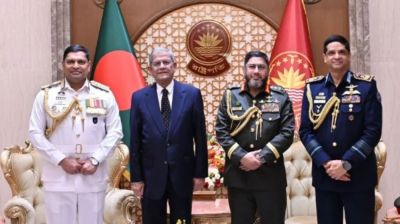
The chiefs of the three services also paid tribute to the martyrs and separately called on the President and the prime minister.
Later in the morning, Tarique Rahman attended a reception for gallantry award-winning freedom fighters and their heirs at the Army Multipurpose Complex in Dhaka Cantonment. Around 101 freedom fighters and their successors attended the programme.
Addressing the gathering, the prime minister pledged to rebuild Bangladesh as a fascism-free, dignified and exemplary state on the global stage, saying the government would continue to honour freedom fighters and support them and their families to the best of its capacity and resources.
He said the freedom fighters had earned a unique place in history through their courage and sacrifices, regardless of whether they had received gallantry titles such as Bir Sreshtha, Bir Uttam, Bir Bikram and Bir Protik.
“The glory of fighting for and winning a nation’s independence is more important than any title,” he said.
Recalling the sacrifices of the Liberation War, he said independence had come at the cost of millions of lives, the honour of countless women and the sacrifices of those who had been wounded or permanently disabled.
Identifying himself as the son of a freedom fighter, Tarique said he felt proud to attend the programme and that the achievements of the Liberation War continued to move him deeply.
He also recalled the BNP government’s initiatives for freedom fighters, including the establishment of the Ministry of Liberation War Affairs in 2001 and the enactment of the Jatiya Muktijoddha Council Act in 2002 during Khaleda Zia’s tenure.
Speaker Hafiz Uddin Ahmed, Chief Justice Zubayer Rahman Chowdhury, Finance Minister Amir Khasru Mahmud Chowdhury, Home Minister Salahuddin Ahmed, cabinet members, lawmakers, the Chief Election Commissioner, election commissioners, political leaders, senior officials, diplomats and other distinguished guests attended the afternoon reception.
Descendants of Bir Sreshtha and other gallantry award-winning freedom fighters, families of those killed or injured during the July-August 2024 uprising, and relatives of army personnel killed in the BDR carnage were also present.
Special programmes were organised at cantonments, naval installations and air force bases across the country. The day’s observances began with special prayers after Fajr, seeking the country’s welfare, continued progress of the armed forces and eternal peace for their fallen members.