


 For all latest news, follow the Daily Sun's Google News channel.


Nur-e-Taj Begum, a middle-aged woman, from Taltola, Sirajdikhan, came to the Munshiganj Sadar upazila Department of Public Health Engineering (DPHE) office to collect kits to test her tube-well water on 18 November. But she had to return disappointed.
She said, “This is my second visit to the Sadar office to test my tube-well water. I want to know if it contains any harmful elements. But the staff of the office informed me that the test cannot be performed now. They have asked me to contact them later.
“Eight months ago, I installed a deep tube well in my house. The water colour is red. I fear there is arsenic. I contacted the Tongibari office near my house. They advised me not to drink it but to use the water for other purposes. Now the colour looks a bit natural, but still I want to test it.”
While she was talking, the correspondent noticed equipment worth crores of taka standing beside a newly constructed laboratory which was locked from outside.
When asked why, despite having a laboratory nearby, residents of the district were not benefiting from it and still had to go to Tongi or Dhaka to have their tube-well water tested, Sub-Assistant Engineer at the Munshiganj DPHE office SM Abdur Rahman said, “We have some kits to test arsenic on the spot but they expired in 2025, and we did not get a new supply. Now, we have a laboratory building. It has not been operational since its construction four years ago.”
He said, “It was constructed under a project but it has remained locked as no manpower was recruited for the operation of the labs. Recently, a junior chemist was given additional charge. He comes here sometimes.”
Talking to the Daily Sun, he said, “Neither the project office nor the DPHE recruited any manpower. I was given additional charge. I am arranging furniture and equipment but still don’t know what types of equipment they have or if they have any chemical reagents.”
The DPHE has 14 labs in Dhaka, Tongi, Mymensingh, Rajshahi, Khulna, Cumilla, Rangpur, Bogura, Sylhet, Jhenaidah, Barishal, Noakhali, Gopalganj and Rangamati.
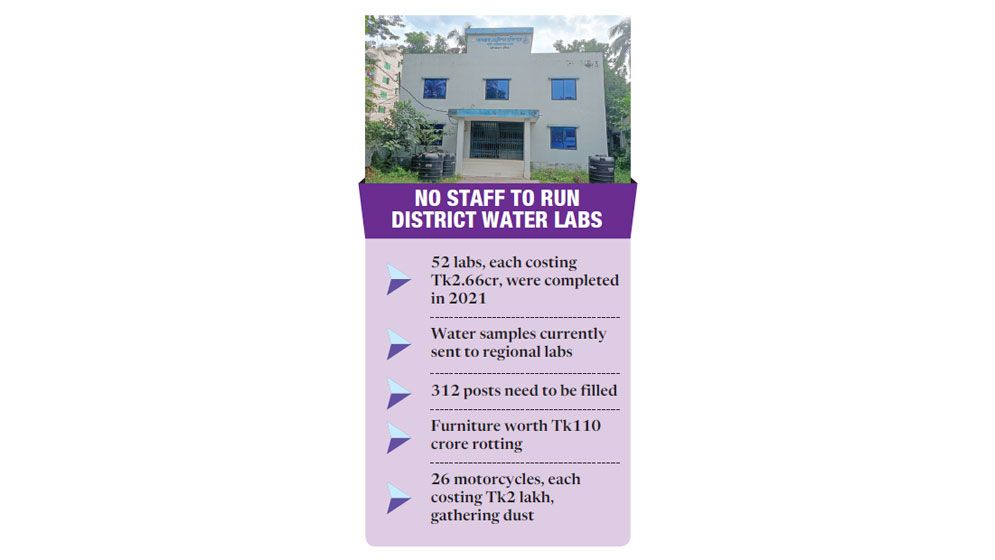
Officials of the DPHE said that, considering the need, the 52 labs were completed in 2021 under the “Strengthening Water Quality Testing System” project, but none is in operation. The new district lab has the facility to test 20 water parameters, while the central lab has 48 parameters, and 12 regional labs have the capacity to test 32 parameters.
The project worth Tk178.56 crore was approved in September 2019 for a five-year period. However, it was revised twice in 2024 and 2025, extending the deadline to December 2026.
According to the second revised development proposal for the project, Tk2.66 crore was allocated for each of 52 district lab buildings. Besides, the allocation for furniture and equipment was Tk110 crore. The equipment was imported mostly from the USA, the UK and Germany.
312 posts vacant
The correspondent visited at least four of the labs in Narayanganj, Munshiganj, Patuakhali and Barguna and talked to engineers from Jhalokathi and project officials, including the project director. They said that no labs are functional as they need 312 staff members, including 34 junior chemists, 34 sample analysers, 41 sub-assistant engineers and 52 office assistants. Twenty-six motorcycles, each costing Tk2 lakh, are gathering dust.
Project Director Md Hasanuzzaman said that the recruitment of 52 peons had been under way since 2025 and very little had been done to fill the other posts.
The correspondent visited another lab in the Narayanganj Sadar DPHE building. The lab is on the first and second floors of the upazila building and was found locked on 18 November.
Shilpi Nag, a sample analyser who was recently posted at Narayanganj Sadar Laboratory, was not present at the time. Later, she said over the phone, “In the laboratory, there are seven posts. Recently, junior chemist Taslima Begum and I joined the lab. But we don’t have supporting staff. So, we are now only checking the equipment.”
At the Barguna district lab, the situation was similar: equipment remained unpacked on the floor of the new lab near the Executive Engineer’s Office.
Jhalokathi DPHE Executive Engineer Khandaker Ershaduzzaman Mridul said that the district had to send 1,200–1,300 samples to regional labs as its lab is not functional due to a lack of manpower.
He also said, “Our laboratory has no approach road either. The construction work was completed four years ago, and now moss has grown on the interior walls as there is no one to take care of the premises. Fungus has attacked all the furniture and equipment. A brand-new motorcycle has remained unused.”
Director of the Strengthening Water Quality Testing System project Munshi Md Hasanuzzaman said that the DPHE's establishment section needed to intensify its lobbying with the Bangladesh Public Service Commission for the recruitment of manpower to overcome the crisis. Due to the funding crisis, recruitment of 52 office assistants is currently stalled.
He said, “We had funds for purchasing chemical reagents for the lab, but the lab has no manpower; that is why we are not buying those. Our project ends in December, and after that we will not be able to use the funds.”
Service seekers like Nur-e-Taj may have to wait longer as the project will end in December, with no time to process the tender for purchasing chemicals. The DPHE then has to wait for the budget for chemicals.
Regarding kit supply, Superintending Engineer (Laboratory Circle), posted at Mohakhali Central Laboratory Md Abdul Halim Khan said, “The central lab does not purchase any kits or chemicals for field offices. Under an arsenic prevention project, kits were purchased and distributed to district offices. We have no funds for buying the kits.”
DPHE Chief Engineer (Routine Charge) Md Jamanur Rahman said, “I have taken charge very recently and am not very aware of the matter. I will take immediate action in this regard.”
Dr Rowshan Momtaz, who is a water resources expert and Director of the International Training Network Centre at Bangladesh University of Engineering and Technology, said, "People are being denied the opportunity to know the quality of their water. People now have to go to regional offices to test water and confirm its usability. When they send samples over long distances, quality is compromised. Besides, tests for all parameters are also not available at the labs. We are interested in big investments but not in operation and maintenance, which is very unfortunate. They should be serious about public health."