



 For all latest news, follow the Daily Sun's Google News channel.


Youth opportunities fail to create jobs: PPRC
A key finding is that young people and employers recognise the same challenges but differ over who should address them
Daily Sun Report, Dhaka
Published: 21 Nov 2026, 06:45 PM
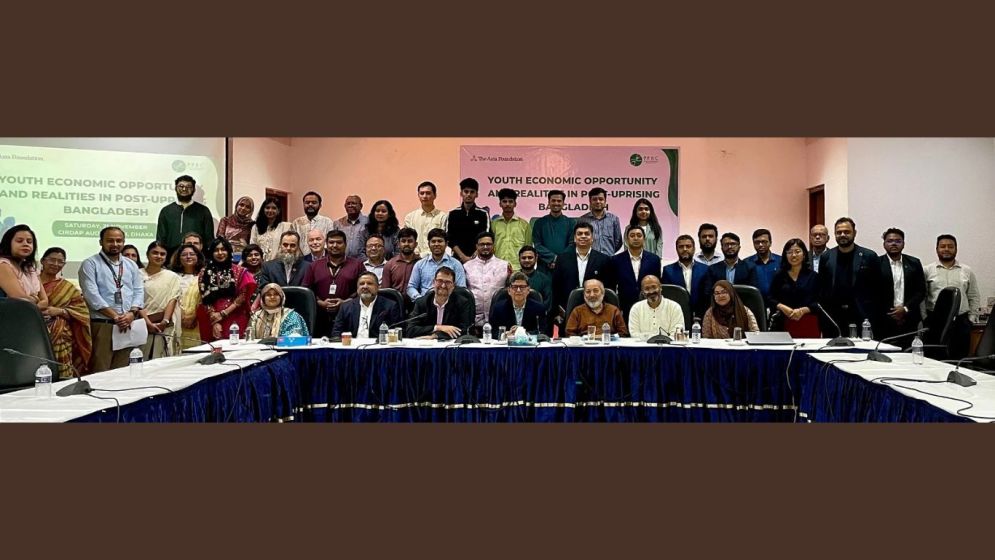
Photo: Daily Sun
Bangladesh has economic opportunities for young people, but weak institutional support is preventing those opportunities from translating into jobs, viable businesses and secure livelihoods, according to a new study by the Power and Participation Research Centre (PPRC) on Saturday.
The study identifies a gap between government
policies and the institutions responsible for connecting young people and
entrepreneurs with employment, finance, training and markets. PPRC Executive
Chairman Dr Hossain Zillur Rahman described this gap as the country’s “missing
middle.”
“Opportunities may be created, but they are not
being turned into outcomes,” Rahman said at a national dissemination event
titled “Youth Economic Opportunity and Realities in Post-Uprising Bangladesh.”
The event was organised by PPRC with support from
The Asia Foundation. Rahman and PPRC Senior Research Associate Namira Shameem
jointly presented the findings.
Conducted between August and September 2026, the
rapid regional study involved consultations with young people and employers in
Rajshahi, Jashore and Chattogram. It also included questionnaires completed by
100 young people and 59 employers and entrepreneurs, along with field
engagements in Naogaon, Pirganj, Jashore High-Tech Park, coastal Noakhali and
indigenous communities in Bandarban.
The study is not nationally representative. Instead,
it examines the practical barriers that prevent young people from accessing
available economic opportunities.
It found that different regions have considerable
economic potential, but weaknesses in infrastructure, finance, market access
and institutional support are limiting employment and enterprise development.
In Rajshahi, horticulture and mango production offer
scope for processing, logistics and marketing, but inadequate storage, testing
facilities and finance restrict growth.
In Jashore, digital services, light engineering,
flower production and women-led businesses have growth potential, while the
underused High-Tech Park reflects the gap between public investment and
productive use.
In Noakhali, products such as soybean are processed
outside the region, limiting local value addition. Seasonal businesses also
struggle to access suitable finance, while women entrepreneurs face barriers to
credit.
In Chattogram, employers report a shortage of
skilled workers, while young people struggle to gain the practical experience
required for entry-level jobs. In Bandarban, limited access to markets,
infrastructure and services constrains economic activities despite local
initiatives in education, practical skills and technology.
A key finding is that young people and employers
recognise the same challenges but differ over who should address them.
Employers question why graduates are not ready for work, while young people ask
how they can gain experience when employers rarely provide opportunities for
newcomers.
PPRC said responsibility for improving the
transition from education to employment should not rest on young people alone.
Training institutions, employers, financial institutions and government
agencies must work together to address the barriers.
Rahman identified seven priorities, including
strengthening institutions that connect opportunities with outcomes, making
local governments and educational institutions drivers of regional development,
and shifting the focus from certificates to practical skills, mentoring and
self-learning.
He also called for measures to reduce business
failure among young entrepreneurs, ensure productive use of public assets,
promote regional products and creative industries, and improve economic
inclusion for women, indigenous communities and other marginalised groups.
Opening the event, The Asia Foundation's Bangladesh
Country Representative Kazi Faisal Bin Seraj stressed the importance of
meaningful employment for young people's economic security, participation and
sense of ownership.
A written message from Finance Minister Amir Khasru
Mahmud Chowdhury said expanding productive employment for young people must
remain central to the country's economic agenda.
Dr Imran Matin, executive director of the BRAC
Institute of Governance and Development, called for stronger local
institutions, competence-based training, better risk-management support for
youth entrepreneurs, and wider use of mentorship and apprenticeships.
Jean Pesme, World Bank division director for
Bangladesh and Bhutan, said the country’s growth model was no longer
sufficiently inclusive, pointing to weaknesses in the mechanisms that translate
economic growth into jobs.
Speakers also proposed industry-led training,
apprenticeships, employment centres, internship platforms, accessible finance,
regional processing facilities and stronger links between education and
labour-market needs.
The event brought together young people,
entrepreneurs, researchers, development partners, academics, business
representatives, local government officials and media professionals to discuss
the economic challenges and aspirations of Bangladesh's youth following the
July uprising.