


 For all latest news, follow the Daily Sun's Google News channel.


Commerce ministry, UNIDO review draft circular textile strategy
Daily Sun Report, Dhaka
Published: 20 Nov 2026, 08:17 PM
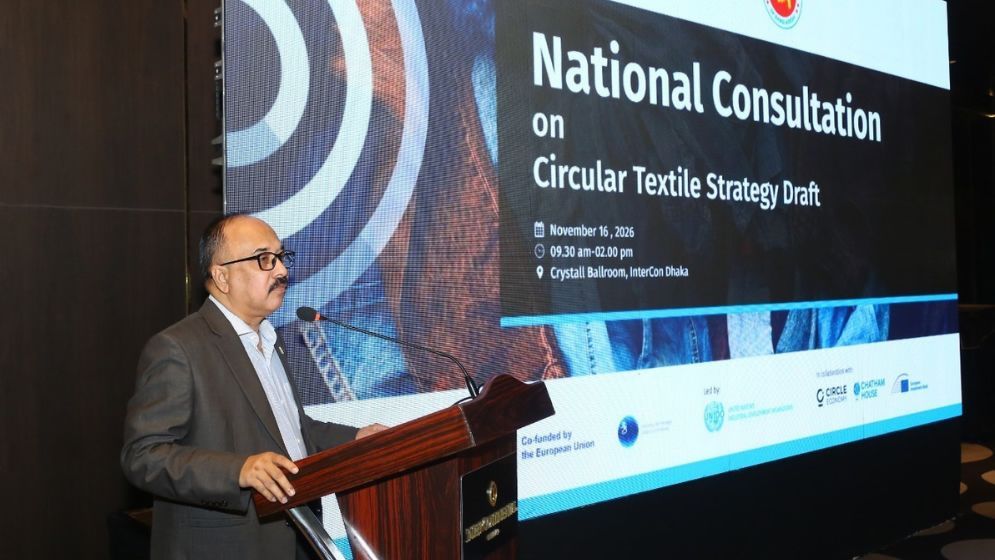
Commerce Secretary Sharf Uddin Ahmed Choudhury speaks at a national consultation meeting on the draft National Circular Textile Strategy in Dhaka. Photo: Courtesy
The Ministry of Commerce and the United Nations Industrial Development Organization (UNIDO), under the SWITCH to Circular Economy Value Chains (SWITCH2CE) project, recently held a national consultation meeting to review the draft National Circular Textile Strategy for Bangladesh and gather recommendations from stakeholders.
Representatives
of the government, industry associations, brands, manufacturers, development
partners and technical experts attended the meeting.
Commerce
Secretary Sharf Uddin Ahmed Choudhury attended the meeting as the chief guest,
while UNIDO Country Representative Alamgir Hossain delivered the welcome
address.
The
meeting was moderated by Alamgir Kabir, a deputy secretary of the ministry.
Muhammed Badrul Haque, joint secretary (planning cell) of the ministry and
National Project Director of SWITCH2CE, delivered the vote of thanks.
Dr
Patrick Schröder, senior research fellow at Chatham House, and KM Asadun Noor,
national project coordinator of SWITCH2CE, presented the draft strategy.
Hubert
Blom, attaché and programme manager for climate change and green inclusive
development at the EU Delegation to Bangladesh; Vidiya Amrit Khan,
vice-president of the Bangladesh Garment Manufacturers and Exporters
Association (BGMEA); and Mohammad Rashed, vice-president of the Bangladesh
Knitwear Manufacturers and Exporters Association (BKMEA), also spoke at the
event.
In
his speech, Sharf Uddin Ahmed Choudhury said adopting circular textile
practices was essential for Bangladesh to maintain its global competitiveness
after graduating from the least developed country (LDC) status.
He
added that the National Circular Textile Strategy would play an important role
in ensuring sustainability across the country's textile production ecosystem.
Hubert
Blom said the readymade garment (RMG) sector would need to comply with new
requirements, including digital product passports, to retain access to the
European market.
Dr
Schröder said the strategy could strengthen cooperation between Bangladesh and
the European Union by drawing on lessons from SWITCH2CE and international best
practices.
He
noted that as the EU developed textile requirements under its Ecodesign for
Sustainable Products Regulation, supply chain traceability and digital product
passports would become key areas of cooperation.
Joint
efforts could help Bangladeshi manufacturers and European buyers prepare for
the new requirements and expand circular textile production, he added.
Participants
discussed the timeline for incorporating recommendations, completing the final
revisions and moving towards the strategy's endorsement.