


 For all latest news, follow the Daily Sun's Google News channel.


Faridpur’s Alfadanga Mosque among five winners of Saudi Al Fozan Award
Arch Daily
Published: 20 Nov 2026, 06:36 AM
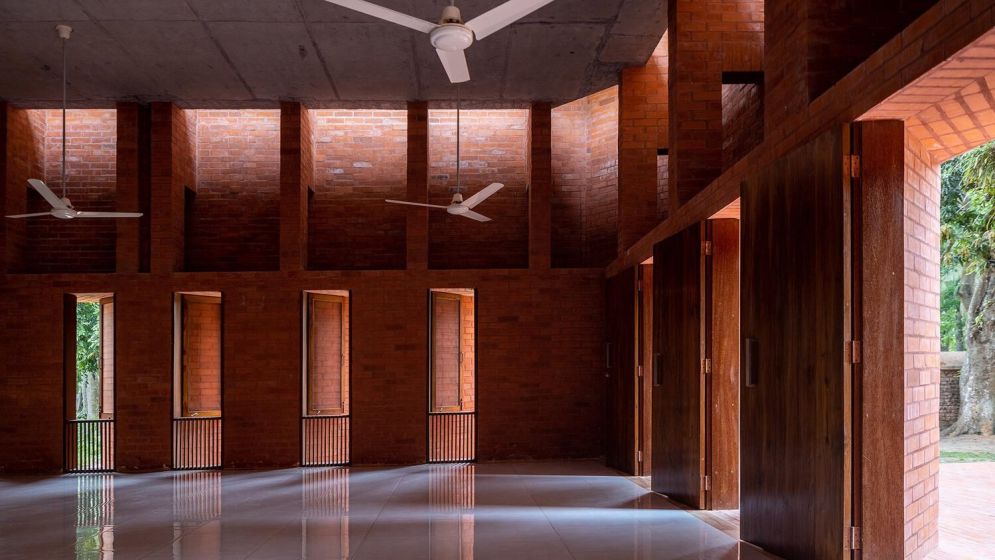
An inside view of the Alfadanga Mosque in Faridpur | Photo: Al Fozan Award Authority
The Abdullatif Al Fozan Award for Mosque Architecture has
announced the winners of its fifth cycle (2023–2026), recognizing five projects
in Bangladesh, the United Kingdom, Oman, Niger, and Indonesia, alongside two
Special Recognition Award recipients: the Mohammed bin Salman Project for
Developing Historic Mosques in Saudi Arabia and Djamaâ El-Djazaïr (Great Mosque
of Algiers) in Algeria. Established in 2011, the international award recognizes
contemporary mosque designs that respond to changing community needs while
maintaining a connection to the architectural heritage and principles of
Islamic architecture.
How can mosque architecture embrace contemporary challenges
while preserving its spiritual, cultural, and social significance? This
question lies at the center of the fifth cycle, themed The Living Mosque, which
seeks to revive the mosque's original role as an urban center closely connected
to its community's everyday life. Beyond its primary function as a place of
worship, the mosque is understood as a setting for social interaction,
education, cultural identity, and public life. This perspective reflects the
award's broader ambition to encourage architectural approaches that connect
traditional values with contemporary design and construction.
An international jury of five experts in architecture, art,
and the humanities evaluated more than 200 nominated mosques worldwide against
five criteria: Beauty, Sustainability, Technology, Social Connectivity, and
Economic Efficiency. The nominations encompassed three Mosque Typologies:
Central Mosques, Neighborhood Mosques, and Friday (Juma') Mosques. Together,
these criteria reflect the award's interest in mosque architecture as both a
physical structure and a social institution, recognizing projects that respond
to their environmental context, support community life, and explore new
possibilities for contemporary religious architecture.
This year’s selected five projects are as follows:
Alfadanga Mosque in Bangladesh
Marina Tabassum Architects, a firm focused on environmental
responsiveness and local culture, combines contemporary design with a strong
connection to place. The practice designed Alfadanga Mosque as part of the
redevelopment of a historic family site, adopting a restrained architectural
approach that responds to its surroundings. The load-bearing brick structure is
punctuated by openings that bring natural light into the prayer space,
establishing a spiritual interior atmosphere. Conceived as an open pavilion,
the mosque maintains visual connections with the surrounding greenery, while
its forecourt provides an additional gathering space for the local community.
Cambridge Central Mosque in the UK
Marks Barfield Architects, a British practice focused on
sustainable and regenerative design, approaches architecture as a means of
creating positive social and environmental impact. Cambridge Central Mosque
brings together Islamic and English architectural traditions through a
contemporary design. Its defining feature is a tree-like timber structure that
supports the roof while shaping the interior space. Natural light filters
through the building, creating a spiritual atmosphere, while the use of timber
and the mosque's relationship with its surroundings reflect the practice's
emphasis on environmental responsibility.
Bab Al Salam Mosque in Oman
Altqadum Office, a Muscat-based design studio founded in
2017, is known for its research-driven approach, exploring Omani cultural
heritage through contemporary architectural design. This approach informs Bab
Al Salam Mosque, which combines the simplicity of traditional Omani
architecture with modern spatial concepts. Natural light and open spaces shape
the worship experience, while local materials and sustainable construction
techniques connect the project to its cultural and environmental context.
Beyond its religious function, the mosque also serves as a community gathering
place.
Hikma Community Complex in Niger
Mariam Issoufou Architects, an architecture and research
practice focused on cultural identity, sustainability, and community impact,
collaborated with Studio Chahar, a design and research studio focused on
creating more equitable, environmentally responsive built environments.
Together, they designed Hikma, a religious and secular complex that combines a
mosque and a library, aiming to revive the role of knowledge in Islam. Drawing
on traditional architecture and local construction techniques, the project uses
compressed earth bricks to create a contextually responsive environment for
worship, learning, and community interaction.
Nurul Yaqin Mosque in Indonesia
Indonesian architects Dave Orlando and Fundy Gunawan focus on contemporary design that responds to nature and local context, combining simplicity, functionality, and spatial comfort. Their approach is reflected in Nurul Yaqin Mosque, which adopts a minimalist form and a floating appearance created by the surrounding water. Constructed from concrete and brick, the mosque features blue terrazzo flooring, while natural light and ventilation shape its interior atmosphere. Subtle Islamic ornamental details complement the restrained design, creating a calm and contemplative space for worship.