


 For all latest news, follow the Daily Sun's Google News channel.


Primary education offices to become 100% tobacco-free
Daily Sun Report, Dhaka
Published: 19 Nov 2026, 08:58 PM
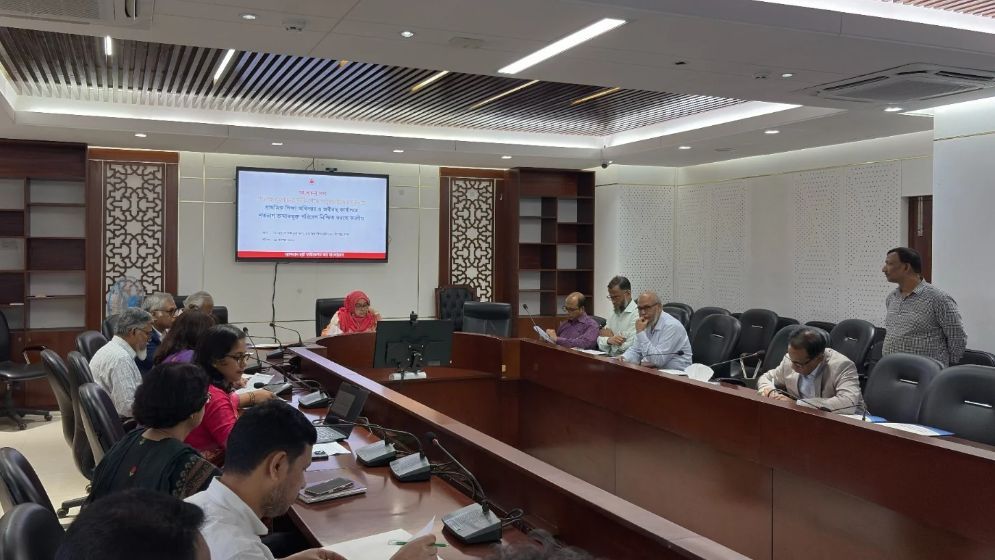
Photo: Courtesy
The Directorate of Primary Education will take steps to ensure a completely tobacco-free environment in all its offices to protect public health and non-smokers from the harmful effects of secondhand smoke.
“No Smoking” signs will also be displayed at
prominent locations across all offices, said Shahina Ferdousi, director general
of the Directorate of Primary Education.
She made the announcement while chairing a
consultation meeting titled “Ensuring a 100% Tobacco-Free Environment in the
Offices of the Directorate of Primary Education and Its Subordinate Offices to
Protect Non-Smokers from the Harmful Effects of Secondhand Smoke” at the
directorate's conference room in Dhaka on Thursday.
The National Heart Foundation of Bangladesh
organised the meeting.
Shahina said initiatives would be taken to
make all offices and premises under the directorate tobacco-free in line with
the Smoking and Tobacco Products Usage (Control) (Amendment) Act, 2026.
Professor Dr Sohel Reza Choudhury, head of
the Department of Epidemiology and Research at the National Heart Foundation
Hospital and Research Institute, said the prime minister aimed to build a
tobacco-free Bangladesh.
To achieve this goal, all government and
private offices, as well as public places, must be kept completely smoke-free
in accordance with the existing tobacco control law, he said.
This would protect non-smokers from
secondhand smoke and encourage smokers to quit tobacco, he added.
He also noted that non-communicable diseases
were among the leading causes of premature deaths in Bangladesh, with tobacco
use being a major risk factor for heart disease, stroke, cancer and diabetes.
Positive changes in the body begin within 24
hours of quitting smoking, while the risk of heart disease declines
significantly over time, he said.
He stressed that government institutions must
ensure tobacco-free environments alongside encouraging smokers to quit.
Representatives of the National Heart Foundation
said there was no safe level of exposure to secondhand smoke. Non-smokers
exposed to tobacco smoke face increased risks of heart disease, stroke, chronic
lung diseases and lung cancer.
Children, pregnant women, older people and
those with respiratory or cardiovascular conditions are particularly
vulnerable, they said.
According to the Global Adult Tobacco Survey
(GATS) 2017, around 38.4 million adults in Bangladesh are exposed to secondhand
smoke at workplaces, public places and on public transport.
The survey also found that 42.7% of adults
working in indoor workplaces, or approximately 8.1 million people, were exposed
to secondhand smoke.
The meeting highlighted that the Smoking and
Tobacco Products Usage (Control) (Amendment) Act, 2026 had created an
opportunity to establish tobacco-free environments in public places and
government offices. However, the prompt formulation of rules under the amended
law was essential for effective implementation.
The rules would clarify the responsibilities,
procedures and measures required to ensure tobacco-free environments in
government institutions and other public places, participants said.
The meeting recommended making all offices
and premises under the Directorate of Primary Education completely
tobacco-free, removing designated smoking areas, prohibiting the sale and
purchase of tobacco products within office premises and forming a monitoring team
to oversee implementation.
It also recommended that the directorate
refrain from accepting any form of partnership or sponsorship from tobacco
companies.
Participants stressed strict compliance with
Article 5.3 of the WHO Framework Convention on Tobacco Control (WHO FCTC) and
Section 5(3) of the tobacco control law.
Officials and employees of the Directorate of
Primary Education and representatives of the National Heart Foundation of
Bangladesh attended the meeting.