


 For all latest news, follow the Daily Sun's Google News channel.


Every taka borrowed must deliver maximum economic, social benefits: Dr Titumir
BSS, Cox's Bazar
Published: 17 Nov 2026, 12:57 AM
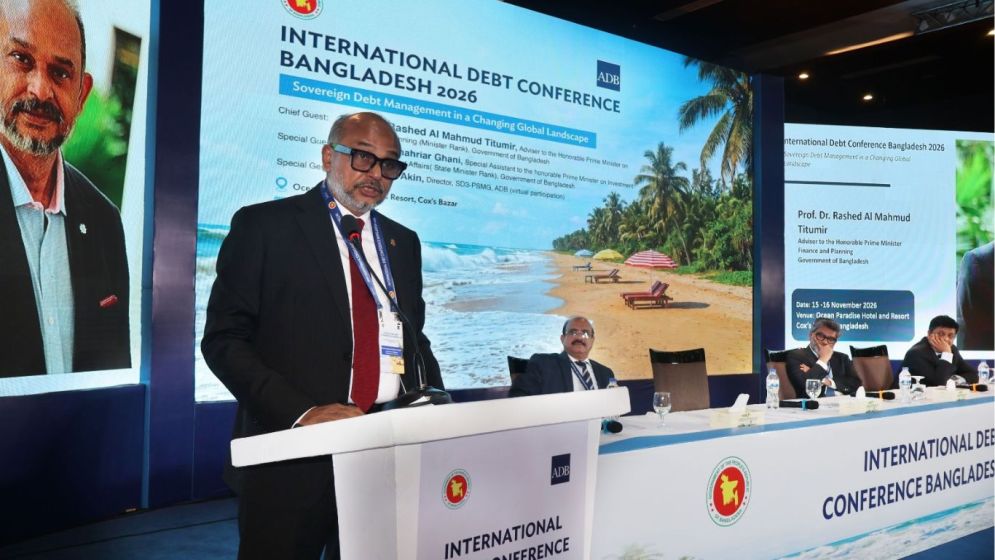
Prime Minister's Adviser on Finance and Planning Dr Rashed Al Mahmud Titumir today spoke as the chief guest at the concluding session of the two-day 'International Debt Conference Bangladesh 2026' in Cox's Bazar. Photo : BSS
Prime Minister's Adviser on Finance and Planning Dr Rashed Al Mahmud Titumir on Monday said the government is focusing not on how much it borrows, but on ensuring that every unit of public resources generates the maximum possible economic and social benefits.
"We are not debating whether we should borrow less or borrow more. Rather, our focus is on how to borrow better, invest better and ensure the highest economic and social returns from every unit of public resources, while remaining accountable to the people," he said.
He was speaking as the chief guest at the concluding session of the two-day 'International Debt Conference Bangladesh 2026' in Cox's Bazar.
Describing borrowing as a means rather than an end to development, Dr Titumir said borrowed funds should be invested in sectors that enhance productivity, improve infrastructure, create employment opportunities and develop human resources.
He stressed that the economic and social returns from borrowing must be commensurate with the liabilities passed on to future generations.
Highlighting the challenging economic circumstances facing Bangladesh, the adviser said geopolitical conflicts in Ukraine and the Middle East had increased the country's energy import expenditure by US$4.2 billion.
"This additional expenditure was neither our choice nor something we could avoid," he said.
Referring to the human impact of the economic pressures, he said around eight million Bangladeshis had fallen below the poverty line again amid inflation and economic disruptions.
Many people who had worked hard to escape poverty were pushed back into it, he said, adding that these were not merely figures in statistical records but real hardships affecting people's lives.
Dr Titumir said the figures were not intended to blame anyone but to explain the circumstances in which the present government began its journey.
Understanding the starting point, he added, was essential to properly assess progress and the challenges ahead.
Describing the country's debt situation, he said Bangladesh's public debt had exceeded Tk 18.9 trillion, equivalent to around 36 percent of GDP. Total external debt of the public and private sectors stood at more than US$104 billion.
The government was spending over Tk 1 trillion annually on interest payments alone. In addition, Tk 56,750 crore had previously been borrowed from Bangladesh Bank to finance the budget deficit, he said.
Emphasising the need for prudent debt management, he said the government must take all existing liabilities and associated risks into account while formulating its borrowing strategy.
As grace periods on previously contracted external loans were coming to an end, debt repayment pressures would increase in the coming years, he noted.
Bangladesh repaid US$4.49 billion in principal and interest on external loans in the fiscal year 2025-26, and the annual repayment amount could rise to US$7.6 billion by FY2030, he said.
Therefore, he stressed, decisions on new borrowing must carefully consider interest rates, maturity periods, repayment schedules, currency composition and exchange-rate risks.
Identifying national ownership and credibility as two fundamental pillars of debt management, Dr Titumir said borrowing decisions must be aligned with the country's development priorities and economic realities.
Transparency regarding debt data, expenditure and risks, alongside accountability to the public, was directly linked to the credibility of government debt management, he added.
The adviser also identified increased revenue mobilisation as a key condition for sustainable debt management.
Noting that Bangladesh's tax-to-GDP ratio remained low, he said the government aimed to increase the revenue-to-GDP ratio by two percentage points over the next five years.
The target would be pursued through expanding the tax base, digitalising tax administration and bringing more economic activities into the formal sector, he said. Higher revenue collection would help maintain a balance between development expenditure and debt servicing.
Highlighting the government's initiatives, Dr Titumir said the present government had stopped borrowing from Bangladesh Bank to finance the budget deficit.
As a result, pressure on money supply had eased and inflation had started declining from around 10 percent. Foreign exchange reserves had also risen above US$30 billion, he said.
He further said the interest rate on 91-day Treasury bills had declined from around 12 percent to nearly 8 percent. The government had also taken initiatives to mobilise financing through long-term bonds and Sukuk.
Emphasising the need to develop the domestic capital market as a source of long-term financing, he said Bangladesh must maintain a balanced mix of domestic and external borrowing, short-term and long-term financing, and concessional and market-based loans.
He also stressed the importance of exploring alternative financing mechanisms, including private investment, public-private partnerships (PPPs), blended finance and credit guarantees.
Regarding the use of new financial instruments, including sovereign Sukuk, the adviser said Bangladesh's local-currency government securities had been included in JP Morgan's GBI-EM index.
He described the inclusion as an important milestone for the country's domestic currency bond market.
Alongside strengthening the capacity of the domestic bond market for long-term financing, Bangladesh also had opportunities to raise funds from international capital markets in a responsible and sustainable manner, he added.
Dr Titumir underscored the need for institutional reforms in debt management, including the establishment of a dedicated debt management office, enactment of a Public Debt Act and strengthening analytical capacity for debt data and risk assessment.
Regular publication of debt information, a medium-term debt strategy, an annual borrowing plan and transparent disclosure of contingent liabilities arising from government guarantees would help identify fiscal risks in advance, he said.
Outlining the government's strategy for economic transformation, he identified three phases:
'Recovery, Restoration and Reconstruction'.
He said the country aimed to move forward through economic recovery, restoration of institutional capacity and structural reconstruction.
Referring to Bangladesh's aspiration to become a US$1 trillion economy by 2034, he identified production, industrialisation, export capacity and employment generation as the key drivers of economic transformation.
Highlighting the economic importance of social protection programmes, the adviser said initiatives such as the Family Card and Farmer Card would contribute to improving living standards, reducing poverty and expanding economic inclusion.
These programmes were not merely forms of assistance but strategic investments in human development and long-term economic capacity, he said.
He also noted that the World Bank and development partners viewed these initiatives as part of the government's planned and financially responsible strategy.
Dr Titumir said the success of debt management should not be measured merely by how much money a country borrowed or repaid.
Rather, the real measure of success would be the extent to which borrowed funds transformed the economy and people's lives and generated economic and social benefits for future generations, he added.
The two-day conference, held on November 15-16, discussed sustainable sovereign debt management, borrowing costs and risks, international bond markets, the IMF's debt sustainability assessment framework, development of domestic bond markets and alternative sources of financing.
Around 100 delegates from nearly 30 countries, including Bangladesh, participated in the conference jointly organised by the Finance Division and the Asian Development Bank (ADB).
Participants included officials from the Finance Ministry and Bangladesh Bank, debt management experts from different countries, and representatives of the World Bank, IMF and ADB.
Representatives from the debt management offices of Sri Lanka, Pakistan, Indonesia and Malaysia also attended the conference.