


 For all latest news, follow the Daily Sun's Google News channel.


Experts demand major polluters provide climate grants not loans
Daily Sun Report, Dhaka
Published: 15 Nov 2026, 07:28 PM
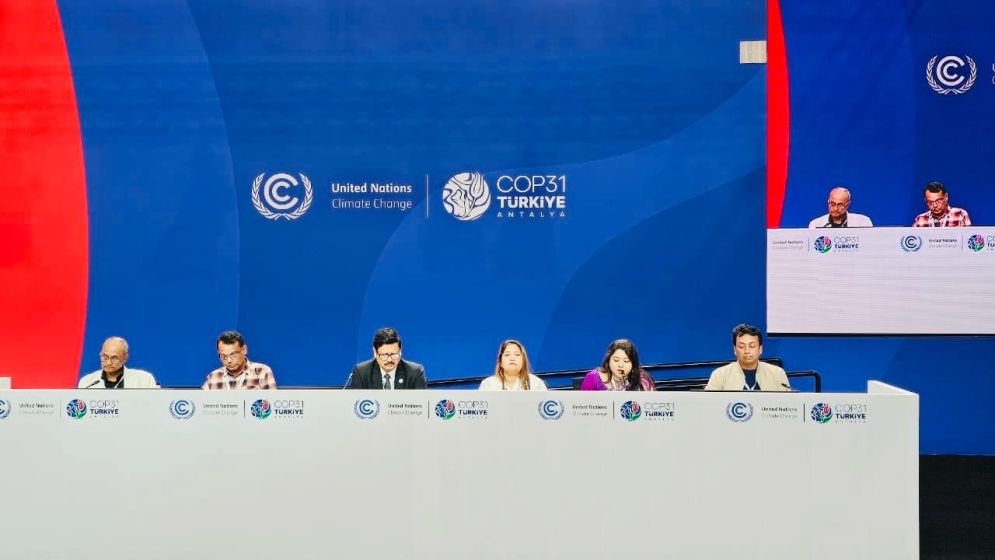
Photo: Courtesy
Bangladesh needs an estimated $1.4 billion to implement its
five-year National Health Adaptation Plan (HNAP) for 2026-2031, as climate
change increasingly threatens public health, health infrastructure and
essential services.
Three Bangladeshi civil society organisations have called
for predictable, accessible and primarily grant-based international climate
finance to help the country address these growing health risks.
They have also urged major greenhouse gas emitters to make
substantial and measurable emissions cuts before 2030 and publicly report their
progress every year.
The demands were made at a joint press conference held on
Saturday night on the sidelines of the ongoing COP31 climate conference in
Antalya, Türkiye.
The event was organised by the Climate Justice Forum (CJF),
the Organisation for Socio-Economic Development (AOSED) and the Centre for
Climate Change and Environmental Research (C3ER) of BRAC University.
The organisations said developed countries must ensure
predictable and easily accessible funding for climate mitigation, adaptation
and loss and damage.
They also stressed the need to involve least developed
countries, small island states and climate-vulnerable communities in climate
planning, financial oversight and assessments of whether funding is reaching
those most at risk.
$1.4 billion needed for health adaptation
According to a C3ER study, Bangladesh's HNAP 2026-2031
requires an estimated $1.4 billion to strengthen the country's health system
against climate change.
The plan prioritises keeping healthcare facilities
operational during floods, improving early detection of climate-sensitive
diseases and preparing health workers to respond to extreme heat.
The study, released at BRAC Centre in Dhaka on 17 October,
identified four potential sources of financing.
Of the required amount, $380 million could come from
domestic government budget allocations, while another $360 million could be
mobilised through investments in health-related sectors such as safe water,
sanitation, drainage and flood-resilient infrastructure.
Together, these domestic sources could provide $740 million,
covering around 53 percent of the total requirement.
The remaining $660 million is expected to come from
development partners ($520 million) and international climate funds ($140
million). The figures represent potential financing targets identified by the
study.
Roufa Khanum, assistant director of C3ER, said Bangladesh
could mobilise $740 million domestically through government budget allocations,
health sector revenues and cross-sectoral investments in water, sanitation and
a healthy environment.
However, international assistance would be essential to meet
the remaining funding requirement.
She stressed that Bangladesh should secure $140 million in
grants from international climate funds to strengthen its healthcare system
without increasing the country's debt burden.
"Predictable, accessible and grant-based support is
essential to turn adaptation commitments into reality and protect the health of
people in climate-vulnerable countries like Bangladesh," she said.
The study identified four priority areas that would account
for 69 percent, or $966 million, of the total HNAP expenditure.
These include $350 million for climate-resilient and
low-carbon health infrastructure, technology and supply systems; $266 million
for risk monitoring and early warning systems; $210 million for strengthening
the capacity of health workers; and $140 million for leadership and governance.
Potential sources of international grants include the Green
Climate Fund, the Adaptation Fund and the Least Developed Countries Fund.
C3ER also recommended forming a task force under the
Ministry of Health, introducing climate risk assessments for new health
projects and establishing separate budget codes to track climate-related and
health-sector spending.
Major emitters urged to cut emissions before 2030
The organisations said adaptation financing would help
Bangladesh strengthen its capacity to address existing health risks, but
preventing those risks from worsening would require rapid emissions reductions
by major polluting countries.
Md Salah Uddin, knowledge management team lead at AOSED,
said major emitters must move beyond long-term net-zero pledges and deliver
meaningful, measurable reductions in greenhouse gas emissions before 2030.
He called for stronger short-term climate targets, publicly
disclosed implementation plans with sector-specific emissions reduction
financing, and an end to new policies and initiatives that increase dependence
on fossil fuels.
Major emitting countries should publish their actual annual
emissions reductions, explain any failure to meet their targets and disclose
corrective measures to address the shortfalls, he said.
Emissions data should be publicly accessible and subject to
independent review, he added, warning that carbon credits must not become an
excuse for continued pollution.
The organisations also stressed that the energy transition
must protect land rights, ensure decent employment and guarantee access to
affordable electricity.
They said responsibility for cutting emissions should rest
primarily with countries that bear greater historical responsibility, are
currently the largest emitters and have the capacity to take effective action.
The three organisations urged the COP31 final decisions to clearly outline what major emitters will do before 2030, how their progress will be independently assessed and when climate-vulnerable countries will receive the funding needed to implement priority plans such as Bangladesh's HNAP.