



 For all latest news, follow the Daily Sun's Google News channel.


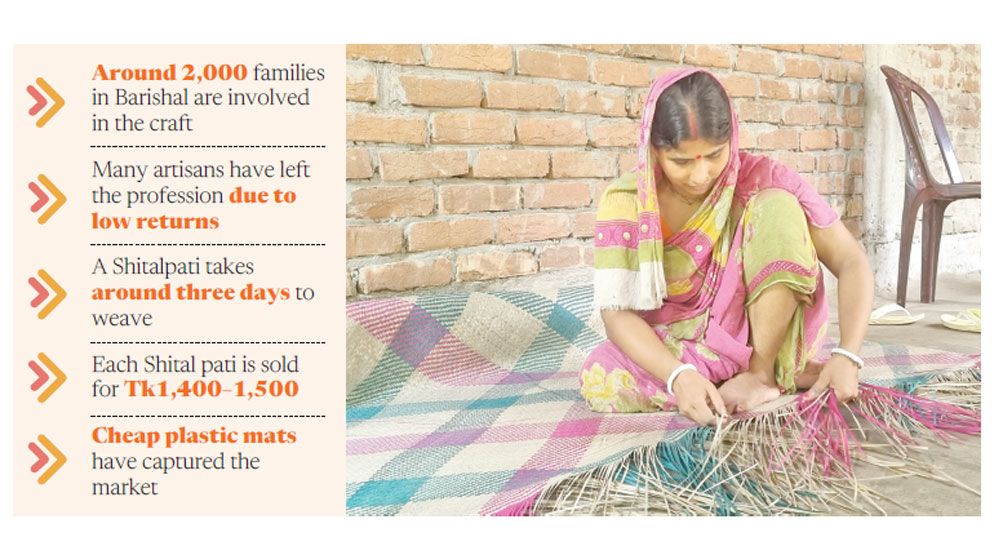
The centuries-old tradition of Shital pati weaving is gradually fading in the Barishal region as plastic mats have flooded the market, forcing many traditional artisans to abandon the profession.
Once a common household item across Bangladesh, Shital pati is a traditional mat woven from thin strips of cane. It is well known for its smooth texture and naturally cool surface and has long been valued for providing relief from the intense heat of summer.
Around 2,000 families are currently involved in the Shital pati industry across the Barishal division, including Kathalia, Helencha, Kazlakathi, Uttampur and Mirganj in Bakerganj, Hailakathi in Jhalakathi, Kamdevpur in Nalchity and Chirapara in Kaukhali of Pirojpur. The number was nearly twice as high in the past.
Kathalia village under Rangashri union of Bakerganj is widely known as a village of Shital pati weavers. Paitra plants, the main raw material for Shital pati, are grown on both sides of roads and around homesteads in the village.
Bhabhatosh Patikar, a resident of Kathalia, said he had been weaving Shital pati since childhood, following a family tradition. “Making a living from this profession has become increasingly difficult. The market is now flooded with cheap plastic mats, which are affordable for ordinary people. I am still continuing the work because it is our ancestral profession,” he said.
Suma Mitra, another artisan from the village, said she had been making Shitalpati since she was 10. “It takes around three days of hard work to make a Shital pati, which we sell to wholesalers for Tk1,400 to Tk1,500. We also need raw materials worth around Tk600. After all the labour, there is very little profit left,” she said.
Many artisans have already left the profession in search of better incomes.
Jagadish Das of Kaukhali in Pirojpur, who previously made Shital pati, said he had stopped weaving mats because the remuneration was insufficient to support his family. “I have been driving an autorickshaw for the past two years. I earn better from this work than I did from making Shital pati,” he said.
Sushanta Ghosh, a researcher working on Shital pati, said the livelihoods of people involved in the traditional craft were deteriorating because of competition from plastic products.
“As their income is falling, many artisans are changing professions. If the government provides support to the weavers and develops a market for Shital pati as an alternative to plastic mats, the industry can be revived. Those who have left the profession may also return,” he said.
Barisal Divisional Commissioner Khalil Ahmed said Shital pati was an important part of the region’s heritage and needs government support to survive.
“Shital pati is our tradition. I have also used it and presented it as a gift to guests. There is a plan to organise a Shital pati fair to promote the traditional craft,” he said.