


 For all latest news, follow the Daily Sun's Google News channel.


SUPER PETROCHEMICAL REFINERY
BPC finds plant built in breach of policy
Daily Sun Report, Dhaka/Chattogram
Published: 12 Nov 2026, 11:04 PM
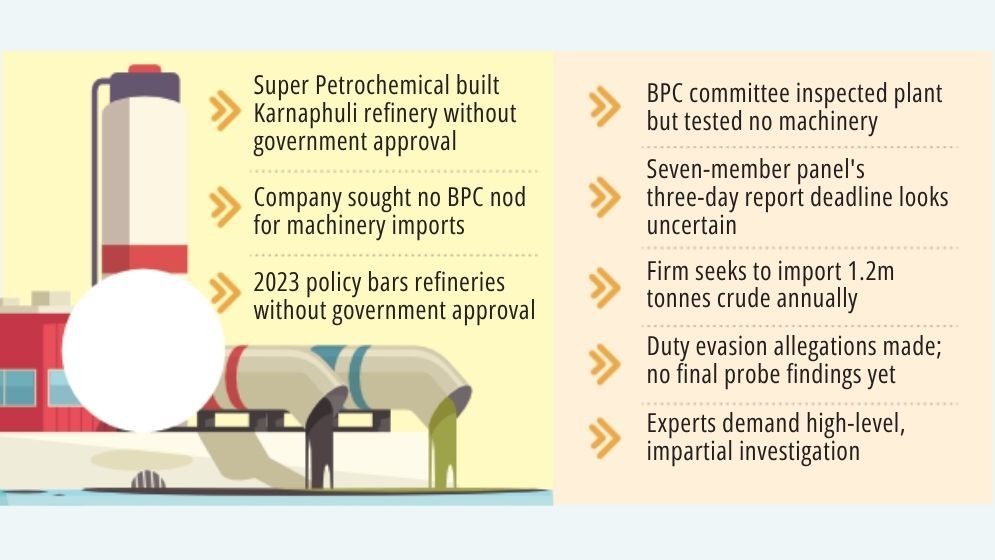
Super Petrochemical PLC, a TK Group concern, has built a refinery at Karnaphuli in Chattogram without government approval, the convener of a Bangladesh Petroleum Corporation (BPC) inspection committee has acknowledged.
He also said the company did not seek BPC approval before importing a large quantity of capital machinery and equipment for the plant.
The convener, BPC General Manager (commercial and operations) Mohammad Zahid Hossain, made the admissions to journalists at the BPC headquarters on Thursday afternoon, after the seven-member committee visited the plant on Wednesday evening.
The 2023 policy on private refineries expressly bars the establishment of any refinery without government approval.
Allegations have also surfaced that moves are under way to clear the company for production before the necessary approvals and technical capacity have been verified.
Zahid Hossain said construction was continuing at the refinery despite the lack of government approval. “Some development work has been done in the project site. New tanks are being built and we have seen the under-construction crude plant,” he said.
“They have given some documents related to the plant. We are reviewing them. As many documents as they will submit till the end, those will be mentioned in the report. The issue of developing units 2 and 3 going beyond the policy will also be mentioned in the report.”
Asked by journalists whether BPC approval had been obtained before the machinery was imported, he said the company had not sought any such approval from BPC for importing capital machinery and other equipment.
Clause 7.1 of the Energy and Mineral Resources Division’s policy on setting up private-sector refineries and on importing, storing, processing, transporting and marketing crude oil (2023) states that no refinery may be established without government approval.
BPC Secretary Shahina Sultana formed the committee by an office order on Tuesday. It was asked to submit, within three days, a report with recommendations on approving production at the refinery. On Thursday, however, the convener said it was uncertain whether the report could be submitted on time. The company might be asked for further explanations and documents, he said.
“We have just visited the plant. The committee may have more queries. The remaining members of the committee will review and discuss those issues before preparing the report,” he said.
The committee spent more than three hours at the plant on Wednesday evening. The convener acknowledged that the inspection did not test the refinery’s actual production capacity or the functioning of its machinery. He said the committee had not started up each machine or unit.
“We visited the plant area for more than three hours. However, we didn’t verify the capacity of the plant. If there is a technical committee, they will inspect those,” he said.
Technical matters such as whether input and output were working properly would be examined by a technical committee, he said, while the ministry would take the final decision on approval.
Questions have been raised in the energy sector over how a recommendation for production approval could be made without verifying technical capacity and safety. Those familiar with the sector say setting up and operating a refinery requires more than 30 approvals and clearances from various government offices. These include clearances from BPC and Bangladesh Bank; location and environmental clearances from the Department of Environment; licences from the Fire Service and Civil Defence; approval from the Department of Explosives; layout and safety approval from the Department of Inspection for Factories and Establishments; special permits from the Import and Export Controller; and a customs bonded warehouse licence and VAT registration from the National Board of Revenue (NBR).
It is alleged that the company advanced construction without properly following these provisions. Allegations of duty evasion on the imported machinery have also been made, and those concerned have questioned whether other goods were imported or smuggled under the machinery declarations. No final findings of any investigation into these allegations are yet available.
Meanwhile, Super Petrochemical has applied to BPC for permission to import 1.2 million tonnes of crude oil a year for refining. The application seeks 400,000 tonnes of light crude and 800,000 tonnes of heavy crude annually.
Documents obtained during inquiries show the import application is alleged to treat condensate and light crude as the same thing. Experts and others concerned say they are not the same raw material. Condensate is essentially a liquid by-product found with natural gas, whereas crude oil comes from oilfields, and the two differ fundamentally in origin, composition and characteristics.
In a letter dated 27 October, which cited BPC’s letter of 10 August, the company set out a plan for possible fuel supplies in 2027. It said it planned to supply BPC with 256,500 tonnes of octane, 119,000 tonnes of petrol, 466,500 tonnes of diesel and 361,000 tonnes of high sulphur furnace oil (HSFO) that year. Producing these fuels would require importing 400,000 tonnes of light crude and 800,000 tonnes of heavy crude, the letter said.
Senior officials of the energy division and BPC said an influential quarter was keen to see the company granted production approval even though the required approvals and conditions had not been met. Questions have also been raised over whether a recommendation for production approval is being prepared by overlooking conditions that were to be met before the refinery was built.
Sector experts say that, for a sensitive and strategic facility such as a refinery, verifying safety, environmental protection, technical capacity and the legality of imported machinery is critical. Granting production approval without confirming these could expose the country’s energy security and regulatory system to serious risk, they say.
They have called for a high-level, impartial investigation into the company’s imports, construction work, duty payments and approvals.
In the seven-member BPC committee, a BPC manager (commercial and operations) is serving as member-secretary. The members are the deputy general manager (operations), the deputy general manager (planning and shipping) and an assistant general manager (planning) of Eastern Refinery PLC (ERPLC), and the deputy general managers (operations) of Jamuna Oil Company PLC (JOPLC) and MPPLC.