



 For all latest news, follow the Daily Sun's Google News channel.


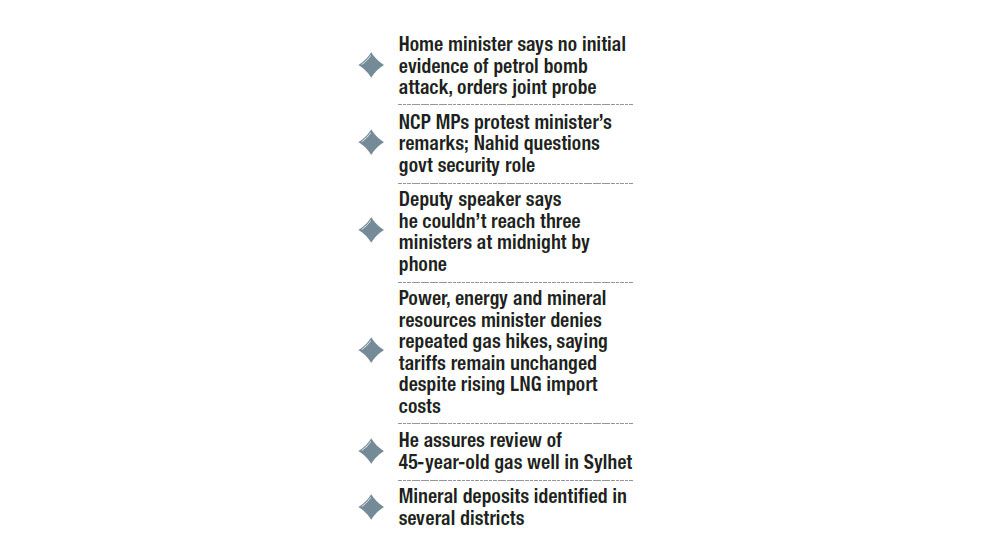
The fourth sitting of the fourth session of the Jatiya Sangsad (JS) turned stormy for some minutes on Thursday following heated exchanges between the opposition and the treasury bench over an alleged arson attack on the ancestral home of reserved-seat MP Nusrat Tabassum in Kushtia.
However, Parliament also witnessed a busy question-and-answer session covering energy, gas prices, mineral discoveries, journalists’ welfare, and efforts to combat misinformation.
Stormy debate over Kushtia fire incident
The heated discussion began shortly after the sitting began with Speaker Hafiz Uddin Ahmad in the chair. Opposition Chief Whip and NCP Convener Nahid Islam raised the issue on a point of order. He alleged that miscreants hurled four petrol bombs at the Daulatpur residence of NCP Member of Parliament (MP) Nusrat Tabassum around midnight on Wednesday, killing two goats and endangering lives.
Accusing the police of prematurely ruling out a petrol bomb attack without conducting a forensic investigation, Nahid said that the Kushtia district Awami League had already claimed responsibility on social media. “If the government can’t ensure the security of MPs and leaders of the 2024 mass uprising, let them tell us clearly – we will find our own way,” he warned, noting that Tabassum had filed a GD two days earlier after receiving phone threats.
In response, Home Minister Salahuddin Ahmed told the House that the fire broke out at 12:20am. Citing initial findings from the Border Guard Bangladesh (BGB), police, and local witnesses, he said that no evidence of petrol bomb blasts was found.
“Preliminary inspection suggests the fire might have originated from an electrical short circuit due to old wiring in the largely unoccupied house, where two goats died and a caretaker’s shoemaking materials were burned,” he said.
However, the minister assured the House that a joint probe committee comprising the BGB, police, fire service, and civil administration had been formed to investigate the incident.
Dissatisfied with the home minister’s remarks, NCP MPs protested loudly. MP Hannan Masud stood up and shouted without a microphone for nearly two minutes, ignoring repeated calls from Deputy Speaker Kayser Kamal – who was presiding at the time – to take his seat.
Addressing the House afterward, the deputy speaker said that he had tried to reach the home minister, law minister, and state minister for power, energy and mineral resources by phone at midnight following the incident, but failed to connect with any of them. Urging MPs to remain patient until the joint investigation concludes, he noted that the administration had subsequently taken prompt action.
Q&A over gas prices, mineral reserves
Power, Energy and Mineral Resources Minister Iqbal Hasan Mahmud Tuku dismissed claims of repeated gas price hikes, telling the House that despite higher LNG import costs due to global conflicts, gas tariffs for households and power plants have not increased. He said BERC regulates LPG prices based on private-sector imports, while the government is expanding rural biogas supply.
In a written reply to MP Abdul Wadud Bhuiyan, he said the Geological Survey of Bangladesh (GSB) had discovered iron ore (magnetite) in Dinajpur's Hakimpur, Chirirbandar and Parbatipur; limestone in Naogaon's Badalgachhi and Hakimpur; and heavy minerals, including ilmenite, zircon, garnet and magnetite, in the sandbars of the Brahmaputra and Jamuna rivers in Kurigram and Gaibandha over the past 15 years. Feasibility and environmental impact assessments are underway before commercial extraction.
The House also discussed reviving the abandoned Atgram-1 well in Sylhet's Kanaighat. Reserved-seat MP Shammi Akther urged a fresh assessment using modern technology, including 3D seismic surveys, to determine its commercial potential.
Drilled to 16,276 feet in 1981–82, the well showed gas in six prospective geological formations, with test production averaging 0.157 million cubic feet of gas and 1,234 barrels of liquid components daily. It was abandoned in 1982 after falling underground pressure reduced gas flow, making extraction commercially unviable under the technology and economic conditions of the time. Tuku assured the House that the matter would be examined and necessary steps considered.
Combating disinformation and journalists' welfare
Replying on behalf of Information and Broadcasting Minister Andaleeb Rahman, State Minister Yasser Khan Chowdhury said PIB's fact-checking unit BanglaFact had published 1,172 fact-checks and investigative reports, including 552 under the current government. It identified 137 fake Facebook accounts impersonating Prime Minister Tarique Rahman, 19 websites mimicking mainstream media and over 900 fake accounts on Facebook and X. A total of 1,691 journalists received training in AI, multimedia journalism and fact-checking through 44 programmes.
He said the government was working with journalist organisations, including DRU, BFUJ, DUJ and the Broadcast Journalist Association, to prepare a verified list of genuine journalists to curb fake journalism without compromising editorial independence.
Between January 1 and September 30, 2026, the Bangladesh Journalist Welfare Trust provided Tk6.48 crore in grants to 1,344 journalists, while 402 students from journalist families received Tk73.26 lakh in educational stipends in FY2025–26. Since its inception, the trust has distributed Tk67.14 crore among 19,321 beneficiaries.
Replying to Independent MP Sheikh Mujibur Rahman Iqbal of Kishoreganj-5, the state minister said BTV and BSS were broadcasting documentaries and reports on the Haor region's agricultural, fisheries and tourism potential, with plans to expand environmental and tourism-focused programmes.