


 For all latest news, follow the Daily Sun's Google News channel.


Bangladesh wouldn’t have got Middle East market without 7 Nov: Zabihullah
BSS, Dhaka
Published: 11 Nov 2026, 07:24 PM
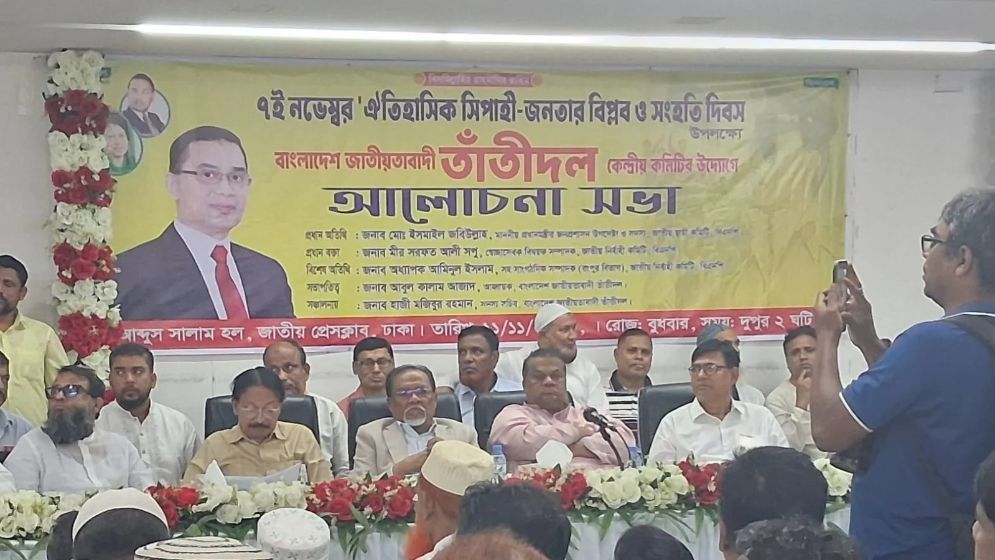
Photo: BSS
Prime Minister’s Adviser on Public Administration Md Ismail Zabihullah on Wednesday said Shaheed President Ziaur Rahman took groundbreaking steps not only in politics but also to revive the country's economy.
He said the concepts of a “mixed economy” and later an “open
economy” were introduced for the first time during his tenure, when the rural
economy became active after coming out of the bloc economy and a new horizon
opened for private entrepreneurs and the industrial sector.
He added that the policies and cooperation of his government
for the expansion of the garment industry in particular, and the importance of
remittances sent by expatriate workers in earning foreign exchange, are being
especially praised on Wednesday.
Ismail Zabihullah, also BNP Standing Committee Member, made
these remarks as chief guest at a discussion meeting, organised by the central
committee of Bangladesh Jatiyatabadi Tati Dal at the National Press Club this
afternoon on the occasion of "Historic Sepoy-Janata Revolution and
Solidarity Day".
Praising the eight-month rule of Prime Minister Tarique
Rahman, he said significant steps have been taken, such as in healthcare,
establishing hospitals and modernising the armed forces.
Various steps are being taken to ease bank loans and to save
the IT sector from unemployment, he said.
He also said Prime Minister Tarique Rahman, the worthy son of late Ziaur Rahman and Begum Khaleda Zia, is leading the party and the state forward as a unique symbol of nationalism.
He said everyone must remain united, forgetting all
differences, to protect the country's democracy and independence in the
interest of the party and the state.
He said it is not enough to depend entirely on the leader’s
image; rather every party activist must work in the field upholding the
leader’s ideals. He also stressed working together to increase economic
production in the country, ensure workers’ fair rights and eliminate
unemployment.
He further said that if the path shown by Shaheed President
Ziaur Rahman and his economic policies can be followed properly, the country's
economy will become more dynamic and the desired development will be possible.
He said that in every crisis the country faced in the past,
everyone from ordinary people to political leaders and activists had united,
driven by a deep inspiration.
Recalling the history of 7 March, he said that between 1972
and 1975 an attempt was made to weaken the state through political plunder
under the cover of state control, the famine of 1974, the economy’s reputation
as a “bottomless basket”, syndication of commodities and bank looting. He said
the formation of the Rakkhi Bahini also created division within the army.
Disregarding the democracy for which the country had become
independent, the one-party rule “BAKSAL” was established in March 1975.
He said the conspiracy of hegemonic forces and a section of
the army was foiled through the united revolution of sepoys and the people on 7
November 1975.
There is a positive similarity between the Sepoy Mutiny of
1857 and the historic Sepoy-Janata revolution of 7 November 1975, which is the
solidarity of ordinary soldiers and the people against imperialist forces, he
said, adding that this was essentially a historic moment for protecting national
sovereignty and independence.
The adviser said that in that critical moment, Ziaur Rahman
came forward and played a historic role in saving the countrymen.
Along with the sepoys, the common people also took part in
the revolution, which built a strong resistance against hegemonism, he added.
Bangladesh Jatiyatabadi Tanti Dal convener Abul Kalam Azad
presided over the meeting. Swechchhasebak Dal's Mir Sarafat Ali Sapu, Prof Aminul Islam, Mozibur Rahman and other leaders were also present.