


 For all latest news, follow the Daily Sun's Google News channel.


CSOs urge shift from climate loans to grants at COP31
Daily Sun Report, Dhaka
Published: 10 Nov 2026, 08:14 PM
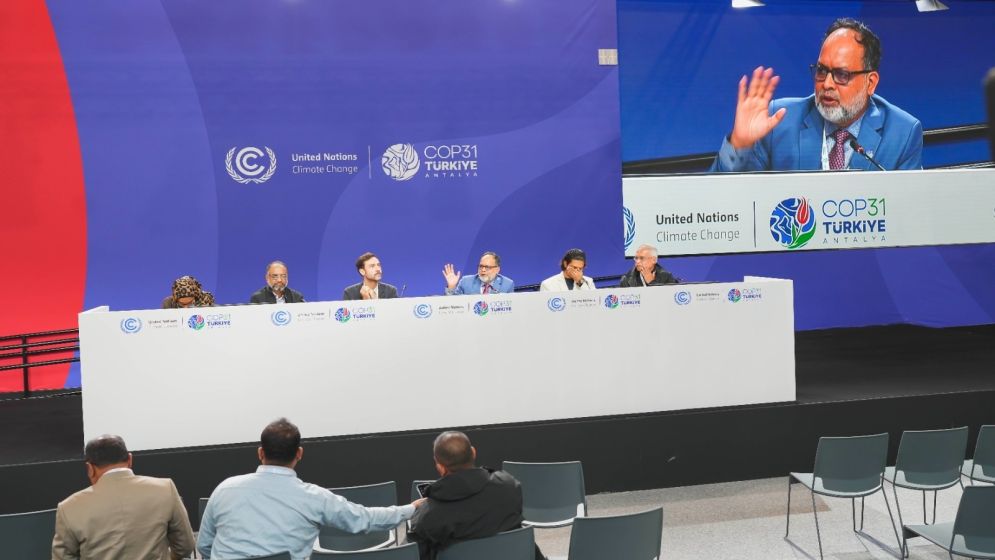
Civil society organisations (CSOs) urge shift from climate loans to grants at COP31. Photo: Courtesy
Civil society organisations (CSOs) have urged developed countries and international financial institutions to provide Bangladesh and other climate-vulnerable nations with more grant-based climate finance instead of loans to fund climate adaptation and renewable energy projects.
They warned that borrowing to tackle climate change is deepening the debt burden of countries that have contributed relatively little to global greenhouse gas emissions.
The call came at a press conference on the second day of COP31 at the Antalya Expo Centre in Türkiye, where Change Initiative and Young Power in Social Action (YPSA) presented findings on the growing link between climate finance and national debt.
At the joint press conference, titled “Breaking the Climate Debt Trap: Financing Nature-Smart Energy Sovereignty”, the organisations highlighted how vulnerable countries are paying twice for the climate crisis – first through the loss of lives, homes and livelihoods, and then through repayments on loans taken to address its consequences.
M Zakir Hossain Khan, co-founder and chief executive of Change Initiative, said 55 countries covered by the Climate Debt Risk Index spent $47.17 billion on debt servicing in 2023 alone. This exceeded the $33.74 billion in climate finance recorded for these countries over the entire 2002–2023 period.
According to the findings, eight countries – Bangladesh, Cabo Verde, Cambodia, Myanmar, Pakistan, the Philippines, Senegal and Sri Lanka – account for 74.3 per cent of the climate loans recorded in the index. All eight received more climate finance in loans than in grants.
The speakers also pointed to a significant gap between climate finance commitments and actual disbursements. Although climate finance from developed countries rose from $115.9 billion in 2022 to $136.7 billion in 2024, only $2.3 billion of the additional $20.8 billion was allocated to adaptation.
They further said that 66.1 per cent, or $32.43 billion, of recorded adaptation commitments had no corresponding payment records.
In Bangladesh, 90.4 per cent of renewable energy investment since 2000 has come through loans, said Mofazzal Hossain, research coordinator at Change Initiative.
He said the country had received $2.54 billion in climate finance for its energy sector, of which $880 million went to coal and gas-fired power plants, including the Matarbari and Bheramara projects.
Under the existing financing model, renewable energy-related debt could reach $105 per person by 2040, compared with the country's current climate debt of around $80 per person across all sectors, he added.
To address the problem, Change Initiative proposed establishing a Renewable Energy Sovereignty Facility, a national financing mechanism combining grants, guarantees and capped public loans.
The proposed facility could support $7.69 billion in renewable energy investment between 2026 and 2030 while reducing new public borrowing from $4.6 billion to $800 million. It could also lower renewable energy debt to $24 per person by 2040, a 77 per cent reduction, according to the organisation.
Khan urged COP31 participants to agree on an initial funding amount and annual targets for adaptation grants from 2027. He also called for greater transparency in climate finance reporting, with loans and grants clearly separated and fossil fuel projects excluded from climate finance accounting.
“LDCs must not become victims twice over: first through climate vulnerability, and second through an unjust debt burden,” he said, stressing that climate finance should be provided as grants to protect ecosystems and human lives.
Mofazzal said the problem was not a shortage of money but the way climate finance was channelled.
“Development banks lend to the Bangladesh government, the government lends to state agencies, and state agencies lend to households and investors. This debt cycle traps everyone. Renewable energy should not add to public debt,” he said.
Brice Böhmer, climate lead at the Transparency International Secretariat, stressed the importance of transparency and accountability in climate finance.
He warned that a lack of transparency could create opportunities for corruption, saying public participation and community oversight were essential to ensure that funds reached those most in need.
Mohammad Shahjahan, director of the KM4D Division at YPSA and lead of the Bangladesh chapter of Climate Action Network South Asia, called on developed countries to provide new, additional, predictable and grant-based climate finance instead of presenting repackaged development assistance and loans as climate commitments.
Roaa, chief executive and founder of United Beyond Borders, said young people in developing countries needed greater access to grant-based funding for community-level projects. She also called for developed countries to be held accountable for their historical emissions.
In his closing remarks, Mohammad Arifur Rahman, chief executive of YPSA, urged journalists to investigate how climate finance mechanisms were adding to national debt burdens.
He said media scrutiny was vital to ensure that climate finance reached the countries most affected by climate change in the form of unconditional grants.
Responding to a question about private sector participation in the Global South, Khan said private investment was important for technology and manufacturing. However, he cautioned that adaptation finance should not be left to private markets or profit-driven approaches.