


 For all latest news, follow the Daily Sun's Google News channel.


Bangladesh validates Multisectoral Action Plan for Eye Health (2027–2029)
Strengthening national commitment and cross-sectoral collaboration
Daily Sun Report, Dhaka
Published: 09 Nov 2026, 08:19 PM
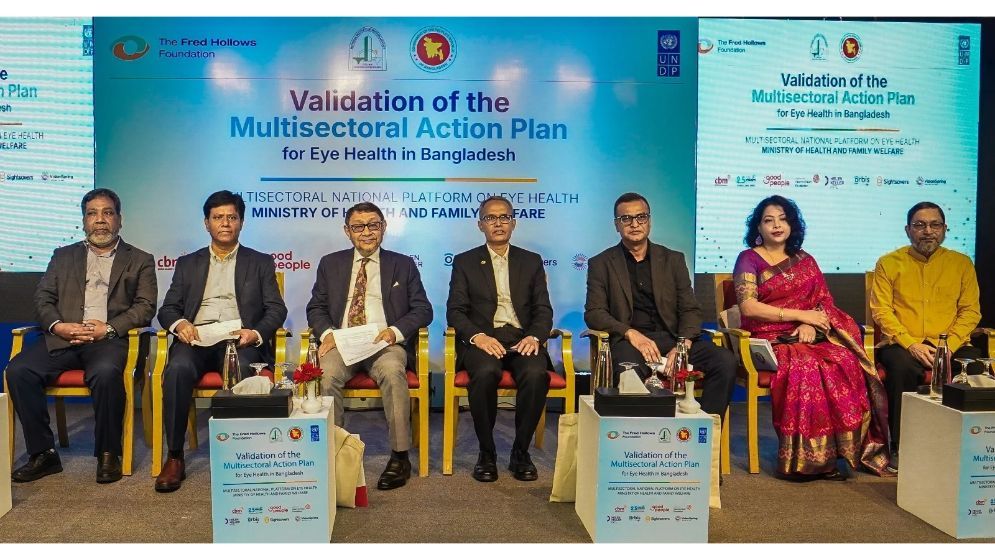
Photo: Courtesy
The Government of Bangladesh has taken an important step towards strengthening national efforts on eye health with the validation of the Multisectoral Action Plan for Eye Health in Bangladesh (2027–2029) at a national workshop held on Sunday at Hotel InterContinental, Dhaka.
The workshop was attended by the Honourable Minister of
Health and Family Welfare as the Chief Guest. The Additional Secretary of the
Ministry of Health and Family Welfare presided over the event, according to a
press release.
The Multisectoral National Platform on Eye Health was
initiated by The Fred Hollows Foundation (FHF), with support from the United
Nations Development Programme (UNDP) Bangladesh, in coordination with
Sightsavers and other members of the International NGO Forum for Eye Health.
Led by the Ministry of Health and Family Welfare (MoHFW), in
collaboration with the National Institute of Ophthalmology and Hospital (NIOH),
the Platform brings together key government ministries, including the
Ministries of Education; Labour and Employment; Agriculture; Industries; Women
and Children Affairs; and Social Welfare, alongside development partners,
INGOs, the private sector and other stakeholders.
The formal session began with welcome remarks from Md
Mohsin, Joint Secretary, Ministry of Health and Family Welfare (MoHFW), and
Chair of the Multisectoral National Platform on Eye Health.
He highlighted the importance of collective commitment and
coordinated efforts across sectors to advance the national eye health agenda.
This was followed by a keynote presentation by Dr Syed
Mehbub Ul Kadir, Director (In-Charge), National Institute of Ophthalmology and
Hospital (NIOH), and Co-Chair of the Platform.
His presentation provided an overview of the Multisectoral
Action Plan (2027–2029), outlining its key priorities, thematic areas and
proposed activities to strengthen coordinated action on eye health across
sectors.
This cross-sectoral approach recognises that eye health is not solely a health-sector issue but a shared development priority.
Vision impairment can affect education, employment, productivity, social participation and overall wellbeing. Addressing it therefore requires coordinated action across sectors to improve access to inclusive and equitable eye care services in Bangladesh.
The validation workshop brought together representatives
from relevant government ministries, UN agencies, development partners, INGOs,
the private sector and technical experts.
Discussions focused on building consensus and collective
ownership of the Action Plan, including its strategic priorities, thematic
areas, institutional roles and responsibilities, and implementation milestones.
The process aims to establish a shared and actionable
roadmap for coordinated implementation over 2027–2029.
The Multisectoral Action Plan provides a framework for
translating national commitment into practical action, strengthening
coordination among sectors and supporting the integration of eye health into
relevant policies, programmes and services.
The Action Plan also reflects Bangladesh’s commitment to the
global agenda on eye health. It provides an opportunity to translate the
commitments and momentum of the Global Summit on Eye Health into coordinated
national action, strengthening partnerships and accelerating progress towards
equitable eye care for all.
Speaking at the event, the Honourable Minister of Health and
Family Welfare, Sardar Md Sakhawat Husain, said, “Creating awareness around
important health issues including eye health is crucial to maintaining the
health and wellbeing of the population of the country. Through stronger
multisectoral collaboration, we aim to ensure that everyone, regardless of
their circumstances, can access the eye care services they need.”
Bangladesh has made progress in expanding eye care services,
but preventable vision impairment and avoidable blindness remain significant
challenges. Sustained investment, stronger health systems, improved access to
services and the integration of eye health into wider development programmes
are essential to addressing these challenges.
Through the Multisectoral National Platform and its Action
Plan, stakeholders will work towards stronger coordination, shared
accountability and the mobilisation of expertise and resources to advance eye
health across the country. Musabbir Alam, Cluster Director – South Asia and
Middle East, The Fred Hollows Foundation, Bangladesh, noted, “The priority now
is to turn our shared commitments into coordinated action and lasting impact.”
The validation of the Action Plan marks an important step
towards a more coordinated, inclusive and sustainable approach to eye health in
Bangladesh, with the shared goal of ensuring that no one is left behind in
accessing quality eye care.