


 For all latest news, follow the Daily Sun's Google News channel.


IJM trains law enforcers to combat sexual exploitation, trafficking of children
The programme will address the dismantling of local and transnational criminal networks
Daily Sun Report, Dhaka
Published: 09 Nov 2026, 05:05 PM
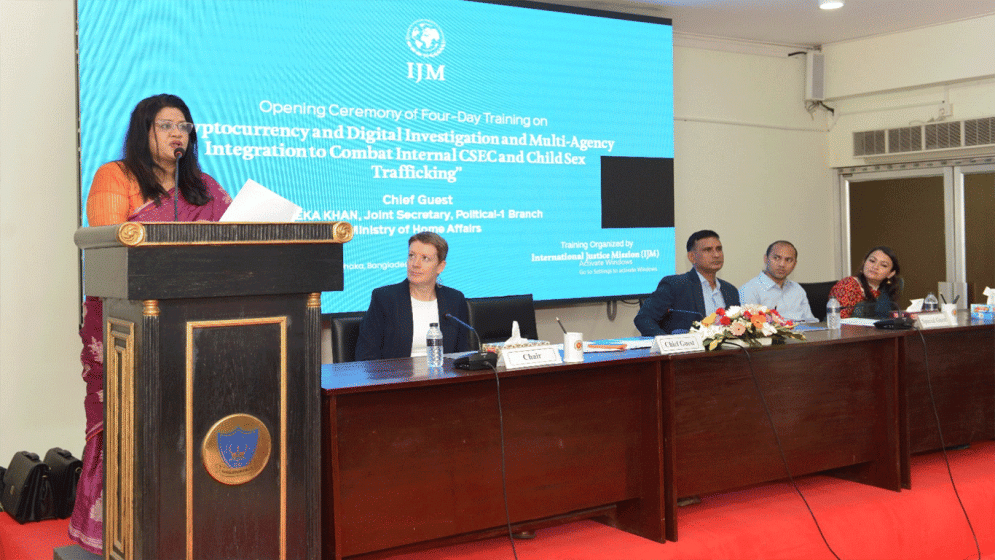
Photo: Courtesy
International Justice Mission (IJM) on Monday launched a four-day specialised training for 39 officials from Bangladesh's law enforcement and intelligence agencies to strengthen their capacity to combat Commercial Sexual Exploitation of Children (CSEC) and child sex trafficking.
The training titled “Cryptocurrency and Digital
Investigation and Multi-Agency Integration to Combat Internal CSEC and Child
Sex Trafficking” launched at the Detective Training School (DTS) in the capital’s
Rajarbag, said a press release.
The four-day training will conclude on Thursday,
with a graduation and closing ceremony, where certificates will be awarded to
the participants.
Rebeka Khan, joint secretary of Political-1 Branch
at the Ministry of Home Affairs (MoHA), inaugurated the training as chief
guest.
Claire Wilkinson, country director of IJM
Bangladesh, chaired the inaugural session.
Sultana Esrat Jahan, additional superintendent of
police of CID, Alyse Kennedy, political officer (TIP) of US Embassy Dhaka and
IJM Bangladesh’s staff were present during the event.
The 39 participants represent five law enforcement
and intelligence agencies: 11 officials from the Criminal Investigation
Department (CID), 12 from the National Security Intelligence (NSI), 10 from the
Police Bureau of Investigation (PBI), two from Dhaka Metropolitan Police (DMP),
two from Gazipur Metropolitan Police (GMP), and two from the National Central
Bureau (NCB).
Four specialist trainers – Shahnewaj Raju,
additional SSP, CPC, CID; Mohammad Ashiqur Rahman, joint director, NSI; Md
Jahurul Huq, superintendent of police, PBI; and Caleb Carroll, manager, law
enforcement development and partnerships, European Anti-Trafficking Program,
IJM – will facilitate 14 sessions throughout the four-day programme.
Chief guest Rebeka Khan said, “The Bangladesh government
has taken important steps to strengthen its response to trafficking and the
exploitation of vulnerable persons. Significant efforts have been made to
improve investigation and prosecution, strengthen victim protection and
assistance, enhance institutional coordination, and promote whole-of-government
responses to crimes like CSEC.”
Encouraging the training participants from different
law enforcing agencies, Rebeka added, “We must strengthen our capabilities,
partnerships, and implementation. Success is not measured by the number of
policies adopted, meetings or trainings organised. It is measured by outcomes,
children who are protected from exploitation. It is measured by victims who
receive justice, and investigations that lead to accountability. Finally,
success is measured by public confidence that our institutions can effectively
protect the vulnerable and uphold the rule of law.”
The joint secretary thanked IJM Bangladesh for
organising the training.
In her opening remarks, IJM Bangladesh’s Country
Director Claire Wilkinson said, “The nature of crime is changing, and the
methods used by criminal networks are evolving rapidly. Child sexual
exploitation and trafficking are no exception. If our investigations focus only
on the immediate offender or the person directly found at the crime scene, we
risk leaving the larger network untouched.”
She added, “The challenges are significant, these
crimes may be becoming more sophisticated, but our collective response can become
more sophisticated too.”
“Let us use this training opportunity to strengthen
our capabilities, deepen our partnerships and reaffirm our collective commitment
to making Bangladesh safer for every child,” she further said.
The training covers emerging trends in
cryptocurrency-related crimes and their connections to human trafficking, CSEC,
cyber fraud, and money laundering in Bangladesh and internationally. Participants
will explore cryptocurrency and blockchain fundamentals, the use of digital
currencies in criminal operations, and open-source intelligence (OSINT)
resources.
Sessions will also examine Bangladesh's human
trafficking landscape, recent developments in the US Trafficking in Persons
(TIP) Report, and the financial dimensions of internal trafficking cases,
including money laundering and ransom collection trends.
Through practical exercises and investigative
case-based learning, participants will develop skills in blockchain analysis
and tracing digital assets, identifying financial transactions linked to
trafficking networks, and using digital intelligence to support proactive
investigations.
The programme will also address the dismantling of
local and transnational criminal networks, investigator safety in online
environments, and dark-web investigation techniques.
IJM aims to reduce CSEC in Bangladesh by 50% by 2030
and ensure the protection of 6 million children. To achieve this, IJM
Bangladesh has been supporting the first responders, decision makers and policy
makers as they can implement the laws and policies to prevent CSEC effectively.
The organisation will implement activities in 11
districts under Dhaka, Khulna, Barishal, and Mymensingh divisions.