


 For all latest news, follow the Daily Sun's Google News channel.


Rizvi blames fascist regime for preventing celebration of 7 Nov for 17 yrs
Rizvi said 7 November had been observed at the government level since 1976
Daily Sun Report, Dhaka
Published: 08 Nov 2026, 07:38 PM
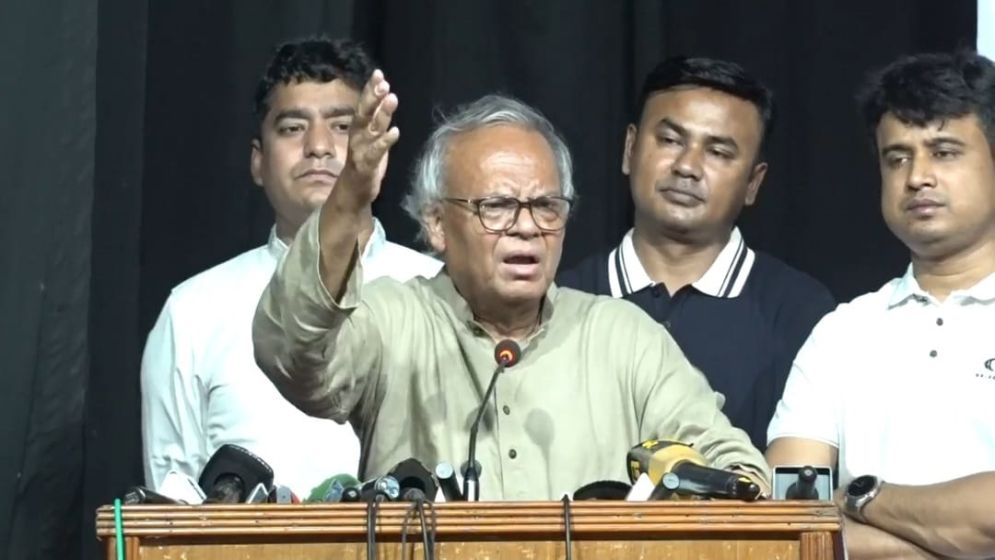
Photo: Daily Sun
BNP acting secretary general Ruhul Kabir Rizvi has said the fascist regime did not allow the celebration of National Revolution and Solidarity Day for 17 years during Sheikh Hasina’s rule, but the spirit of 7 November remained alive through various political and social organisations.
“The spirit of 7 November provides guidance for
building a democratic Bangladesh free from hegemony. It opened the way for
multi-party democracy, people's political rights and an independent foreign and
domestic policy,” he said.
Rizvi made the remarks as the chief guest at a
discussion organised by the central committee of Bangladesh Jatiyatabadi
Chhatra Dal at the TSC Auditorium of Dhaka University on Sunday, marking the
historic National Revolution and Solidarity Day.
The DU unit of Chhatra Dal also organised a day-long
photography exhibition on the TSC premises to mark the occasion.
Rizvi said 7 November had been observed at the
government level since 1976. However, the day was not allowed to be celebrated
during Sheikh Hasina's 17-year rule due to what he described as fascist
attacks. Despite the restrictions, various organisations continued to observe
the day through political and social programmes, keeping its spirit alive among
the people.
He said 7 November was significant not only for the
restoration of multi-party democracy and democratic rights but also for
establishing an independent foreign and domestic policy.
Bangladesh's decisions on friendship, alliances and
international agreements should be made by its own government and people,
rather than under the direction of any foreign power, he added.
Referring to the political situation after
independence, the BNP leader alleged that attempts had been made to establish
an individual-centred system of governance, restricting the formation of
political parties, freedom of expression and criticism of the government.
He claimed that people who criticised the government
faced enforced disappearances and killings, alleging that the Rakshi Bahini had
been used for such purposes.
“Thousands of leaders and activists of opposition
political parties were killed at that time. Some say 25,000, some say 30,000,
while others put the figure at 40,000,” he said.
Rizvi alleged that people had been deprived of the
freedom to speak, write in newspapers and express their political opinions. He
said 7 November had opened a way out of that situation and expressed hope that
people would once again enjoy the freedom to express their views and move
around without fear.
Discussing the political developments following the
assassination of Sheikh Mujibur Rahman on 15 August 1975, Rizvi said most
members of the cabinet led by Khandaker Mushtaq Ahmed had previously served in
Mujib's cabinet.
He said subsequent internal conflicts and military
coups created further uncertainty. Following Brigadier Khaled Musharraf's coup
on 3 November 1975, Ziaur Rahman was placed under house arrest, creating fears
among the people that one-party rule and foreign influence might return.
According to Rizvi, anti-India sentiment and public
anger had grown during that period. Many people viewed Khaled Musharraf's coup
as an Indian-backed attempt to restore Baksal.
He also said the subsequent involvement of Colonel
Abu Taher and Jasad further complicated the political situation before Ziaur
Rahman emerged as a central figure in the events of 7 November.
Explaining the differences between Ziaur Rahman and
Colonel Abu Taher, Rizvi said Zia wanted to build an efficient, modern and
professional army, while Taher wanted to use the military for political
purposes and establish a political structure within it.
He referred to the JSD's People's Army slogan,
“Sepoy-sepoy bhai bhai, officerder kalla chai”, saying it was contrary to the
discipline and professionalism required in the armed forces.
Rizvi said Ziaur Rahman opposed the politicisation
of the army and wanted it to function with discipline and professionalism. He
also wanted to establish democracy, press freedom, freedom of movement and a
constitutional system of governance.
“Under Ziaur Rahman's leadership, Bangladesh
developed a modern, strong and professional army,” he said.
On foreign policy, Rizvi said Ziaur Rahman had
managed Bangladesh's international relations efficiently by strengthening ties
with both the United States and China. He noted that China had not recognised
Bangladesh until 15 August 1975, making the development of bilateral relations
during Ziaur Rahman's tenure particularly significant.
Referring to the 1990 mass uprising, Rizvi said
democracy had once again been undermined during HM Ershad's rule through
martial law and restrictions on people's rights. However, he said the
anti-dictatorship movement led by students and the public, under the leadership
of BNP chairperson Begum Khaleda Zia, succeeded in restoring democracy.
He also alleged that Sheikh Hasina's government had
created a situation resembling one-party rule. Despite repression and various
obstacles, opposition political organisations, including Chhatra Dal, continued
their movements.
Rizvi said Chhatra Dal leaders and activists had
repeatedly attempted to enter Dhaka University and faced attacks but returned
to the movement each time. Their sacrifices and bloodshed were not in vain, as
their struggles contributed to the broader mass resistance that followed.
Drawing parallels between the July 2024 mass
uprising and the events of 7 November, Rizvi said both movements reflected
people's resistance against hegemony and authoritarian rule.
“This country of 180 million people cannot be
controlled by any foreign power or its domestic allies,” he said.
Referring to the sacrifices of young people,
including martyrs Abu Sayeed, Mughd, Ahab and Wasim Akram, during the July
uprising, he said their sacrifices could not be allowed to go in vain.
He said no one could return to power by disregarding
the mass uprising in which people had faced bullets and sacrificed their lives.
Referring to the possibility of Sheikh Hasina's return, Rizvi said making
statements from abroad would not help anyone regain public support.
Describing Bangladesh's history as one of struggle
and resistance, he referred to the Language Movement of 1952, the mass uprising
of 1969, the Liberation War of 1971 and the anti-dictatorship movement of 1990.
He said student leaders had remained committed to
the movement against Ershad despite various temptations. Leadership like that
of Begum Khaleda Zia had helped advance the struggle for democracy and people's
voting rights, he added.
Rizvi also praised BNP Chairman Tarique Rahman,
saying that just as martyred President Ziaur Rahman had played a courageous
role during the country's crisis by declaring independence, Tarique Rahman was
leading the party through various adversities.
“Despite hundreds of attacks and obstacles, he is
taking the party forward on the right path. The nationalist force cannot be
suppressed through intimidation,” he said.
He called for continuing the struggle to establish a
democratic, independent and hegemony-free Bangladesh by upholding the spirit of
the day.
Chhatra Dal President Rakibul Islam Rakib, General
Secretary Nasir Uddin Nasir, DU Chhatra Dal unit President Ganesh Chandra Roy
Sahas and General Secretary Nahiduzzaman Shipon were present at the discussion
and photography exhibition.