


 For all latest news, follow the Daily Sun's Google News channel.


Experts propose 7-point plan to ensure climate security for disabled people at COP31
Malay Chaki and Raisa Imran Chowdhury conducted the question-and-answer session with journalists
Daily Sun Report, DU
Published: 05 Nov 2026, 06:51 PM
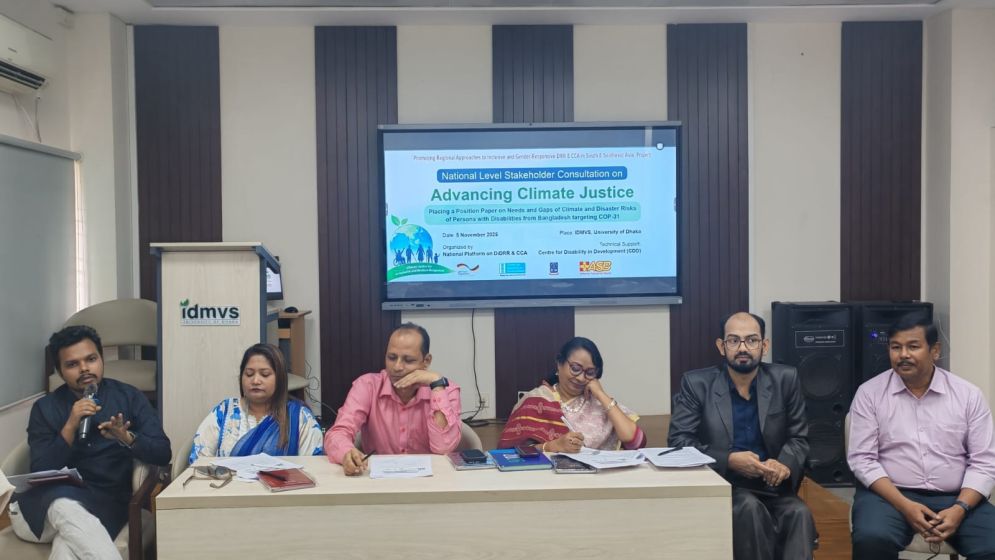
Photo: Daily Sun
Experts have proposed a seven-point recommendation to ensure climate justice, protection and equal participation for people with disabilities in climate change-related disaster management ahead of the upcoming 31st United Nations Climate Change Conference (COP31).
The proposals include ensuring dedicated allocations
for people with disabilities from international climate funds, making early
warning systems and disaster shelters fully accessible, and securing their
meaningful representation in climate policy-making processes.
The national policy proposal and strategic
recommendations, titled "Advancing Climate Justice for Persons with
Disabilities: Protecting Rights, Preventing Disability-Related Harm and
Ensuring Inclusive Climate Resilience in Bangladesh", were unveiled at a
press conference at the conference room of the Institute of Disaster Management
and Vulnerability Studies (IDMVS) at Dhaka University on Thursday.
The National Platform for Disability-Inclusive
Disaster Risk Reduction and Climate Change Adaptation (DIDRR & CCA),
Bangladesh, organised the event with technical assistance from the Centre for
Disability in Development (CDD).
Speakers at the press conference said Bangladesh's
geographical location exposes its coastal communities to multiple
climate-related hazards, including cyclones, tidal surges, rising sea levels, salinity
and extreme heatwaves.
People with disabilities face disproportionate risks
from these disasters due to barriers to information, mobility, emergency
response and essential services.
They said people with disabilities face two major
forms of vulnerability. First, those already living with disabilities often
suffer greater losses because early warning messages are not always accessible
and many cyclone shelters lack appropriate facilities for them.
Second, physical injuries, psychological trauma and
inadequate access to emergency healthcare and rehabilitation during disasters
can leave people with new long-term physical impairments and disabilities.
Against this backdrop, the platform prepared the
policy proposal ahead of COP31, scheduled to take place in Antalya, Türkiye,
from 9 to 20 November 2026, calling for stronger international commitments to
climate justice for people with disabilities.
The seven-point recommendation, addressed to the
international climate community, the COP31 Presidency and policymakers, call
for recognising the protection of people with disabilities as a major priority
in global climate justice.
The proposals also seek dedicated allocations and
accessible funding opportunities for people with disabilities under
international climate finance mechanisms, including funds addressing climate
change-related loss and damage.
The platform recommended making early warning
systems, rescue operations and multipurpose disaster shelters fully accessible
and inclusive to prevent avoidable losses during disasters.
It also called for ensuring emergency medical
services, physical rehabilitation, assistive technologies and devices, and
long-term social protection to prevent new disabilities and address the needs
of those affected by disasters.
Highlighting the particular vulnerabilities of women
with disabilities, the recommendations called for gender-sensitive and
sustainable climate adaptation and livelihood programmes.
The platform also stressed the need to ensure
meaningful representation of organisations of persons with disabilities (OPDs)
in global and national climate policy-making processes, including negotiations
at COP31.
To strengthen accountability, it recommended
collecting climate risk-related data disaggregated by disability and developing
specific indicators to monitor progress in protecting people with disabilities.
At the national level, the platform urged the
Bangladesh government to ensure the effective inclusion of people with
disabilities in implementing the National Adaptation Plan (NAP) 2023–2050 and
the Standing Orders on Disaster (SOD) 2019.
It also called for disability-inclusive financing in
the national climate budget and meaningful participation of people with
disabilities in disaster management committees at every level, from grassroots
communities to the national level.
Prof Mahbuba Nasreen, adviser to the national
platform and professor at the Institute of Disaster Management and
Vulnerability Studies at Dhaka University, and Md Zahidul Islam, a
representative of people with disabilities, presented the main policy proposals
and recommendations.
Subir Kumar Saha, coordinator of CDD, delivered the
welcome address, while Roufa Khanam, deputy director of the Centre for Climate
Change and Environmental Research (C3ER) at BRAC University, shared the
expectations of Bangladesh's participants ahead of COP31.
Malay Chaki and Raisa Imran Chowdhury conducted the
question-and-answer session with journalists.
In his concluding remarks, IDMVS Director Mohammad
Moniruzzaman Khan said sustainable disaster resilience could not be achieved
without an inclusive approach.
CDD Assistant Director Anika Rahman Lipi moderated
the programme.