


 For all latest news, follow the Daily Sun's Google News channel.


Waste-to-energy and a better tomorrow for Bangladesh
Daily Sun Report, Dhaka
Published: 04 Nov 2026, 11:07 AM
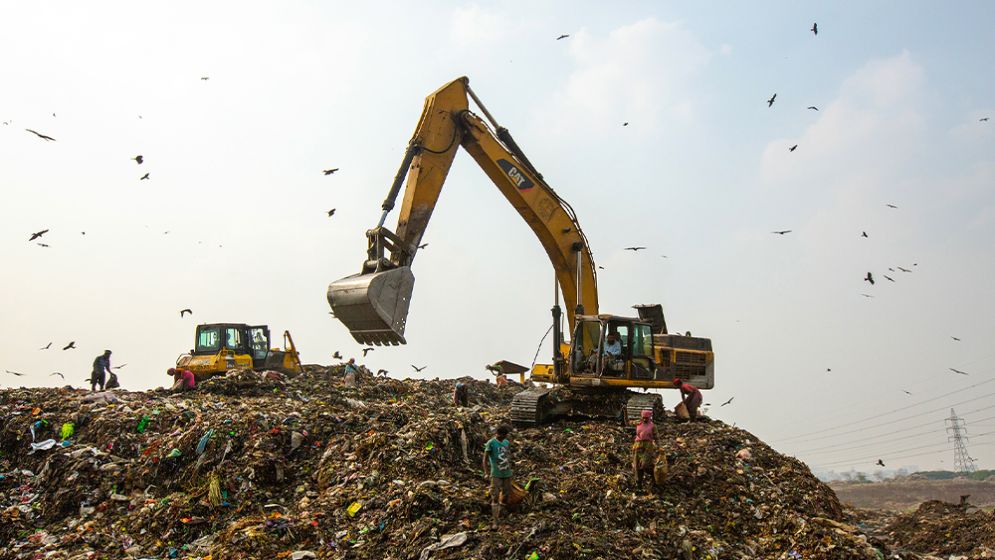
Photo : Collected
At the first Bangladesh Solar Expo 2026, opened on Tuesday by Prime Minister Tarique Rahman at the Bangladesh-China Friendship Conference Centre in Agargaon, one of the most visited exhibits is a finely detailed scale model of a waste-to-energy plant. Visitors stop to study it, and the question most often asked is a practical one: how soon can a plant like this be built in Bangladesh?
The answer is that the technology does work, and at a scale that is hard to argue with. Mass-burn waste-to-energy was developed in Europe in the 1970s, refined in Japan, and industrialised in China. Mainland China today operates more than 1,000 waste-to-energy plants with a combined capacity of about 1.1 million tonnes a day, more than half of the world's total incineration capacity. Around 95 percent of them use the same grate-furnace technology proposed for Aminbazar. As of 2023, 99.9 percent of urban household waste in China was being treated safely rather than dumped.
That record matters for one reason: this is not an experimental technology being tried out in Bangladesh. It is the standard municipal solution in dense Asian cities where land is scarce, waste is mixed at source and volumes keep rising. Modern plants are designed to meet the emission limits of the EU Industrial Emissions Directive (2010/75/EU), with flue gas cleaned of dioxins, acid gases, heavy metals and particulate matter before release. The technology has been proven at municipal scale for three decades.
WHAT AMINBAZAR LOOKS LIKE TODAY
The garbage mound at the Aminbazar landfill in Savar now rises about 90 feet above the ground. It ran out of capacity years ago, yet roughly 4,000 tonnes of waste still arrive every day. The site was built on 52 acres with Japanese support and opened in 2007, designed for 1,700 to 1,800 tonnes a day; it was saturated by 2017–2019, and satellite analysis by CEGIS showed it had spread to 73 acres by 2018.
It sits on a low floodplain at the confluence of the Turag and Karnatali, with no liner and no boundary wall. Leachate runs into the ground and the river: a 2022 study in Soil Systems recorded chemical oxygen demand in raw leachate at 1,343 to 10,400 mg per litre against a national industrial limit of 200 mg per litre. In the dry season, dissolved oxygen in the Turag falls to 0.4 mg per litre, against the 5 to 6 mg per litre fish need. About 85 percent of local water demand comes from the Dupi Tila aquifer, whose clay cap is thin here; shallow tubewells have yielded arsenic, iron, copper and nickel, and residents now drill to 350 feet or deeper.
71 to 72 percent of the waste is organic. Buried, it produces methane — NASA satellite data show Aminbazar releasing an average of 4.1 tonnes an hour, rising to 17.2 tonnes an hour in April 2023. Open burning in the dry season adds dioxins and fine particulates; a World Bank study attributes 11 percent of Dhaka's air pollution to open waste burning. About 1.4 million people live around the site, and in a National Defence College survey 85 percent described the dump as extremely dangerous to their health and lives.
WHAT THE PROJECT CHANGES
The government is building the 42.5 MW North Dhaka Waste-to-Energy Project at Aminbazar, with a target of grid supply by August 2028. The plant uses fully enclosed high-temperature combustion; flue gas is cleaned to EU standards before release. Power is the first dividend: up to 372 gigawatt-hours a year, and unlike solar and wind, it can be supplied around the clock. Burying less organic waste also ends the landfill methane that current practice generates.
Land is the second dividend. Bangladesh has among the lowest arable land per person in the world, and a filled dumpsite stays unusable for decades. The project is expected to free about 20 acres a year — roughly 500 acres over 25 years — for housing, green space and other productive uses.
Employment is the third dividend. Construction is expected to create about 2,000 direct jobs, and some 200 permanent skilled positions, with a training and resettlement programme planned for waste pickers.
THE OBJECTIONS, AND THE ANSWERS
Several environmental groups have objected. One claim is that the government would pay more than $50 million a year in capacity charges, as with coal plants. However, according to the project authority, no such payment exists: the plant earns only for power actually generated and supplied, and comparing it with a coal plant misstates the commercial model.
Another concern is combustion temperature, reduced from 1,000 to 850 degrees Celsius, and dioxin risk from wet waste. In response to these concerns, the project clarifies that the technical proposal submitted to the government in 2019 specified Chinese technology; the solid-waste rules were enacted after the project agreements and did not address plant-specific technical questions; 850 degrees Celsius is the internationally prevailing standard for waste-to-energy; and proven fly-ash treatment will be used so that harmful substances do not enter the environment.
Critics also say North Dhaka generates only about 2,700 tonnes a day, not enough to run the plant. The project authority, however, disputes this assessment, saying that figure is years out of date: about 4,000 tonnes now arrive daily, more than the plant needs.
On procurement, the project company maintains the first round was open bidding, and it won the second round through competitive negotiation against bidders from South Korea, Japan and India.
On oversight, it says officials of the Asian Infrastructure Investment Bank (AIIB) visit the site from time to time and have been on site on several occasions, and are satisfied with the project's environmental and social compliance; grievance mechanisms and public notices are in place; and residents oppose continued dumping and open burning and want the plant commissioned soon.
THE CONCLUSION
Dhaka's waste grows every day and will not disappear on its own. In land, environmental and public-health terms, open dumping at Aminbazar cannot continue. For a city with no spare land, no separation at source and 4,000 tonnes a day, waste-to-energy is not one option among many — it is the only proven option available now, and it has been proven in more than a thousand cities before this one.
A spokesperson for the North Dhaka WTE Project says: “The technology is not on trial here. It is running in more than a thousand plants across Asia and Europe, and it has been proven at municipal scale for three decades. Dhaka produces around 4,000 tonnes of waste a day and has nowhere left to put it. This plant turns that problem into electricity and into land.”