


 For all latest news, follow the Daily Sun's Google News channel.


Research initiative aims to strengthen air quality monitoring in underserved areas
Daily Sun Report, Dhaka
Published: 03 Nov 2026, 07:07 PM
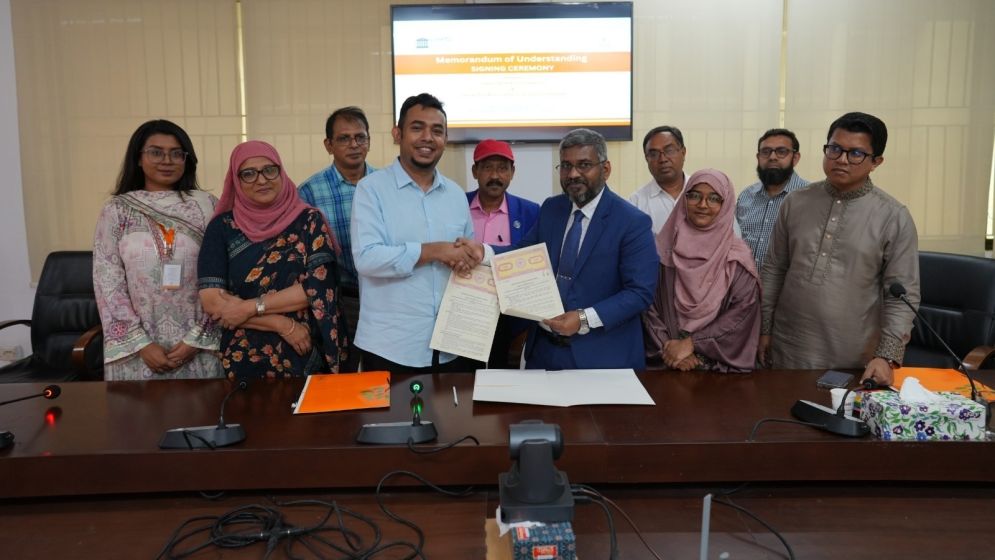
Photo: Courtesy
OBHIZATRIK Foundation, in collaboration with the Center for
Atmospheric Pollution Studies (CAPS), has launched an 18-month research project
aimed at strengthening community-level air pollution monitoring and improving
public access to reliable air quality information in Dhaka.
The project, “Breathing Dhaka: Open-Access Hyperlocal PM₂.₅
Monitoring in Dhaka’s Underserved Communities for Evidence-Based Air Quality
Policy,” is supported by the Air Quality Fund 2026 of the Energy Policy
Institute at the University of Chicago (EPIC).
The inception meeting of the initiative was held at the
Department of Environment (DoE), Poribesh Bhaban, Agargaon, Dhaka on Tuesday.
The meeting was attended by Dr Md Lutfor Rahman, director
general of the Department of Environment, as the chief guest, and Prof Dr ATM
Nurul Amin, emeritus professor of Urban Environmental Management, Department of
Development and Sustainability, as the special guest, and was chaired by Farid
Ahmed, deputy director of the Department of Environment.
Dr Md Lutfor Rahman emphasized the importance of
strengthening air quality monitoring initiatives to address the growing
challenges of air pollution in Dhaka. He expressed hope that collaborative
initiatives such as “Breathing Dhaka” would generate valuable evidence to
support effective air pollution management and contribute to improving the
city's air quality.
Ahmed Imtiaz Jami, president of OBHIZATRIK Foundation,
presented an overview of the project's objectives, implementation strategy, and
expected outcomes. Professor Dr Ahmad Kamruzzaman Majumder, chairman of CAPS
and technical lead of the project, presented the technical framework,
monitoring approach, and proposed implementation process.
Dr Mohammad Abdul Motalib, deputy director of the Air
Quality Management Division at the Department of Environment, emphasised the
importance of proper instrument calibration, post-collection data validation,
and community engagement to ensure reliable monitoring results and effective
project implementation. He also highlighted the need for behavioural change
initiatives to complement technological interventions in addressing air
pollution.
Ahmed Imtiaz Jami, president of OBHIZATRIK, said, his foundation
has been working with underserved communities, many of whom are
disproportionately exposed to environmental pollution and its associated health
risks.
“Through ‘Breathing Dhaka’, we aim to generate accessible,
community-level air quality information while strengthening collaboration with
government institutions, research organizations, and development partners. We
believe that reliable data, public awareness, community participation, and
behavioural change are essential to building healthier and more resilient
communities.”
Dr ATM Nurul Amin, while emphasising the importance of
connecting scientific research with practical action, said, scientific data
collection is essential, but meaningful research must go beyond monitoring. “We
must engage local communities and translate scientific evidence into effective
policies to ensure lasting impact.”
Professor Dr Ahmad Kamruzzaman Majumder presented the technical framework and monitoring approach. He said, “Breathing Dhaka” will establish eight PM₂.₅ monitoring stations in underserved and pollution-prone areas of Dhaka.