


 For all latest news, follow the Daily Sun's Google News channel.


How newspapers depict 7 Nov Sepoy-People's Revolution
Syed Abdal Ahmed, BSS
Published: 03 Nov 2026, 02:23 PM
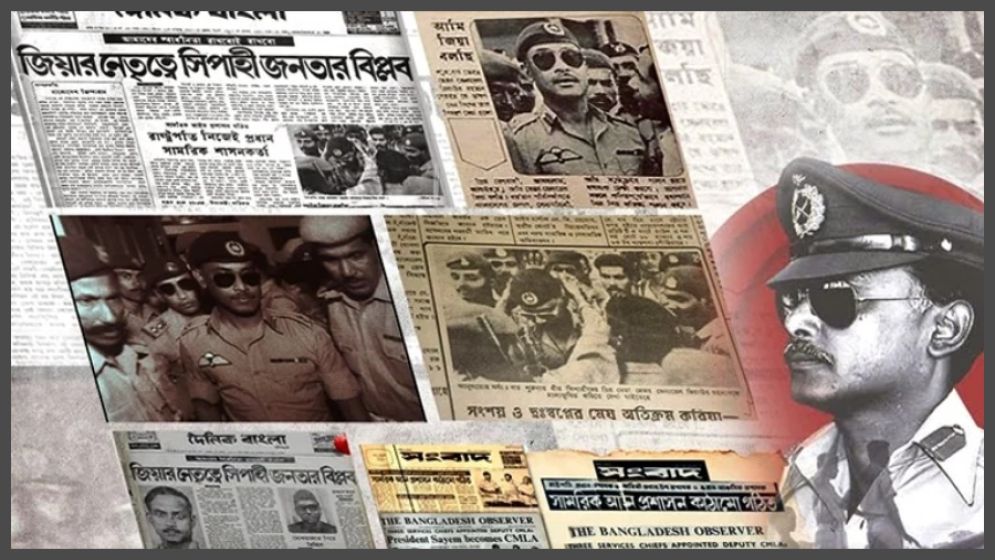
How newspapers depict 7 Nov Sepoy-People's Revolution. Photo: Collected
7 November marks the anniversary of the historic Sepoy-People's Revolution holding a unique place in Bangladesh's political history. On this day in 1975, patriotic sepoys and the people joined in a revolution. The revolution thwarted all conspiracies by hegemonic forces and consolidated the country's independence and sovereignty. 7 November therefore remains a prominent day in the nation's history as National Revolution and Solidarity Day.
Following the political upheaval of 1975, Bangladesh was effectively without a government on November 3, 4 and 5. During this period, conspirators kept Army Chief Major General Ziaur Rahman confined to his residence in the cantonment. But all their plots were foiled by the Sepoy-People's Revolution that took place on the night of November 6. Zia was released after four days in captivity. His voice was heard on the radio: 'This is Zia speaking.' In his address, he called on everyone to unite and work hard to move the country forward.
On November 7, Ziaur Rahman's brief, emotional and timely address swept across the country, stirring a wave of nationalism. During the Liberation War, Ziaur Rahman had also inspired hope among the people by declaring Bangladesh's independence. The same was true on November 7, 1975. Those who heard his announcement of the Sepoy-People's Revolution on the radio could never forget the experience. It was as though Bangladesh had been born anew that day. The scene of national unity and solidarity that emerged was, in a word, unprecedented. Newspaper accounts of that day remain living testimony to the events.
A report in the Daily Ittefaq: 'A City Overflowing with a Tide of Joy'
The report published in the Daily Ittefaq under the headline 'A City Overflowing with a Tide of Joy' stated:
'Darkness still hung over the sky. Dhaka was shaken by the sound of gunfire in the final hours of the night. The atmosphere was tense and suffocating. Every moment seemed endless. After a sleepless night, frightened city dwellers may have been thinking of those terrible days in Dhaka in 1971.
'At that moment, the announcer at Radio Bangladesh's Dhaka station proclaimed the slogan, "Long Live the Sepoy Revolution!" The anxious city dwellers listened intently. What message would the radio deliver at such an unusual hour? The announcer declared, "The Sepoy Revolution has succeeded. General Zia has been freed from the hands of reactionary forces. He will address the nation shortly."
'The announcement brought an end to four days of distressing nightmares. Before daybreak, people took to the streets, displaying fearless courage even in the face of intense gunfire. Army vehicles and tanks rumbled along the roads. Then came processions, one after another. The soldiers were greeted with jubilation and embraced wholeheartedly. The army became the people's army.
'The morning of November 7, 1975, resounded with the people's cries of triumph. The same scene unfolded not only in military vehicles but also in buses and trucks. An earnest appeal was made to preserve the country's sovereignty, accompanied by a plea for wholehearted public cooperation. On November 7, the joyful pulse of the people beat in unison with that of the sepoys.'
A report in the Daily Sangbad: 'Joyful Processions of People Across the Capital'
A report published in the Daily Sangbad under the headline 'Joyful Processions of People Across the Capital' said that Dhaka was a festive city on Friday, brimming with the joy of victory. At around 2am on Thursday night, Radio Bangladesh announced that Major General Ziaur Rahman, a leading figure in the struggle for independence, had assumed the responsibilities of Chief Martial Law Administrator of the People's Republic of Bangladesh and Chief of Army Staff. Immediately after the announcement, a spontaneous tide of hundreds of thousands of people poured onto the streets, their processions echoing with applause and slogans like a flood bursting its banks.
It was an indescribable and unprecedented spectacle. Along the city's roads and through its lanes, people welcomed the fearless sepoys of the army, who were safeguarding Bangladesh's independence, offering them flowers, garlands and heartfelt tributes. From late the previous night until well into the day, the army and the people merged into one, standing hand in hand and making the whole city resound with deafening slogans. The united voices of sepoys and civilians rang out with cries such as 'Long Live Bangladesh', 'Long Live Major General Ziaur Rahman', 'Long Live the Sepoy Revolution', 'Long Live Mushtaq Ahmed' and 'Sepoys and People Are Brothers'.
There were processions everywhere: processions of tanks, buses, trucks, jeeps and rickshaws, as well as crowds marching on foot. These were joint processions of the army and the people, bringing together people of all ages. Amid applause, qawwali, songs, marching bands and dancing, vehicles carrying sepoys and civilians travelled throughout the city. From time to time, army personnel fired celebratory shots into the air from their Sten rifles, further delighting people standing beside the roads, at their doors and windows, and on rooftops.
Wherever the brave sepoys passed, people of all ages greeted them warmly with flower garlands and raised hands. The soldiers did not simply tour the city in vehicles; they also visited residential colonies, neighbourhoods and local communities, embracing people and shaking hands with them in an atmosphere of Eid-like joy. Some offered the soldiers sweets and treated them with affection and hospitality.
It was an unprecedented display of unity between the people and the armed forces. Dhaka's streets had not witnessed processions of such scale and joy since December 16, 1971.
Students of Dhaka University, employees of offices and courts, workers from mills and factories, businesspeople and members of all sections of society also organised processions of joy and victory throughout Dhaka that day.
A report in the Daily Bangla on November 8: 'A Tide of Joyful People Flooded the Streets'
A report published in the Daily Bangla the following day, November 8, under the headline 'A Tide of Joyful People Flooded the Streets', described the scene:
'An unprecedented tide of people filled Dhaka with joy yesterday. Thousands took to the streets following the successful Sepoy-People's Revolution under the leadership of Major General Ziaur Rahman and after hearing Zia's voice on the radio.
'The Sepoy Revolution, which began late on Thursday night, reached its successful culmination through the spontaneous participation of people from all walks of life. Thousands of brave soldiers had emerged from their military barracks carrying the news of the revolution's success under General Zia's leadership. People from every section of society joined hands with them, declaring their wholehearted support. Together, they raised their voices in favour of the revolution.
'The celebrations began at dawn and continued throughout the day. Even after the sepoys returned to their barracks at around 2pm at General Zia's request, the people's celebrations continued. Through countless processions and public gatherings, people expressed their support for the revolution and extended their heartfelt congratulations to General Zia.'
Our staff reporters from different parts of Dhaka wrote the following accounts of the city the previous day:
From Rayerbazar, Jigatala, Dhanmondi, New Market, Elephant Road and Shahbagh, reports described how these areas had been crowded with people since the early hours of Friday morning. No one could be kept indoors. People came out spontaneously, including students, young people and the elderly. Small children and, in some places, women also joined the crowds.
Another extraordinary scene unfolded along the roads. Vehicles everywhere carried jubilant crowds of revolutionary sepoys and civilians. Open military vehicles, half-tracks and jeeps raced in every direction, while tanks rolled through the streets. Civilians rode alongside armed revolutionary sepoys. Everyone chanted slogans such as 'Long Live Bangladesh', 'Sepoys and People Are Brothers' and 'Long Live General Zia'. In an outpouring of exuberance, automatic weapons were fired into the air. Gunfire echoed through the streets, while the people's jubilant cries rang out across the city.
It was a scene reminiscent of December 1971, an unprecedented display of unity between the people and the armed forces. The same jubilation and slogans could be seen not only in military vehicles but also in civilian transport. Ordinary people and revolutionary army sepoys rode together.
Overjoyed by Major General Zia's triumphant return, the people of Dhaka spontaneously took to the streets in processions. On November 7, the morning was filled with deafening slogans from jubilant crowds travelling in trucks. Zia's voice, which had stirred the people of Bengal during the turbulent days of the struggle for independence, seemed once again to unleash a wave of excitement.
The Daily Ittefaq editorial: 'Independence, My Independence'
In its November 8 editorial titled 'Independence, My Independence', the Daily Ittefaq wrote:
'The message once again resounding through the loudspeakers following the massive, widespread and spontaneous uprising of soldiers and people on the morning of November 7 was none other than a powerful declaration to defend national independence and sovereignty. Whatever obstacles may arise, whatever adversities may appear, and however sharp the claws of the hyenas may be, an awakened people will not be intimidated. That is the message of the unprecedented uprising of November 7.
'If any force or group opposed to Bangladesh's independence and sovereignty believes that the temporary confusion prevailing in the country presents an ideal opportunity to undermine its independence and sovereignty through domestic conspiracies and destructive activities, we wish to make it unequivocally clear that this belief will prove entirely mistaken. Bengalis know not only how to win independence but also how to defend it.'
The Daily Sangbad editorial: 'The Pioneering Role of a Leader of the Liberation Struggle'
In an editorial titled 'The Pioneering Role of a Leader of the Liberation Struggle', the Daily Sangbad wrote that Ziaur Rahman, a heroic leader of the struggle for independence, had come forward at a moment of national crisis. His timely wisdom and determination had provided the nation with guidance to overcome the crisis and laid the foundations for a sound and clearly defined course of action at a time when the nation was uncertain and disoriented.
After the armed forces took power through the Sepoy Revolution on November 7, Major General Zia temporarily assumed the responsibilities of Chief Martial Law Administrator and Chief of Army Staff in the morning at the request of the people, the army, navy, air force, Bangladesh Rifles, police and Ansar. Alongside the measures taken to address the immediate crisis, he did not hesitate for a moment to play a lasting role in restoring normality to the administrative structure. Despite the people's love and congratulations, he did not become intoxicated with power, even for an instant, but remained a fearless soldier of the struggle for independence.
Major General Zia's name is firmly engraved in the hearts of the people of Bangladesh. After the nation was left stunned and bewildered on March 25, 1971, his voice was heard on the morning of March 26 over Swadhin Bangla Betar, inspiring the nation to continue its struggle. That day, the fearless soldier was among the first to issue a fervent call for the people to fight for independence. Responding to that call, people throughout the country joined hands with the patriotic and heroic soldiers of Bengal to achieve national liberation. The historic role played by Major General Zia, then Deputy Chief Martial Law Administrator, will remain indelibly etched in the nation's history.
The measures announced for governing the country made it clear that setting an example of noble ideals was what most inspired people to unite the entire nation in the interests of the country and for public welfare. Khondaker Mostaq Ahmed's address to the nation on the radio the previous day created the conditions for restoring a democratic social order. Despite spontaneous public demands that he resume the presidency, his decision to transfer power set a noble example that would deeply touch the hearts of the people of this country.
Peace is now the greatest desire of the people of Bangladesh, who have suffered so much turmoil. To achieve this longed-for peace, the most important requirement is to establish a deep sense of unity among workers and all other working people, intellectuals, the armed forces and people from every other sector of society.
The Daily Bangla editorial: 'Long Live Bangladesh'
In its November 8, 1975 issue, the Daily Bangla published an editorial titled 'Long Live Bangladesh', which stated:
'On Friday, a historic and unprecedented revolution began in the life of the nation. The joint revolution of sepoys and the people, led by the heroic figure of the Liberation War, Major General Ziaur Rahman, achieved a resounding victory.
'At the wish of the armed forces and the people, General Zia has temporarily assumed the responsibilities of Chief Martial Law Administrator alongside his duties as Army Chief. Along with the people of the country, the army, navy, air force, Bangladesh Rifles, police and Ansar have joined this historic revolutionary march. The unity between the sepoys and the people is so strong and seamless that it has no parallel. It can be compared only with those rare moments during the struggle for liberation.'
At daybreak on Friday, the streets of the capital, Dhaka, witnessed an extraordinary and unparalleled spectacle. Spontaneous mass processions filled the roads. Sepoys and civilians celebrated together, their cries of victory blending with waves of joyous voices. 'Long Live Bangladesh' rang out from the crowds. The entire capital, along with the rest of the country, was swept up in a shared feeling of patriotism.
Soldiers and civilians became one, touching one another's lives and hearts. The doubts that had long obscured the unity between soldiers and civilians gave way to a renewed sense of independence and patriotism.
This renewed rise of the nation's collective strength and the awakening of its revolutionary spirit once again demonstrated the independence of the Bengali nation. No conspiracy, whether driven by domestic or foreign reactionary interests, could undermine it. No one had the power to strike at or weaken Bangladesh's national sovereignty.
The fearless advance of patriotic soldiers, breaking through the deep darkness of midnight on November 6, conveyed an unwavering conviction and a firm pledge to this nation of 75 million people, a nation shaped by struggle. It also sent a message to the entire world.
After spending a sleepless night enduring several hours of confusion and unbearable anxiety, the people had waited anxiously and expectantly for the uncertainty to end. Their wait came to an end as the first rays of dawn dispelled the sudden darkness. The victorious footsteps of the vigilant soldiers of independence could then be heard on the streets.
Countless men and women immediately left their homes to celebrate the victory. The roads became a surging sea of people, and the city was filled with unending processions. Alongside the sounds of celebratory gunfire, the people's cries of joy filled the morning air. The clamour of countless voices and their eager, expectant cries tore apart the darkness that had suddenly plunged the nation into a state of despair and bewilderment.
The clear Friday sky and the bright morning, illuminated by the rays of a new sun, restored the nation's unshaken faith. They rekindled its unquenchable aspirations, hope and keen sense of self-awareness.
The forces of division and reaction have now been defeated. The dark clouds of doubt and uncertainty have lifted. Nevertheless, no one should become complacent. Lessons must be learnt anew from the disastrous consequences of past mistakes. We must take a fresh pledge to keep the inspiration of this unity alive at all times.
(The author is a veteran journalist and Principal Information Officer (PIO) of the Press Information Department). The article was written in Bengali which has been translated in English by BSS City Editor Harun Al Nasif)
(The author is veteran journalist, writer and Principal Information Officer (PIO) of Press Information Department)