


 For all latest news, follow the Daily Sun's Google News channel.


Dhaka WASA’s Padma water project faces Tk1,562cr loss allegations
Daily Sun Report, Dhaka
Published: 02 Nov 2026, 03:39 PM
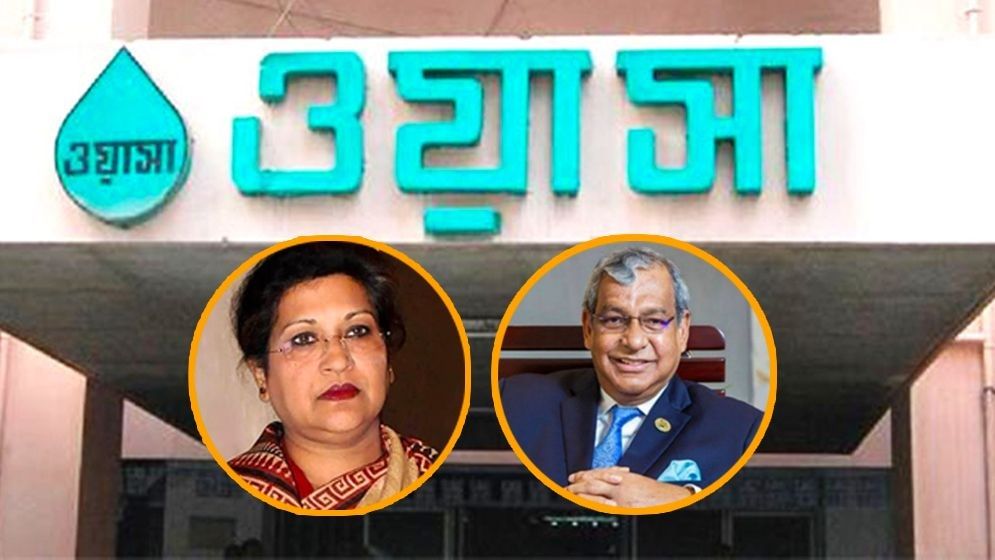
Dhaka WASA’s Padma water project faces Tk1,562cr loss allegations. Photo: Courtesy
Alleged irregularities in Dhaka WASA’s Padma (Jashaldia) Water Treatment Plant project may have caused financial losses of around Tk1,562 crore to the utility and the government, according to sources familiar with the project.
The alleged irregularities include the use of substandard pipes, failure to build a water supply network and payment of the contractor's final bill and security deposit without ensuring the promised water supply.
The allegations involve former prime minister Sheikh Hasina’s younger sister Sheikh Rehana, former Dhaka WASA managing director engineer Taqsem A Khan, project director Md Rafiqul Islam and Azizul Akil David, a Bangladesh representative and consultant for the Chinese contractor. Sources allege that they worked together to override technical objections, use inferior pipes and provide financial benefits to the contractor.
Tk1,562 crore in alleged losses
The project was undertaken to reduce pressure on groundwater resources by treating water from the Padma River at Jashaldia in Munshiganj and supplying it to Dhaka. Although the project cost around Tk4,000 crore, allegations have emerged that the infrastructure needed to ensure the expected water supply was never developed.
According to sources, around Tk500 crore was allegedly misappropriated in the purchase of pipes worth nearly Tk2,000 crore. The contractor also withdrew a security deposit of Tk360 crore despite WASA having to spend its own money to repair defects covered by the warranty.
Sources further said that a necessary water supply network, which could have been built at a cost of around Tk500 crore, was never constructed.
According to WASA's average production figures, the project has a daily water shortfall of 20 crore litres, around 44 per cent of its planned supply. Between 1 June 2019 and 24 October 2026, a period of 2,703 days, the cumulative shortfall amounted to 54,060 crore litres.
Assuming that 90 per cent of the missing water could have been sold to residential customers and the remaining 10 per cent to commercial customers, the potential revenue has been estimated at around Tk1,062 crore.
The calculation uses residential and commercial water tariffs of Tk16.70 and Tk46.20 per 1,000 litres respectively, effective from July 2024.
Adding the alleged Tk500 crore misappropriated in pipe purchases brings the total to Tk1,562 crore. However, this figure represents the estimated potential sales revenue from the missing water combined with the alleged misappropriation. It is not an audited figure of net financial losses.
Engineer removed after raising objections
Disputes over the quality of pipes supplied for the project began in 2014. On 9 October that year, project director engineer MA Rashid Siddiqui wrote to the contractor raising objections to the supply of K-9 ductile iron pipes.
Taqsem A Khan expressed his dissatisfaction in an email that night, copying deputy project director Rafiqul Islam and David.
Sources said Rashid Siddiqui was subsequently removed from the project and replaced by Rafiqul Islam.
They alleged that Rashid was replaced to conceal the purchase of cheaper, thinner pipes and that engineers considered loyal to the project leadership were later sent to China to inspect the supplies. They also claimed that the requirement to test the pipes at Bangladesh University of Engineering and Technology (BUET) after their arrival in the country was not followed.
Rashid Siddiqui said he was removed from his position because he refused to accept substandard pipes. Although the Anti-Corruption Commission (ACC) later took an initiative to test the pipes through BUET, the process was not completed.
He said the city’s residents and WASA were now bearing the consequences of implementing the project with inferior pipes through an abuse of power.
Pipes burst when five pumps were operated
Sources said pipes burst at two locations along the transmission line between the intake facility and the treatment plant when all five pumps were operated simultaneously to test the project's full capacity.
They claimed that water surged through the road surface and a wall of a building collapsed following the incident.
Although the damaged pipes were subsequently repaired, the project's capacity was never tested again with all five pumps running together, sources said.
The project's construction method also came under scrutiny. The project director proposed using unrefined soil-cement columns, but Bodo Gopart, team leader and contract specialist at Danish consultancy firm Grontmij, rejected the proposal, saying the method did not meet international standards.
According to sources, Taqsem became angry after the objections were raised. The consultancy subsequently withdrew its expert from the project.
Sources alleged that Taqsem, Rafiqul and David then proceeded with the project according to their own preferences.
Questions over Rafiqul and David's roles
Sources alleged that Rafiqul Islam played a significant role in concealing irregularities in the project and obstructing efforts to investigate them.
While Taqsem went into hiding after the July uprising, Rafiqul remained in his position before retiring recently.
Sources claimed that Rafiqul used financial inducements to retain his position and played a role in preventing an ACC investigation. They also alleged that members of his family lived in Murshidabad, India, where part of the money obtained through corruption had been invested.
David has also faced allegations of influencing contract-related activities and involvement in irregularities.
According to sources, he was a former president of the BUET unit of Bangladesh Chhatra League. They alleged that although he did not complete his studies at BUET, he introduced himself as an engineering expert and a BUET alumnus.
Sources said David, who once worked as a small-scale contractor, became a major businessman with support from Taqsem's close circle.
They also provided information about his alleged assets, including a duplex flat in Gulshan and a 4,000-square-foot office at Unique Heights, 117 Kazi Nazrul Islam Avenue.
Sources further alleged that David continued to run his business by paying various individuals under the current government. They described him as a businessman previously known for his close links to the Awami League who was now attempting to build connections with the BNP.
The same sources claimed that Taqsem, Rafiqul and David owned second homes in Malaysia and had invested money obtained through corruption there. They also alleged that Sheikh Rehana had laundered money to London.
No findings from investigations by the relevant authorities into these allegations have been made public.
Alleged pressure over consultancy appointment
Sources said Rafiqul Islam's wife and David were associated with National Design and Consultant Limited, which also had links to BUET Chhatra League leaders and engineers involved in Awami League politics, including former lawmaker engineer Md Abdus Sobur, who was elected using the boat symbol.
The firm carried out various works, including land filling, for WASA's Saidabad Project-2.
According to sources, Rafiqul had pressured the authorities to appoint David as a consultant to the Chinese contractor.
Asked about the allegations, David said the government was investigating the matter and that anyone found guilty should be punished. He declined to offer any further explanation.
Questions over investigation and accountability
Urban planner Professor Dr Adil Muhammed Khan said an unscrupulous network involving WASA officials, engineers, contractors and senior government figures had engaged in corruption worth hundreds of crores of taka.
He criticised the interim government for failing to ensure punishment for those responsible after the mass uprising and said the current government had also taken no significant initiative in this regard.
He said people accused of corruption continued to receive important postings, describing the situation as a state failure.
Those responsible must be punished, while the project must also be made to deliver the services it was designed to provide, he said. Despite the failure to secure the expected benefits, the government still has to repay instalments on foreign loans taken for the project, he added.
Former WASA board chairman engineer Dr Golam Mostafa said the board had repeatedly urged the authorities to undertake a project to build a water supply network to address shortages during the dry season.
Although funding was available, Taqsem A Khan did not seek the board's advice on the matter, he said. This raised questions about the project's construction quality, while a technical audit, although necessary, could not be conducted at the time.
Sources alleged that building the supply network would have exposed the project's failure to deliver the promised volume of water. They claimed that Taqsem had therefore obstructed the construction of the network.
Repeated phone calls and text messages seeking comment from Taqsem's personal number went unanswered. After the mass uprising, he submitted his resignation by email while in hiding. Sources said his whereabouts had remained unknown since then.
State Minister for Local Government, Rural Development and Cooperatives Mir Shahe Alam said irregularities, corruption and plundering had taken place in projects undertaken by the previous government.
A ministry committee had investigated the matter and sent its report to the ACC, he said. A detailed investigation by the commission would bring the irregularities to light, after which legal action would be taken against those responsible.
The current government would not spare anyone involved in corruption, he added.
Source: Bangla Edition