


 For all latest news, follow the Daily Sun's Google News channel.


Reclaiming footpaths could mark beginning of new horizon for economy
Special Correspondent
Published: 02 Nov 2026, 12:00 AM
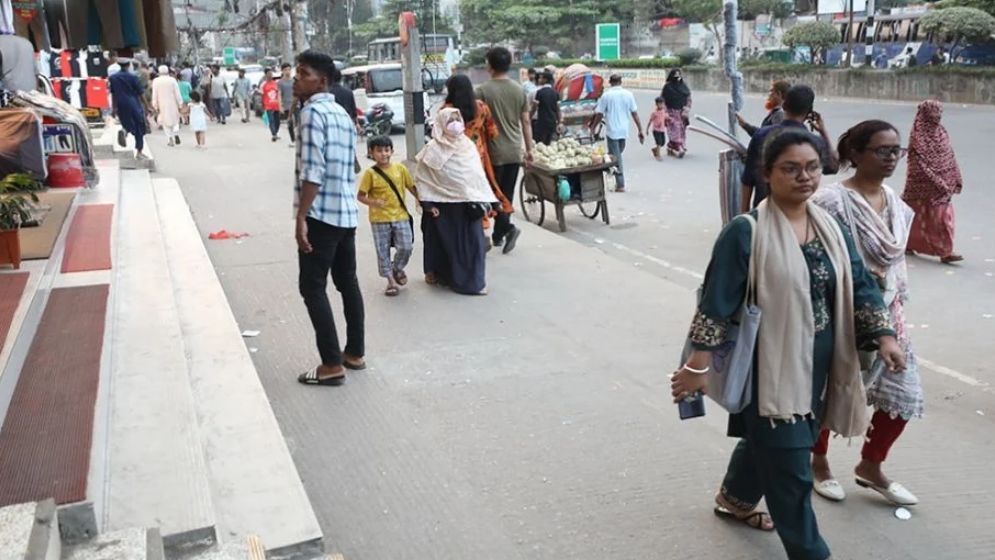
Pedestrians walk freely along a footpath at Mirpur-10 roundabout in the capital in October 2026 following the eviction of hawkers and makeshift shops from the area. Photo: Daily Sun
Karnaphuli Garden City Shopping Complex opened in the late 19th century in the capital’s Kakrail. Back then, this elite shopping mall attracted middle-to-upper-class shoppers looking to buy clothing, shoes, cosmetics, jewelry, and various other goods. However, over time, the mall began losing customers due to various reasons. Sales dropped so drastically that shop owners unanimously decided to close the complex permanently on 1 October.
The Karnaphuli Garden City Shopping Complex began its journey in 1998, spanning the basement and the first four floors of a 20-story building, with apartments occupying the remaining floors. A total of 125 merchants had purchased ownership of the 198 shops built by the Karnaphuli Group. Now, facing a lack of customers, the shop owners have unanimously agreed to shut down the shopping complex and sell off their ownership.
It is not just Karnaphuli Shopping Complex; many such shopping malls across the country, including Dhaka, are shutting down or on the verge of closure. Eastern Plaza, once an elite shopping mall in the capital, is now run-down and dilapidated, and could shut down at any time. Shopping malls like Eastern Mallika, Police Plaza, Rapa Plaza, Shimanto Square, Hosaf Tower, Mouchak Market, Shah Ali Market in Mirpur-10, and Century Arcade are now virtually customer-free. Shopkeepers in these malls are facing mounting losses day by day and are also contemplating shutting down their shops.
These shopping malls were originally developed targeting the middle and lower-middle classes. However, these shoppers are now heading to the footpaths. Consumers state that products of almost identical or comparable quality are now available on the footpaths at relatively lower prices. As a result, they are opting for footpath hawkers instead of shopping malls. Everyone knows the reason why the same product is cheaper on the footpaths than in shopping malls: a street hawker does not have to pay shop rent, electricity bills, VAT, or taxes. Consequently, product prices on footpaths are naturally much lower than in shopping malls. Moreover, these street stalls lack legal authorization and accountability. There are also allegations of consumers being defrauded with low-quality goods at these stalls. As a result, while buyers may reap short-term savings, the overall economy of the country ultimately pays the price. When a street hawker pays no income tax or VAT, the government loses thousands of crores of taka. The burden of this loss falls back on the very consumer buying low-cost products from the footpath.
The stalls occupying Bangladesh’s footpaths are entirely illegal, operating without relevant laws or policies. Hawkers set up shop on footpaths across Dhaka and other parts of the country through a tripartite collusion involving the hawkers themselves, local influential figures or musclemen with political backing, and the law enforcement agencies. These hawkers run their businesses by paying monthly bribes to local influencers and law enforcement agencies. While their businesses function, public suffering increases. Unable to walk on footpaths, pedestrians are forced onto the roads, creating traffic congestion. The economic loss caused by traffic congestion in Bangladesh is among the highest in the world. Unplanned hawking also destroys the aesthetic beauty of cities, and in some areas, hawkers become a catalyst for deteriorating law and order.
Recently, administrators of the two Dhaka city corporations have taken steps to bring hawkers under a structured system, launching a bold initiative to reclaim footpaths. Hawkers have already been cleared from areas like Mirpur, Uttara, and New Market, and plans are underway to free footpaths in other neighborhoods.
Last Saturday, Dhaka South City Corporation (DSCC) conducted an eviction drive to free the footpaths in front of New Market in the capital. To prevent hawkers from returning, the agency planted over a hundred tree saplings along the footpaths. Meanwhile, the drive has transformed Mirpur-10: following last month’s operation, the area around the Mirpur-10 roundabout and adjacent footpaths looks completely different. The long-standing congestion is gone, allowing pedestrians to walk cleanly, comfortably, and without hindrance. If all footpaths can be reclaimed in this manner, traffic congestion in Dhaka city will decline, urban beauty will enhance, and public suffering will decrease.
Last April, Prime Minister Tarique Rahman directed relevant authorities to arrange alternative employment for hawkers. Following the Prime Minister’s directive, efforts are now underway to relocate hawkers from footpaths and establish alternative arrangements.
In the past, we have seen similar eviction drives conducted, only for hawkers to return within days through compromise deals with local political leaders. To prevent a recurrence, the city corporation has implemented several measures. The Dhaka North City Corporation (DNCC) is searching for alternative sites to rehabilitate evicted hawkers. Once suitable locations are identified, the agency plans to allow hawkers to conduct business regularly during specified hours. Considering the hawkers’ livelihoods, both city corporations have initiated steps to arrange dedicated spaces where businesses can operate under city corporation supervision. The DNCC noted that allowing hawkers to operate only two days a week at holiday markets might make sustaining their livelihoods difficult. Therefore, allocating dedicated spaces for regular business operations is under consideration potentially between late afternoon and 11pm. These will strictly be designated open plots, not roads, as using roads will not be permitted. If necessary, boundary walls could be built around the designated spaces. During rehabilitation, the DNCC must also ensure that external groups cannot illegally collect extortion money from the hawkers, though a fixed government fee may be collected from them.
According to government statistics, there are over six hundred thousand hawkers nationwide, with nearly four hundred thousand operating in Dhaka city alone. Of these, only 130,000 are members of hawker associations, while the remaining 270,000 are mobile hawkers. However, according to our information, the actual number of hawkers across the country is no less than two million. Currently, the extortion money hawkers pay to various groups does not reach the government treasury. But once a complete list of hawkers is prepared and they are assigned designated locations, the fees they pay will go directly to the government. This will increase government revenue and benefit the national economy. Hawkers will also gain legal recognition for their businesses, bringing the quality of their products under accountability. Consequently, unfair competition between shopping malls and street hawkers will cease.
Several countries worldwide, including the United Kingdom, Singapore, and Thailand, faced similar hawker-related challenges in the past. They successfully resolved these issues by bringing hawkers under a structured system and effective management framework.
Thailand has done extensive work regarding hawkers. Its capital, Bangkok, was once severely disrupted by street hawkers, leading to daily traffic gridlocks and harming the country’s tourism-dependent economy. Hawkers set up shop wherever they pleased by bribing police and local influential figures. Tourists faced various forms of harassment, and crime occurred. Because hawkers were unregistered, taking action against them was difficult – they would simply move to another spot after committing a crime. This posed a serious threat to Thailand’s tourism sector. Under these circumstances, the government initiated targeted interventions, starting with creating a complete inventory of all hawkers in Bangkok. Registration was made mandatory, and government-issued identification cards were distributed. Designated zones, specific spots, and set operating hours were established for registered hawkers. A monthly government fee of 100 Baht was initially fixed for hawkers (which has now risen to 1,500 Baht per month). In this way, Thailand brought hawkers into an institutional framework while providing them opportunities to increase their earnings. Establishing fixed operating hours resolved traffic congestion issues. Today, Thailand’s street markets are major tourist attractions, and many have adopted hawking as a formal profession. Thailand’s hawker rehabilitation program stands as a prime example of how proper planning and execution can transform a problem into a promising economic sector. Today, many countries have launched street food hubs and night markets to attract tourists; Singapore’s night markets, for instance, are now a major draw for visitors.
Therefore, the hawker issue in Bangladesh is not an isolated challenge. Various countries across the globe have successfully resolved this problem.
If the government brings all hawkers under a registration system, an accurate registry can be created. The city corporation could charge a one-time registration fee, such as Tk1,000, which hawkers would readily accept. The government can allocate specific locations across Dhaka city with fixed hours and assigned spots. In return, the government or city corporation can collect a set service charge, which hawkers will gladly pay provided the government eliminates extortion by law enforcement agencies and influential figures. In this way, instead of evicting hawkers, they can be integrated into a disciplined employment framework. This initiative will boost employment, raise government revenue, and prevent shopping malls like Karnaphuli Garden City from closing due to unfair competition, while curbing extortion. Re-establishing discipline among hawkers and ending illegal footpath occupation will ultimately elevate our economy, environment, and quality of life.