


 For all latest news, follow the Daily Sun's Google News channel.


CPD urges four reforms by 2029 for smooth LDC exit
Daily Sun Report, Dhaka
Published: 02 Nov 2026, 12:00 AM
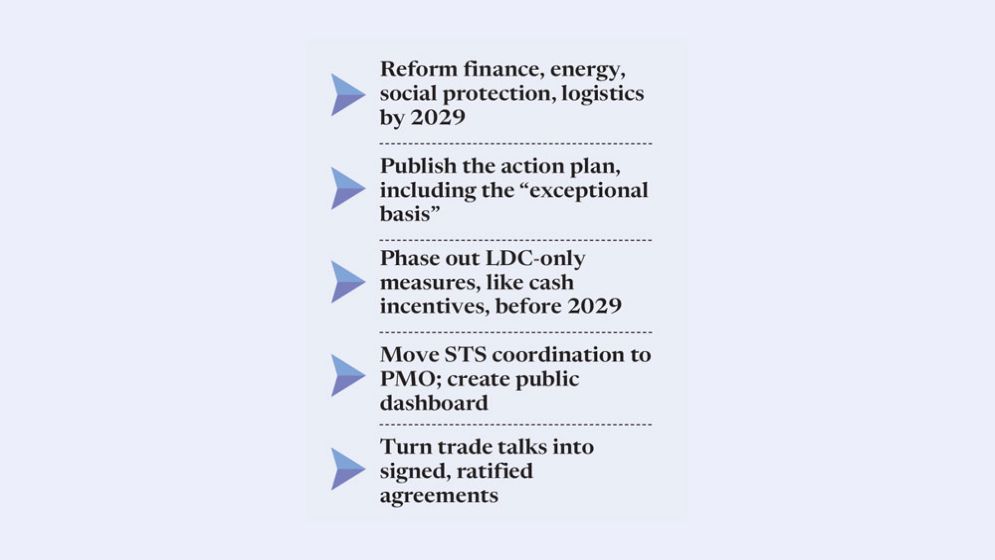
The Centre for Policy Dialogue (CPD) on Sunday urged the government to reform public financial management, energy, social protection and logistics within three years to secure a smooth, sustainable and irreversible graduation from the least developed country (LDC) category.
The think-tank also called for action on graduation preparedness, macroeconomic stabilisation, and an investment and growth turnaround.
CPD Distinguished Fellow Debapriya Bhattacharya, a ranking member of the UN Committee for Development Policy (CDP), presented the recommendations at a media dialogue on “Bangladesh’s LDC Graduation: The UNGA Decision and Our Observations” in Dhaka. CPD Executive Director Dr Nazneen Ahmed moderated.
Welcoming the extension to 24 November 2029, Debapriya called it exceptional but no relaxation of reform requirements, adding the CDP would not support another.
“An exceptional decision demands exceptional performance,” he said. “If the reforms are not completed, the country’s credibility will be called into question.”
He said reforms in the four sectors would make export diversification beyond ready-made garments (RMG) possible and raise productivity and competitiveness.
The government’s press note, he said, was incomplete, omitting the “exceptional basis” and reform expectation; he urged publication of the action plan. He recommended identifying every measure available only to LDCs, such as export cash incentives, and phasing each out before November 2029.
Debapriya said the Smooth Transition Strategy (STS) needed a clear reform pathway. Bangladesh, he noted, was better at drafting commitments than delivering them, the final STS having come only in 2025.
He proposed moving STS coordination from the Economic Relations Division to the Prime Minister’s Office, engaging Parliament and creating a public dashboard backed by better process and outcome data.
Citing the challenges, he said the tax revenue-to-GDP ratio stood at 6.9% in FY2025-26, while non-performing loans made up 32.8% of outstanding loans as of June 2026. Private investment was 21.5% of GDP, and RMG accounted for 80.6% of exports. These figures underscored the urgency of banking sector restructuring, revenue mobilisation, investment promotion and diversification.
Most deals with other countries remained at an early stage, he said, and the next three years must turn talks into signed and ratified agreements, with fiscal and budgetary measures supporting diversification.
CPD Distinguished Fellow Professor Mustafizur Rahman said graduation should be treated “as a catalyst for Bangladesh’s structural transformation and long-term development”, not merely three more years of market access. The focus, he said, must be on making the transition sustainable beyond 2029. He called for an inclusive process bringing in small businesses, entrepreneurs and investors rather than one driven solely by large business, with a strong, accountable coordination and monitoring framework at the highest level.
Institutions such as the BBS must also strengthen statistical capacity, he said, as “what cannot be measured cannot be effectively monitored”.
CPD Additional Director (Research) Towfiqul Islam Khan, presenting a Reform Tracker assessment, said the think-tank was monitoring 23 graduation-related reform proposals. Six were at the proposal stage, nine had been initiated, two had reached legal and policy measures and six were at operationalisation; none had reached action implementation.
The tracker flagged challenges including securing preferential market access after graduation, implementing trade agreements, improving labour standards, strengthening logistics and ensuring industrial facilities operate effectively. It stressed the need to expedite trade negotiations with the European Union, Japan, South Korea, India and China, alongside Bangladesh’s bid to join the Regional Comprehensive Economic Partnership (RCEP).