


 For all latest news, follow the Daily Sun's Google News channel.


DU, Stockholm University hold dialogue on air pollution
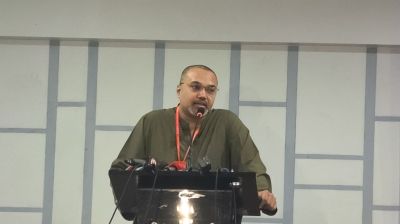
Prime Minister's Adviser Mahdi Amin said the government was prioritising renewable energy to address the ongoing energy crisis
Daily Sun Report, DU
Published: 01 Nov 2026, 05:40 PM
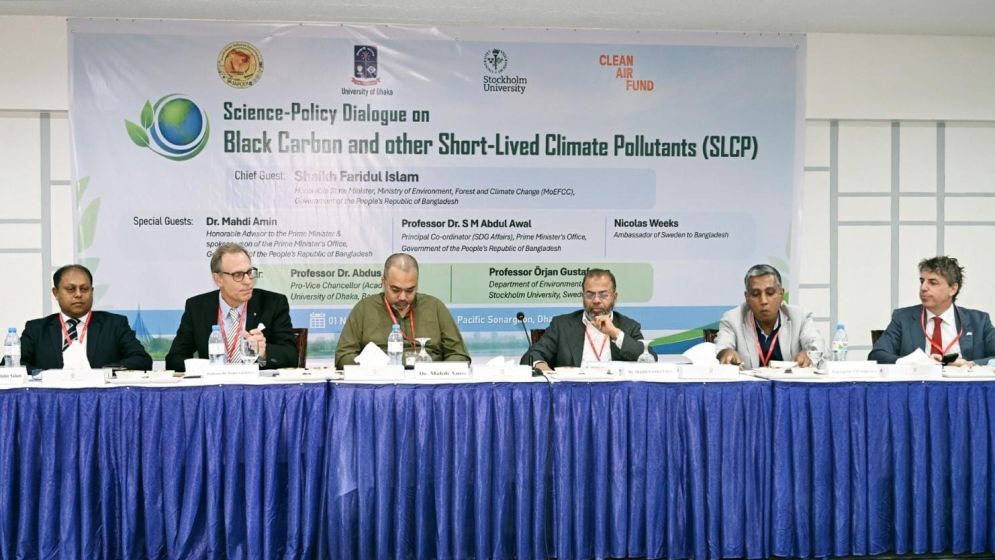
Photo: Daily Sun
The University of Dhaka (DU) and Stockholm University of Sweden, in collaboration with the Clean Air Fund, organised a high-level science-policy dialogue on black carbon and other short-lived climate pollutants (SLCPs) on Sunday.
The dialogue focused on ways to reduce emissions and
strengthen air quality management in Bangladesh.
The dialogue took place at the Pan Pacific Sonargaon
Hotel, with DU Pro-Vice-Chancellor (Academic) Prof Abdus Salam presiding over
the programme.
State Minister for Environment, Forest and Climate
Change Shaikh Faridul Islam attended the inaugural session as the chief guest,
while Prime Minister's Adviser and spokesperson for the Prime Minister's Office
Mahdi Amin, Principal Coordinator (SDG Affairs) at the Prime Minister's Office
Prof SM Abdul Awal, Swedish Ambassador to Bangladesh Nicolas Weeks and
Stockholm University Prof Orjan Gustafsson attended as special guests.
Addressing the programme, State Minister Shaikh
Faridul Islam said the government planned to generate 4,000 megawatts (MW) of
solar power within the next three months, including 296 MW from Dhaka city
alone.
"The initial target is to generate 10,000 MW of
solar power," he said, adding that the government would gradually expand
solar power generation capacity to reduce dependence on fossil fuels and
accelerate the transition to clean and green energy.
He said the current administration had inherited
substantial dirty energy infrastructure, including coal-fired power plants,
from the previous government. These plants burn approximately 12,000 tonnes of
coal every day, indicating the scale of black carbon emissions, he added.
Speaking about measures to tackle pollution from
brick kilns, the state minister said they account for around 13% of the
country's total air pollution, partly because many of them use high-sulphur
coal.
The government is also shutting down 200
wood-burning kilns across the country and replacing them with concrete block
production facilities to reduce pollution, he said.
"By adopting concrete block production, we can
effectively work towards making our air pollution-free," he added, noting
that the transition would eliminate smoke emissions, leaving only minimal noise
pollution.
Prime Minister's Adviser Mahdi Amin said the
government was prioritising renewable energy to address the ongoing energy
crisis, as previous policies had left the country's energy sector vulnerable.
"To overcome this situation, we aim to
diversify our energy sources. The government is prioritising renewable energy,
with a particular focus on solar power. Additionally, projects for generating
energy from waste are currently underway," he said.
He added that reducing dependence on fossil fuels
and promoting environmentally friendly transport, particularly electric
vehicles, were among the government's key priorities.
Referring to the canal-digging programme initiated
by Shaheed President Ziaur Rahman and the introduction of environment-friendly
CNG-powered vehicles during Begum Khaleda Zia's tenure, Mahdi Amin said the BNP
had a history of formulating policies to strengthen climate resilience.
He also mentioned that the BNP government had taken
initiatives to ban plastic and polythene while promoting jute-based and other
environmentally friendly products.
The previous BNP governments also organised
tree-planting campaigns and tree fairs at weekly, monthly and annual levels, he
said, adding that the government now wanted to revive and further develop that
culture.
"We all aspire to build a Bangladesh where
nature is not destroyed in the name of development, but rather preserved. We intend
to undertake projects and development initiatives that prioritise environmental
conservation," he said.
He stressed the importance of maintaining a balance
between human life, nature and the environment to ensure a sustainable future
for the next generations.
"We envision a Bangladesh where future
generations can breathe clean, fresh air. To achieve this, we must prioritise
eco-friendly initiatives as part of our comprehensive, multi-faceted
planning," he added.
Referring to the BNP's election manifesto, he said
the party planned to construct reservoirs through master plans for the Padma
and Teesta barrages to maintain the natural flow of water and improve water
resource management.
In his remarks, DU Pro-Vice-Chancellor (Academic)
Prof Abdus Salam said black carbon consisted of tiny particles suspended in the
atmosphere, produced by the incomplete combustion of fossil fuels such as
diesel, petrol and octane, as well as biomass.
He explained that black carbon absorbs solar
radiation and heats the Earth's surface, contributing to climate change and
environmental degradation.
Prof Salam said Bangladesh had made progress in
reducing black carbon emissions through previous policy interventions,
including restrictions on benzene.
He said black carbon concentrations in the
atmosphere had declined from around 40 micrograms per cubic metre in the past
to between 6 and 12 micrograms per cubic metre in recent measurements.
However, the level remained significantly higher
than in developed countries, where concentrations ranged from 0.1 to 2.5
micrograms per cubic metre, he said.
"Although we have reduced black carbon
significantly, we still need strong measures to bring it down further," he
added.
Prof Salam said both fossil fuel combustion and
biomass burning contributed significantly to black carbon emissions,
particularly in Dhaka. Transboundary pollution also played an important role in
Bangladesh's air pollution, alongside several other sources.
He called for stronger policy implementation,
cleaner transport systems, cleaner household energy, improved industrial and
construction management, regional cooperation and better monitoring of
long-range air pollution.
His recommendations included enforcing emission
standards for vehicles and industries, promoting clean energy and public
transport, regulating construction activities, developing green infrastructure
and increasing funding and institutional capacity for air quality management.
He also stressed the need for regional collaboration
to address transboundary pollution.
Swedish Ambassador to Bangladesh Nicolas Weeks said
Sweden's new five-year development cooperation strategy with Bangladesh placed
significant emphasis on green transition, climate resilience and
environmentally sustainable growth.
He said the strategy reflected Sweden's belief that
economic development and environmental sustainability should progress together
rather than as separate priorities.
"There is significant potential for future
cooperation between our two countries," he said, stressing the importance
of joint scientific research and stronger partnerships.
He added that stronger collaboration could generate
better ideas and produce more effective outcomes, expressing his hope for
deeper cooperation between Bangladesh and Sweden in the upcoming years.