



 For all latest news, follow the Daily Sun's Google News channel.


No board-level rule bars students who fail selection tests from sitting the HSC examinations, leaving each college to decide for itself. In many institutions, particularly small rural ones, almost every student is allowed to sit regardless of the test result.
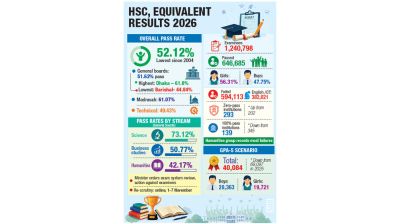
This year, with answer scripts marked to standard, the results have exposed the consequences, with the national pass rate falling to 52.12%, the lowest since 2004.
Practice varies widely. Some colleges do not allow students who fail the selection test to fill out examination forms, while others permit those who fail in up to three subjects.
No board rule requires colleges to hold remedial classes, or to give weak students another chance to improve before the final examinations.
Education boards confirm the gap
Professor Sharif Morshed Reza, controller of examinations of the Barishal Board of Intermediate and Secondary Education, said there was no uniform practice among colleges.
“If selection tests are conducted properly, students can identify their weaknesses and get an opportunity to prepare before the final examinations. However, many institutions are now facing a shortage of students. Some colleges do not even have enough students. So, they make decisions after considering various factors,” he said.
Professor Syed Aktaruzzaman, chairman of the Dhaka Board of Intermediate and Secondary Education and president of the Inter-Education Board Coordination Committee, told the Daily Sun: “Generally, well-established colleges do not allow students who fail the selection test to fill out their examination forms. However, many colleges in rural areas, particularly those with a small number of students, allow almost all students to fill out the forms, regardless of whether they pass or fail. So, we cannot judge the overall quality of the education system or the validity of selection tests solely based on their results.”
A case in point
At Sonagazi Government College in Feni, only 101 of 407 candidates passed this year’s HSC examination, a pass rate of 24%. The college has 591 students, of whom only 24 passed every subject in the selection test: six from science, 16 from humanities and two from business studies. Many of those who failed one or more subjects were allowed to fill out their forms on special consideration.
Principal Reza Md Enamul Haq Chowdhury said the college had arranged free special classes, taught by its own teachers and funded by the institution, for students who failed the selection test and were weak in English and ICT.
“Only 37 to 38 students regularly attended the special classes. They were among those who eventually passed the HSC examinations. Those who did not attend the classes failed to pass. We even asked them to attend, but they did not come,” he said.
He said a large number of students had lost interest in their studies, and many did not attend classes regularly or pay adequate attention.
“We allowed some students to fill out their examination forms on special consideration. Had we allowed everyone to do so, the college’s pass rate would have been even lower. Besides, a significant number of students do not sit for the examinations for various reasons or leave their studies for other pursuits,” he said.
‘Weak students need feedback, special classes and remedial education’
Professor Mohammad Mojibur Rahman of the Institute of Education and Research (IER) at Dhaka University said this year’s results had served as a diagnosis of the education system, exposing its fragility and weaknesses.
“The main purpose of pre-test and selection examinations is not merely to determine whether students pass or fail but to identify their weaknesses and gaps in skills. Once these gaps are identified, students should receive proper feedback, special classes and remedial education,” he said.
“Failing in one subject should not deprive a student of the opportunity to sit for the board examination. Instead, colleges should give students two to three months to overcome their weaknesses through special classes and other support. Such initiatives should not be left to the discretion of individual institutions; they need to be brought under a specific policy.”
“For a long time, our education system has been operating without a specific education policy. The government should take urgent steps to formulate and implement an effective policy. Otherwise, the education system may face an even deeper crisis,” he added.