



 For all latest news, follow the Daily Sun's Google News channel.


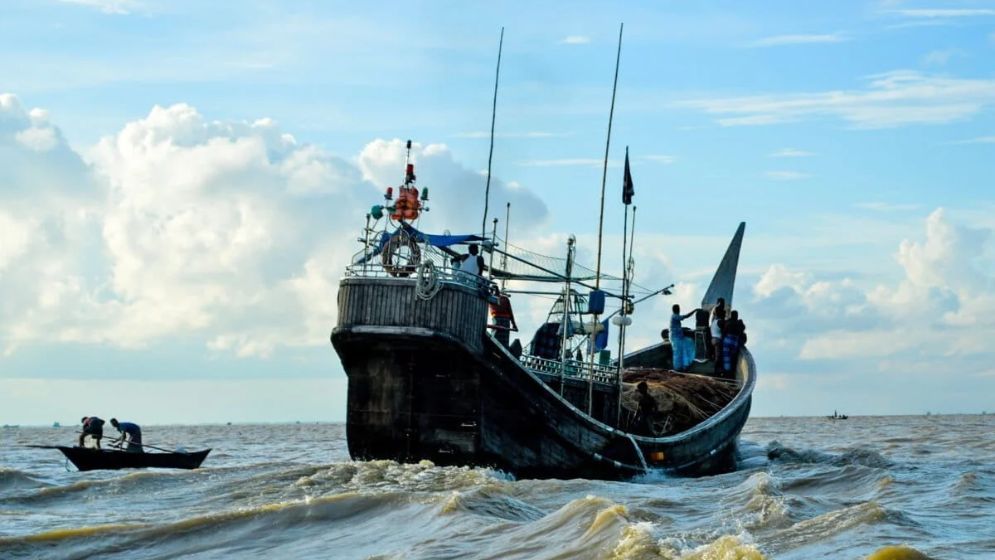
Representational Image.
Fishermen have returned to the Bay of Bengal in large numbers after the end of the 22-day ban, which was imposed to protect mother hilsa during their breeding season.
Thousands of
fishermen have resumed fishing, hoping for good catches of the prized silver
fish. Fishing boats are now moving across the 160-kilometre stretch of the Bay
of Bengal.
The first catches
have already begun arriving at riverside fish depots, bringing them back to
life after weeks of inactivity. Fresh hilsa, along with pangas and other fish,
are being brought ashore in plastic trays, and auctioneers' calls once again
fill the fish landing centres.
Traders and workers,
who remained largely idle during the three-week ban, are now busy buying and
selling fish at the city's Fringi Bazar fish market. However, hilsa prices have
remained almost unchanged, and larger fish continue to sell at pre-ban rates.
Fishing and trading
activity was witnessed firsthand today between 7:00am and 11:00am at the city's
Fisherighat. Many fishermen ventured into the Bay of Bengal after midnight on
Thursday, and their boats began arriving at the ghat, adjacent to the Kotwali
area, at daybreak.
There are around 80
small and large hilsa arat depots at the ghat. Fishermen bring their catches to
these arat depots, where the fish are auctioned and sold within a short time.
Very little fish is preserved for later sale.
Two categories of
traders buy fresh hilsa from the landing centre: local retailers, who sell the
fish at Fisherighat, and wholesale traders, who transport it to different
upazilas.
Md Harun, a
fisherman from Banskhali village near the ghat, said he went fishing at night
and sold hilsa worth Tk12,800 at dawn.
"If we can
continue to catch hilsa like this, we will be able to repay our debts within a
few days," he said, expressing hope that hilsa would remain available
throughout the rest of the season.
Another fisherman,
Jahirul Islam, said 11 fishermen went out at midnight and sold their catch for
Tk27,000. They planned to return to the river after a short break. He
cautioned, however, that hilsa availability might decline within the next few
days.
Depot owner
Salauddin said hilsa prices were unlikely to fall soon because demand remained
high. A one-kilogram hilsa is selling at Tk2,000 to Tk2,200, while fish weighing
400 to 500 grams sell at Tk1,000 to Tk1,200 per kilogram. Smaller hilsa weighing
200 to 300 grams sell at Tk400 to Tk500 per kilogram, he said.
He added that some fishermen were also catching pangas alongside hilsa. Large pangas are selling at Tk1,000 per kilogram, while smaller ones fetch Tk700 to Tk800.
Salauddin said
prices may decline if catches increase in the coming days.
Another depot owner,
Md Abdur Rahim, said fish started arriving at the ghat this morning. The actual
trend in arrivals would become clearer by today and tomorrow, he said, as in previous
years the volume declined after the initial two days.
Arat owner Abdul
Jalil said larger hilsa were arriving in greater numbers after the ban, while
the supply of smaller fish remained very low. Although hilsa catches were still
limited, fishermen were able to recover some of their losses by catching pangas
alongside hilsa, he said.
Veteran fish trader
Nurul Islam said the rivers used to be abundant with hilsa at this time of
year. He regretted that enforcement drives had not produced the expected
results, as some fishermen continued to catch mother hilsa.
Moshiur Rahman,
Assistant Director of Marine Fisheries, Chattogram, told BSS that fishermen
were now benefiting from the strict implementation of two drives aimed at
protecting hilsa. One is a ban on catching juvenile hilsa (jatka) from 1 November
to 30 June. The other is a directive not to catch mother hilsa in November next
year, he added.