


 For all latest news, follow the Daily Sun's Google News channel.


Experts highlight progress, next steps for plastic circularity
Mohammad Navid Safiullah, secretary in routine charge at the Ministry of Environment, Forest and Climate Change, attended as chief guest
Daily Sun Report, Dhaka
Published: 29 Oct 2026, 07:22 PM
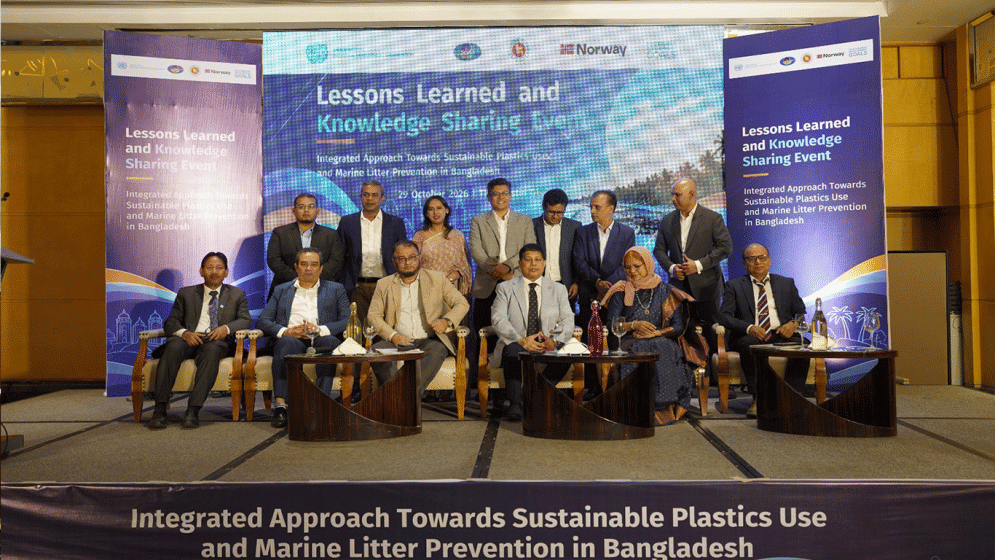
Photo: Daily Sun
Speakers at a knowledge sharing event in the capital on Thursday said sustaining progress on plastic pollution requires effective producer responsibility, stronger recycling systems and continued investment in industry skills.
Organised by the Department of Environment (DoE) and
the United Nations Industrial Development Organization (UNIDO), the event
marked the conclusion of the “Integrated Approach Towards Sustainable Plastics
Use and Marine Litter Prevention in Bangladesh” project, supported by the
Government of Norway.
Held at The Westin Dhaka, the gathering brought
together government officials, industry representatives, recycling
entrepreneurs and development partners to review achievements and identify
priorities for carrying the work forward.
Mohammad Navid Safiullah, secretary in routine
charge at the Ministry of Environment, Forest and Climate Change, attended as
chief guest. The event was chaired by Dr Md Lutfor Rahman, director general of
Department of Environment. Special Guests included Dr Nurun Nahar, additional secretary
of the ministry, and Alamgir Hossain, country representative of UNIDO
Bangladesh.
Plastic waste places pressure on Bangladesh’s
drainage systems, rivers and coastal ecosystems, while discarded materials
represent a loss of resources for industry. The project addressed these
challenges through connected interventions in policy, consumer behaviour,
industrial production and recycling.
In his welcome address, Dr Abdullah Al Mamun,
project director and deputy director of DoE, outlined work undertaken through
nationwide assessments, more than 60 cleanup campaigns, industrial assessments
and collaboration with recyclers.
He emphasised that the introduction of Extended
Producer Responsibility (EPR) must now be followed by effective implementation.
Presenting the project’s implementation journey, Dr
Rana Pratap Singh, project manager, UNIDO Vienna, highlighted support for EPR
policy development, public awareness and practical improvements in industry. He
reported online awareness reach of approximately 10 million and in-person
engagement of around 50,000 people, including through school and university
activities.
Singh also highlighted the financial value of
Resource Efficient and Cleaner Production (RECP), noting savings achieved
through its application. He described cooperation with health authorities and
local agencies in establishing the biomedical waste management intervention in
Sirajganj, illustrating the importance of coordination across institutions.
The project’s industry work combined RECP with
Design for Environment (DfE), helping participating businesses examine how
resources are used during production and how products can be designed to reduce
environmental impacts. These approaches connect waste prevention within
factories with the longer-term recovery and recycling of materials.
Alamgir Hossain described the initiative as a
flagship programme for UNIDO in Bangladesh. He noted feedback from industry
that RECP and DfE training had supported the development of new products,
demonstrating the practical value of technical capacity building. He also
expressed UNIDO’s interest in continued cooperation with the Government on future
initiatives.
Dr Nurun Nahar emphasised the Ministry’s commitment
to carrying forward the work. She highlighted the opportunity to develop a pool
of trainers in cooperation with the plastics industry association and called
for cleanup efforts to continue through engagement with district
administrations.
Chairing the event, Dr Md Lutfor Rahman acknowledged
the trainers developed through UNIDO’s support and stressed the importance of
sustaining practical interventions such as the Sirajganj biomedical waste
management model. He called for continued improvements in waste segregation and
a stronger focus on recovering plastics as resources.
An open discussion moderated by Mohammed Solaiman
Haider, additional director general, DoE, brought implementation challenges
into focus. Participants called for better infrastructure and operating
conditions for recycling enterprises, stronger packaging standards, systematic
inclusion of informal recyclers and environmental education from the primary
level. Opportunities to further develop the PlasticPath digital platform were
also raised.
Delivering the vote of thanks, Kazi Suman, deputy
project director and deputy director, DoE, acknowledged the collaboration of
stakeholders across more than 300 project activities.
The event highlighted that plastic circularity
depends on connecting policy with practical systems for better production,
responsible consumption and material recovery. The project’s technical
knowledge, trained professionals and partnerships provide a foundation for
continuing this work beyond its closure.