


 For all latest news, follow the Daily Sun's Google News channel.


Dhaka, Tokyo deepen partnership, eye trillion-yen investment prospects
BSS, Tokyo
Published: 27 Oct 2026, 01:33 PM
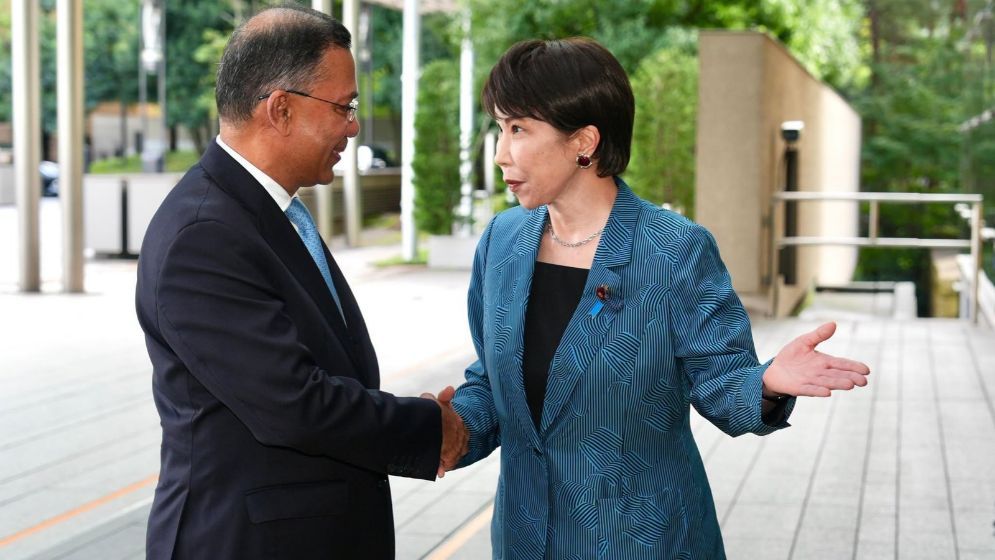
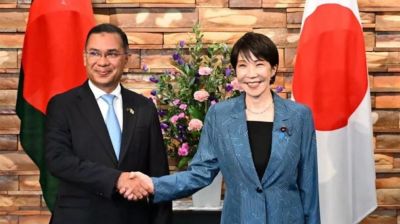
Prime Minister Tarique Rahman and his Japanese counterpart Sanae Takaichi hold a bilateral summit on 27 October 2026. Photo: PMO
Japanese Prime Minister Sanae Takaichi on Tuesday welcomed projected Japanese private investment of up to one trillion yen in Bangladesh over the next five years, expected to create 200,000 jobs, while praising Prime Minister Tarique Rahman’s investment promotion efforts.
The projection was outlined in a joint statement issued following bilateral summit talks between the two prime ministers in Tokyo on the second day of Prime Minister Tarique Rahman’s official visit here from 26 to 29 October.
The leaders welcomed major investments being announced on the occasion and agreed to strengthen economic cooperation through resilient supply chains, improved connectivity and a more conducive business environment.
They also decided to upgrade their flagship bilateral initiative into “BIG-B for Shared Prosperity”, widening its focus to address emerging economic opportunities, supply chain risks, technological changes and geopolitical uncertainties.
BIG-B for Shared Prosperity
The two prime ministers agreed that the upgraded initiative would integrate the development of power, energy, deep-sea port, industrial and ICT infrastructure to establish a major nexus for industrial value chains and develop a trade and supply gateway.
Its four priorities are enhancing connectivity, strengthening resilience against natural disasters and geopolitical uncertainties, promoting public-private partnerships for economic growth and rulemaking, and expanding cooperation for peace and stability.
Under the framework, the two countries will work together to develop the Matarbari-Maheshkhali area into a major logistics, energy and industrial hub centred on the Matarbari Deep-Sea Port.
The leaders underscored the importance of enhancing resilience and preserving each country’s freedom of decision amid a rapidly changing global environment.
Third terminal, MRT and port connectivity
Giving particular emphasis to regional connectivity, the two prime ministers agreed to proceed with preparatory work for the early operationalisation of the third terminal at Dhaka’s Hazrat Shahjalal International Airport.
They also expressed their intention to advance the early construction of Dhaka’s MRT lines and discuss future cooperation, including the operation and management of Matarbari Deep-Sea Port.
The leaders reaffirmed their commitment to steadily advancing cooperation to strengthen connectivity in the region and sustain rapid economic growth.
Investment and business environment
Takaichi commended the Rahman administration’s efforts to promote foreign direct investment and welcomed the projection of Japanese private investment and employment generation over the next five years.
The two leaders agreed to establish complementary and resilient supply chains in manufacturing, food and agriculture, ICT and pharmaceuticals.
Takaichi emphasised the need to further improve Bangladesh’s investment environment, while Tarique Rahman highlighted recent government initiatives and committed to facilitating business through better rulemaking, transparency and predictability.
The commitment covers operational procedures relating to taxation, customs clearance, remittances and licensing.
The leaders welcomed a Memorandum of Cooperation (MoC) between Japan’s Ministry of Economy, Trade and Industry and Bangladesh’s Economic Relations Division on economic relations and improvement of the business environment.
They also welcomed two Memorandums of Cooperation (MoCs) between Japan’s Ministry of Agriculture, Forestry and Fisheries and, respectively, Bangladesh’s Agriculture Ministry and Fisheries and Livestock Ministry to expand business and attract investment in the relevant sectors.
A yen loan project pledged to improve the investment environment also received their welcome.
To sustain business momentum, the two prime ministers expressed willingness to plan a Japanese business delegation to Bangladesh and hold economic dialogues in the near future.
They also sought to promote cooperation through the Japan-Bangladesh Joint PPP Platform and the Bangladesh Special Economic Zone.
Trade pact and industrial diversification
The two leaders welcomed the signing of the Japan-Bangladesh Economic Partnership Agreement (EPA) and reaffirmed their commitment to its early entry into force to deliver mutual benefits to their peoples.
They expressed their determination to promote trade, investment and industrial diversification through the agreement, supporting Bangladesh’s smooth, sustainable and resilient transition from Least Developed Country status.
Takaichi said Japan looked forward to further discussions on Bangladesh’s request to join the Regional Comprehensive Economic Partnership agreement.
Both leaders reiterated the importance of a free, fair and rules-based international economic order.
Energy security and climate cooperation
Prime Minister Tarique Rahman appreciated Japan’s 50 billion yen “Emergency Support Loan for Enhancing Economic Resilience and Stable Energy Supply”, the first yen loan project under Japan’s Partnership On Wide Energy and Resources Resilience Asia, or POWERR Asia.
Takaichi expressed Japan’s continued support for energy infrastructure to help bridge Bangladesh’s energy supply-demand gap.
Amid volatile global energy markets and rising prices, the leaders stressed international cooperation on strengthening oil stockpiles and close coordination between energy-producing and consuming countries.
They also agreed to deepen cooperation on energy security, supply chain resilience and secure digital connectivity.
On climate change, the two sides highlighted cooperation in developing a long-term low-emission development strategy, improving energy efficiency and capacity, and promoting renewable energy.
They welcomed the signing of a Letter of Intent on climate change cooperation between their environment ministries, alongside public-private dialogues under the existing environmental cooperation framework.
Digital transformation and skilled workforce
Building on bilateral ICT cooperation, the leaders recognised the importance of exploring further opportunities in digital transformation, development of highly skilled ICT professionals and secure and reliable digital connectivity.
They also agreed to continue cooperation to strengthen human capital, develop a skilled workforce and address social vulnerabilities.
Their cooperation will cover public health and medical care, education, disaster risk reduction and management, waste management, sustainable cities and local government.
Tarique Rahman highlighted his government’s commitment to good governance, social and financial assistance and balanced regional development.
The two leaders welcomed the pledge for the “Upazila Governance and Development Project (Phase 2)”, a yen loan programme aimed at strengthening local governments’ administrative and fiscal capacities.
They reaffirmed the importance of quality infrastructure, transparent and equitable development finance, debt sustainability and transparency.
They also committed to continuing capacity building for judicial officials through Japan’s legal technical assistance.
Defence and maritime security
The two prime ministers reaffirmed their intention to enhance bilateral security cooperation amid growing geopolitical uncertainty.
They welcomed the signing and entry into force of the agreement concerning the transfer of defence equipment and technology and expressed expectations for further progress in bilateral cooperation.
Takaichi acknowledged Bangladesh’s position as one of the largest contributors to UN peacekeeping operations and expressed Japan’s commitment to deepening cooperation in defence, maritime situation awareness, coastal patrol and port security.
The leaders welcomed the provision of a patrol vessel through Japan’s Official Development Assistance and five patrol boats through its Official Security Assistance programme.
They also committed to exploring future cooperation under the Official Security Assistance programme.
Democracy and people-to-people ties
Reviewing relations since Bangladesh’s independence, the two leaders valued the longstanding friendship and progress under their Strategic Partnership in infrastructure, energy, human resource development, trade and investment.
They reaffirmed shared values of democracy, freedom and the rule of law.
The Bangladesh Prime Minister expressed appreciation for Japan’s consistent development support over five decades and its contribution to global peace, stability and prosperity.
The Japanese premier appreciated Bangladesh’s vibrant democracy, welcomed the credible and peaceful general election held in February 2026 and congratulated Tarique Rahman on assuming office.
The two leaders committed to promoting cultural and educational exchanges, Japanese language education, Japan-related research and Japanese government scholarships.
They also agreed to explore enhanced exchanges and capacity development opportunities for senior Bangladeshi public officials.
Rohingya return and Myanmar crisis
The two prime ministers expressed concern over the worsening crisis in Myanmar, its regional security implications, displacement and increasing transnational crime.
They called for an immediate cessation of violence, release of those detained, conditions conducive to humanitarian assistance and dialogue involving all parties and affected groups, including the Rohingyas.
Takaichi commended Bangladesh for temporarily sheltering displaced people, including Rohingyas from Rakhine State, and expressed support for continued humanitarian assistance.
Tarique Rahman underlined that the Rohingya problem originated in Myanmar and its solution lay there.
The leaders agreed that an ultimate solution required the voluntary, safe, dignified and sustainable return of displaced people, including the Rohingyas, to Myanmar.
Middle East peace and maritime safety
The Bangladesh and Japanese premiers called for early de-escalation in the Middle East and the urgent and full reopening of the Strait of Hormuz, ensuring safe, secure and unimpeded passage for all vessels in accordance with international law and without additional costs.
They recognised the strategic importance of peace and stability in the Red Sea and Bab el-Mandeb Strait for global energy security and uninterrupted trade.
They stressed the protection of civilian vessels and seafarers and urged restraint from actions endangering maritime personnel.
The leaders also underscored the urgency of advancing the Comprehensive Plan to rebuild Gaza and reaffirmed support for a just, lasting and comprehensive resolution of the Palestine question, including a two-state solution.
They reaffirmed the importance of freedom of navigation and overflight and peaceful settlement of maritime disputes in accordance with international law, as reflected in the United Nations Convention on the Law of the Sea.
UN cooperation and nuclear disarmament
The two prime ministers reaffirmed their commitment to multilateralism, international law and the principles of the UN Charter.
Takaichi commended the election of Foreign Minister Dr Khalilur Rahman as president of the 81st UN General Assembly and expressed Japan’s intention to cooperate with him to help build a more resilient and effective United Nations.
The leaders agreed to continue cooperation towards early UN Security Council (UNSC) reform, including expansion of both permanent and non-permanent membership categories.
They also reaffirmed their commitment to a world without nuclear weapons and to maintaining and strengthening the Nuclear Non-Proliferation Treaty.
Expressing concern over nuclear weapons and ballistic missile programmes on the Korean Peninsula in violation of UN Security Council resolutions, they also called for an immediate resolution of the abductions issue.
Tarique Rahman thanked Takaichi and the Japanese people for their warm hospitality and invited her to visit Bangladesh at a mutually convenient time.