


 For all latest news, follow the Daily Sun's Google News channel.


Prices rise, wages lag, debt mounts
Five years of inflation outpacing wage growth have steadily eroded household purchasing power

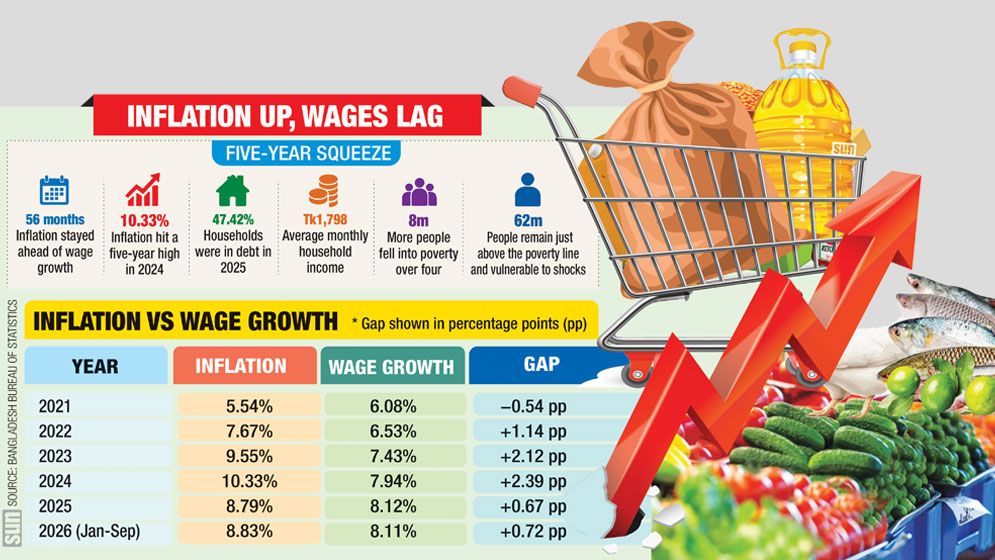
Five years of inflation outpacing wage growth have squeezed household budgets across Bangladesh, forcing families to cut essentials, exhaust savings and borrow to meet everyday expenses.
Every morning, Rita, 26, takes her eight-year-old son Arafat to school before heading to work as a domestic helper. When school ends around 11am, she returns to collect him, locks him and his five-year-old brother, Rifat, inside their two-room rented home in Kallyanpur, Dhaka, and rushes back to work. The boys remain alone until she returns around 5pm.
Rita repeatedly calls home during work breaks to check that the door is secure. Uncomfortable asking neighbours to watch the boys, she says she has little choice but to leave them alone while she works.
Her husband, Ripon, 40, works as a truck helper and takes on courier and ride-sharing jobs at night. He earns Tk16,000-18,000 a month, while Rita brings in another Tk6,000-7,000 from domestic work.
Even with both working, the family struggles to cover rent, food, cooking gas, utilities, transport and school costs.
Next month, they plan to move to a cheaper home, cutting rent from Tk12,000 to Tk8,000. The Tk4,000 saving will ease some pressure, but also reflects the sacrifices they must make to survive on limited incomes.
“Even with three jobs, we cannot manage the expenses. I want to send the children to a good school, but first we must feed ourselves,” Ripon said.
Their struggle mirrors a broader squeeze. After years of high inflation, wages have failed to keep pace with prices, leaving many households cutting spending, using savings or borrowing to cover routine costs.
Inflation continues to erode purchasing power
Bangladesh Bureau of Statistics (BBS) data show annual average inflation rose to 7.67% in 2022, 9.55% in 2023 and 10.33% in 2024. Average wage growth during those years was 6.53%, 7.43% and 7.94%, respectively.
The gap was widest in 2024, when inflation exceeded wage growth by 2.39 percentage points.
Inflation eased to an annual average of 8.79% in 2025, but wage growth remained lower at 8.12%. During January-September 2026, inflation averaged 8.83%, compared with wage growth of 8.11%, according to BBS.
In September 2026, inflation stood at 8.34%, against wage growth of 7.9%. Food inflation was 7.22%, while non-food inflation reached 9.30%.
Inflation outpaced wage growth for 56 consecutive months, from February 2022 to September 2026. Although the gap has narrowed since 2024, workers’ earnings continue to struggle to match the rising cost of living.
The BBS wage index tracks lower-paid skilled and unskilled workers in 63 occupations across agriculture, industry and services. When earnings rise more slowly than prices, workers lose purchasing power even when nominal wages increase.
Former Bangladesh Bank chief economist Mustafa K Mujeri told the Daily Sun that prolonged inflation was putting sustained pressure on household budgets. A slowdown in inflation does not mean prices are falling; it means they are rising more slowly.
For households with uncertain incomes, that leaves little scope to rebuild savings or prepare for medical bills, periods without work and other unexpected expenses, he added.
Borrowing to meet basic needs
Repeated increases in fuel, gas and electricity prices have added to household costs, forcing some families to draw down savings simply to meet daily expenses.
“How can I save when I am struggling just to run my household?” said Shariful Islam, a resident of Mirpur, Dhaka.
He said he had been running a monthly deficit of Tk20,000-30,000 and had exhausted Tk400,000 in savings over the past five years. He is now carrying Tk300,000 in debt.
The BBS Living Standards Survey 2025 found that 47.42% of households were indebted. Conducted from September 14 to 18, 2025, at the request of the National Pay Commission, the survey covered 3,000 households in 150 sample areas.
During the preceding year, 51.91% of rural households, 40.19% of urban households and 32.11% of households in city corporation areas had borrowed to meet basic living expenses.
Average monthly household income nationwide was Tk33,513, against expenditure of Tk35,311 — an average shortfall of Tk1,798.
Monthly expenditure averaged Tk46,778 in city corporation areas, Tk37,344 in urban areas and Tk32,532 in rural areas.
Food accounted for roughly half of household expenditure nationally. In city corporation areas, non-food costs accounted for 56.7% of spending, reflecting the burden of housing, transport, utilities and other expenses.
Selim Raihan, executive director of the South Asian Network on Economic Modeling (SANEM), said the findings were credible given the prolonged period of high inflation. Even relatively better-off households were borrowing, while poorer families often needed loans for food, healthcare and education, he said.
Raihan described widespread indebtedness as concerning amid rising poverty, sluggish investment and limited job creation. Weak real wage growth, food price pressures and a shortage of productive jobs were undermining the financial security of low-income and lower-middle-income households, particularly those dependent on informal work, he said.
Borrowing may bridge an immediate shortfall, but repayments reduce money available for future expenses and can force families to borrow again, leaving even less for food, education and healthcare.
Poverty gains come under pressure
The World Bank’s Bangladesh Development Update estimates that around eight million additional people have fallen into poverty over the past four years. It puts the poverty rate at 22.5% in 2026, up from 18.7% in 2022, and estimates that around 62 million people remain just above the poverty line and vulnerable to economic shocks.
The bank has linked the deterioration to high inflation, declining real incomes, weak private investment and limited employment opportunities. Disruptions to economic activity and rising production costs have also constrained businesses’ ability to expand and create jobs.
Natural disasters or sharp increases in essential prices, including rice, could push more people into poverty. Bangladesh’s poverty rate fell from 48.9% in 2001 to 18.7% in 2022, according to BBS. However, the World Bank’s latest figures are estimates rather than a new BBS household survey; the latest BBS Household Income and Expenditure Survey dates from 2022.
A separate Power and Participation Research Centre study estimated that 27.93% of the population was below its defined higher poverty line in 2025. That measure is different and not directly comparable with the World Bank’s estimate.
Despite differences in measurement, the findings highlight the vulnerability of households with little financial protection against rising costs or lost income.
Raihan said social protection remained inadequate, with support often reaching people only after they had already suffered serious hardship.
Limited jobs deepen the squeeze
A shortage of secure employment is making it harder for families to increase their incomes.
An International Monetary Fund report published in the September edition of “Finance & Development” said 36% of educated young people in Bangladesh were unemployed.
The BBS Labour Force Survey 2024 recorded 2.624 million unemployed people, including 2.032 million aged 15-29. Nearly 29% were university graduates.
Fahim Mashroor, founder and managing director of Bdjobs.com, estimated that 2.2 million to 2.3 million young people enter the labour market each year, including around 750,000 graduates. The expansion of industries and suitable jobs has not kept pace with the supply of graduates, he said. Young people unable to find work may remain dependent on their families, while households lose opportunities to increase their combined income. For families already struggling with higher living costs, irregular work and insecure earnings offer little protection against financial shocks.
What is needed now?
Dr Zahid Hussain, former lead economist at the World Bank’s Dhaka office, said controlling inflation must go hand in hand with tackling pressures on household purchasing power.
Lower inflation alone will not restore financial security if wages continue to lag behind prices, he said.
Policy priorities should include addressing supply-chain inefficiencies and weaknesses in market competition that contribute to high consumer prices, improving targeted support for low-income households and strengthening social protection. Measures to encourage investment, raise productivity and create productive jobs are also needed to provide households with more secure and reliable incomes, Dr Zahid said.
Read More