


 For all latest news, follow the Daily Sun's Google News channel.


The government plans to invest Tk535.54 crore in establishing nuclear medicine centres in five districts to expand access to specialised diagnostic services beyond major urban centres.
The project is scheduled for consideration at an ECNEC meeting today at the Bangladesh Secretariat, with Prime Minister Tarique Rahman, the committee’s chairman, presiding.
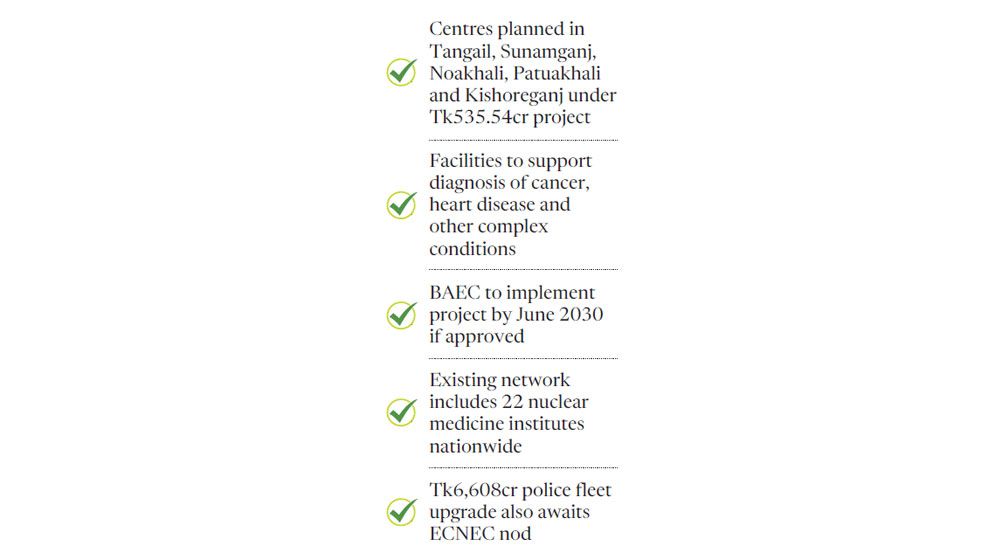
The project, titled “Construction of Institutes of Nuclear Medicine and Allied Sciences on Medical College Hospital Campuses,” proposes centres in Tangail, Sunamganj, Noakhali, Patuakhali and Kishoreganj, a senior Planning Commission official told the Daily Sun. If approved, the Bangladesh Atomic Energy Commission (BAEC) will implement the project by June 2030, the official said. The proposed centres are intended to provide specialised diagnostic services for complex diseases, including cancer, heart disease and disorders affecting the thyroid, kidneys and liver. The initiative also aims to make such services more accessible and affordable, particularly for patients living outside major medical hubs.
Planning Secretary SM Shakil Akhtar said the number of patients suffering from complex diseases was increasing and the project would bring nuclear technology-based medical services closer to the population.
Dr Monjur Ahasan, chief scientist at the BAEC, told the Daily Sun that nuclear medicine was a specialised field requiring advanced equipment and trained technical personnel. He said the technology played an important role in diagnosing complex diseases, including cancer, heart disease and disorders affecting the thyroid, kidneys and liver.
Establishing centres at medical college hospitals in the five districts would extend access to specialised diagnostic services beyond major urban centres, he added.
Although such services could be costly, government subsidies helped make them more affordable, particularly for low-income patients, Dr Monjur said. The proposed centres are also expected to create opportunities for medical research and the development of specialised healthcare professionals, according to project documents.
Nuclear medicine uses radioactive materials and specialised imaging techniques to diagnose diseases and, in certain cases, support treatment. Access to such facilities can be particularly important for patients who would otherwise need to travel to larger cities for specialised medical services.
According to the project proposal, the BAEC has been providing nuclear technology-based medical services since 1960.
The proposal says 22 nuclear medicine institutes have been established at medical college hospital campuses and related institutions across the country. These include facilities at 13 government medical college hospital campuses and a national institute at Bangladesh Medical University. It also refers to centres at seven other medical college hospital campuses and at the National Institute of Diseases of the Chest and Hospital campus in Mohakhali.
Despite the existing network, the government considers further expansion necessary to address geographical disparities and growing demand for specialised healthcare.
The project document states that Bangladesh has 37 medical colleges, of which 22 have nuclear medicine services on their campuses. An earlier initiative considered establishing new centres in eight districts, while the current proposals for the five locations were developed after land was allocated for the facilities.
Md Ehsanul Hoque, former member of the Planning Commission’s Socio-Economic Infrastructure Division, said in a written statement that the proposed centres would help expand internationally standardised nuclear medicine services across different parts of the country.
He said the initiative could improve equity in healthcare while creating opportunities for medical research and the development of specialised personnel.
The project includes construction of facilities, procurement of domestic and foreign medical equipment, recruitment and training of personnel, and the purchase of vehicles and furniture required to make the centres operational.
If approved, the investment would extend nuclear medicine services to the five districts and strengthen the country’s specialised healthcare capacity.
Police fleet modernisation
Bangladesh Police may receive 5,830 new vehicles under a Tk6,608.14 crore modernisation plan aimed at improving mobility, emergency response and operational capacity nationwide.
The home ministry has placed two projects under the plan before the Executive Committee of the National Economic Council (ECNEC) for approval.
Of the proposed expenditure, Tk4,328 crore would be spent on procuring 4,829 operational vehicles, while Tk2,280.14 crore would go towards 1,001 specialised vehicles, a planning official told the Daily Sun.
Both projects are scheduled to run from October 2026 to June 2029, with the government bearing the full cost, the official said.
The proposed investment comes amid a shortage of police vehicles and an ageing fleet that can hamper routine patrols, emergency response and the efficient deployment of personnel.
According to the project proposals, Bangladesh’s 639 administrative police stations currently have 1,237 vehicles to cover an area of around 147,000 square kilometres. This averages fewer than two vehicles per station, while around 64% of the existing fleet is more than a decade old.
The projects are expected to improve police mobility and operational readiness. Their impact on public safety, however, will depend on effective procurement, proper maintenance and deployment according to operational needs.
The specialised vehicle project includes equipment for specific law enforcement requirements, such as riot-control vehicles, all-terrain vehicles, mobile command centres and crime-scene vans.