



 For all latest news, follow the Daily Sun's Google News channel.


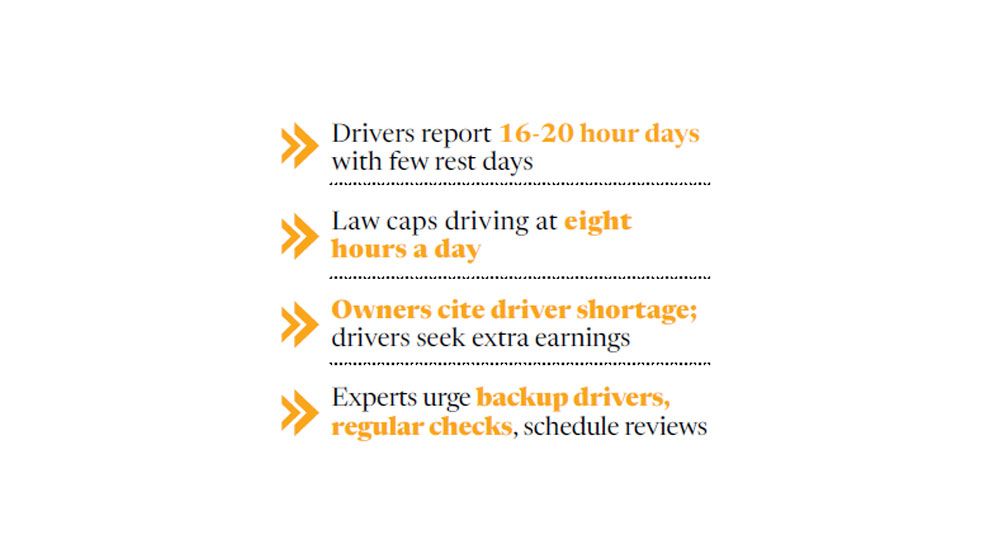
Long working hours and too little sleep among professional drivers are raising the risk of road accidents in Bangladesh, even though the law limits driving to eight hours a day. “If I work 16 to 17 hours a day, when will I sleep? I barely get enough time to eat properly,” said Sujon, a long-distance bus driver who works from Dhaka’s Gabtoli area.
The 40-year-old said he sometimes worked up to 20 hours a day during Eid. He has no fixed weekly day off and sometimes gets leave only after 10 to 12 days of work. He also drives between Dhaka and Itakhola in Narsingdi, making four to five one-way trips a day. Each takes about three hours, or up to four in heavy traffic.
He said the schedule had affected his health. When exhausted, he lets a supervisor or assistant drive so he can rest.
“Rather than driving while sleepy, it is better to let someone else drive. I can rest during that time and feel fresh enough to drive for the remaining hours,” he added.
A bus owner on the Dhaka-Chattogram route, who asked not to be named, said a driver shortage forced operators to make existing staff work overtime. “Otherwise, the business would suffer,” he said. Motor vehicle rules limit driving to eight hours a day and 48 hours a week.
In a notice on 23 May, the Bangladesh Road Transport Authority (BRTA) said no driver may drive continuously for more than five hours. After that, drivers must rest for at least 30 minutes before driving a further three hours at most.
The BRTA warned that prolonged driving increases fatigue, drowsiness and the likelihood of falling asleep at the wheel.
BRTA Chairman Abu Momtaz Sad Uddin Ahmed said in Mymensingh on 4 March that many drivers spent up to 14 hours a day behind the wheel.
A study published in March by Dr JM Adeeb Salman Chowdhury, associate professor of statistics at Comilla University, surveyed 373 drivers in Dhaka, Chattogram and Cumilla. They worked an average of 9.25 hours a day. Some 46.6% had sleep problems and 66.5% suffered from lower back pain. Drivers told researchers they could earn more by working additional hours. Fatigue has been cited in several fatal crashes this year.
On 3 May, eight people were killed when a truck and a pickup collided head-on at Telibazar in Sylhet’s Dakshin Surma upazila. Mohammad Shafiqul Islam Bhuiyan, deputy director of the Fire Service and Civil Defence in Sylhet, said the truck driver had driven through the previous night and fallen asleep towards dawn.
On 7 August, nine people died when two buses collided head-on at Kashikapon in Osmaninagar upazila. Anisur Rahman, officer-in-charge of Sherpur Highway Police Station, said both drivers appeared drowsy.
Just four days ago, 12 people were killed in a head-on collision between a bus and a truck at Bonpara in Natore. Surviving passengers alleged that the bus driver had fallen asleep and a supervisor was driving.
Mozammel Haque Chowdhury, secretary general of the Bangladesh Passenger Welfare Association, said driving for long periods without breaks was a major cause of accidents. He said long-distance buses should have backup drivers, operators who break the rules should face action, and drivers’ hours and rest should be checked regularly.
Saidur Rahman, executive director of the Road Safety Foundation, said overtime was a major contributor to accidents.
He said responsibility should not rest solely on drivers or owners’ associations, and that the entire road transport system should be held accountable.
Prof Hadiuzzaman of BUET’s Accident Research Institute said lack of sleep impairs judgement and slows reactions, often without drivers realising it. He said transport schedules should be reviewed to ensure adequate rest between trips.
Read More