


 For all latest news, follow the Daily Sun's Google News channel.


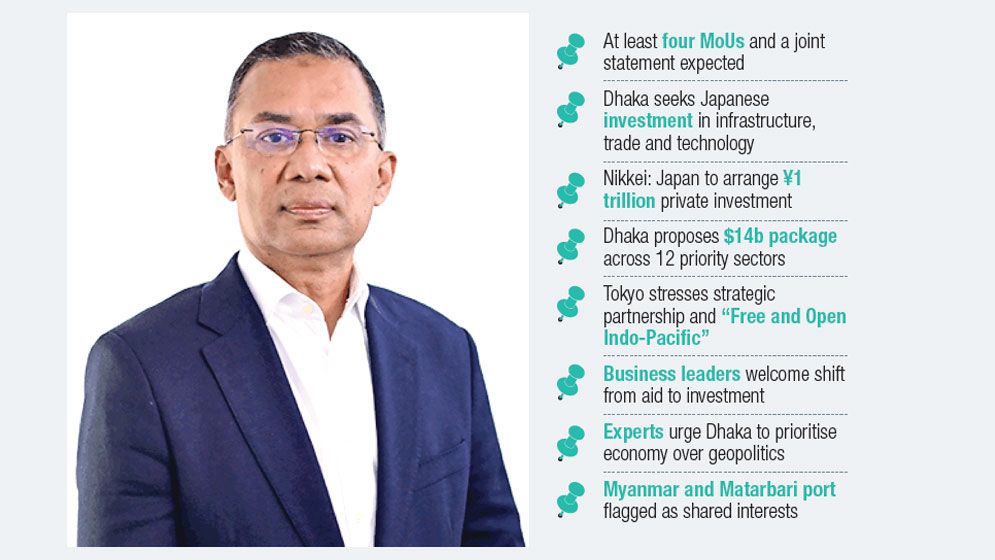
Prime Minister Tarique Rahman is scheduled to leave for Tokyo tomorrow, with Bangladesh seeking investment and trade gains from Japan and Tokyo placing the emphasis on strategic cooperation.
Bangladesh and Japan are expected to sign more than four memorandums of understanding (MoUs) and issue a joint statement setting out the outcomes of the visit and future directions for bilateral cooperation.
Foreign ministry sources in Dhaka said the proposed agreements cover agriculture, fisheries, human resource development, skills training, civil aviation, trade, environmental protection and local government modernisation.
“Preparations are underway on around eight cooperation documents. The final number to be signed, however, will depend on the completion of negotiations,” Foreign Secretary Asad Alam Siam said.
In a statement on Tuesday, Japan’s foreign ministry said the visit was expected to further strengthen the “Strategic Partnership” with Bangladesh, which it described as a key regional partner sharing values such as freedom, democracy and the rule of law. It said the visit would also enhance coordination towards realising the updated “Free and Open Indo-Pacific” (FOIP) vision.
Dhaka’s investment pitch
Japan has long been one of Bangladesh’s major development partners, supporting projects including the Dhaka Metro Rail, the Matarbari port and power project, and the third terminal of Hazrat Shahjalal International Airport.
Bangladesh is now preparing a proposed $14 billion package to attract Japanese investment and cooperation in 12 priority sectors for 2026-31. Some of the sectors fall under the Bay of Bengal Industrial Growth Belt (BIG-B) initiative.
The package includes $3.45 billion for transport and urban connectivity and $3.14 billion for integrated industrial, port and commercial hubs, among them the Matarbari hub. It also earmarks $2.22 billion for energy and climate resilience, $1.57 billion for manufacturing, semiconductors and automobiles, and $1.22 billion for agriculture, the blue economy and tourism.
On Thursday, Nikkei Asia reported that Japan would agree to arrange ¥1 trillion ($6.36 billion) in private-sector investment in Bangladesh over the next five years.
Business leaders welcomed the report. Abdul Haque, a founding member and former president of the Japan-Bangladesh Chamber of Commerce and Industry (JBCCI), said Bangladesh had pursued such investment for three decades.
“It’s a big opportunity. We have been trying for this for the last 30 years. They were more interested in official development assistance (ODA). It’s good to see that the governments of the two countries are now thinking differently,” he told the Daily Sun.
“Japan is facing an internal economic crisis. Therefore, their entrepreneurs are looking for countries to invest in. Japanese investment will help Bangladesh to ensure transfer of technology and capacity building,” he added.
Haque, a recipient of Japan’s Order of the Rising Sun, Gold Rays with Rosette, said he expected the Bangladesh government to undertake the reforms needed to attract more Japanese investment.
Tokyo’s strategic priorities
Prof Shahab Enam Khan of the Department of International Relations at Jahangirnagar University described the visit as crucial, coming after the prime minister’s tour of Beijing.
“Bangladesh’s paramount interest is in its economy. Japan’s market is changing gradually. We should focus on export of our skilled manpower there. Besides, we need the country’s assistance to develop our technology sector as well,” he told the Daily Sun.
Former ambassador Mahfuzur Rahman said that while Dhaka would concentrate on economic issues, Tokyo had interests beyond the economy.
“Japan’s main objective is to strengthen strategic cooperation. They have used terms like freedom, democracy and the rule of law, and free and open Indo-Pacific, which are similar to the approach of the US. There is the issue of Quad and BIG-B. Japan can think of the interests of its partners in these initiatives. It may put a cover or coating, while discussing economic issues with Bangladesh,” he said.
He said India, which had earlier stepped back from BIG-B to seek bilateral benefits from Bangladesh and strengthen its position in negotiations with the US, probably wanted to return to the initiative.
Read More
He added that Japan and the US might have similar intentions.
“The US always sees everything in the big picture. It, along with Japan and India, considers the rise of China in Asia as a threat. It may have convinced Japan to take the initiative to bring Bangladesh close to India, saying that the strained relations between the two countries could lead Dhaka to lean further towards China,” he said.
Prof Shahab, who is also executive director and CEO of the Bangladesh Centre for Indo-Pacific Affairs, said Bangladesh should stay out of the geopolitical contest among major powers.
“Bangladesh and Japan rather should think about Myanmar, as both countries have common interests there. Matarbari Deep Sea Port should be scaled up, without considering the objection of any third country, so that Myanmar can use it. If normalcy returns in Myanmar, both Bangladesh and Japan will benefit,” he said.
Read More