



 For all latest news, follow the Daily Sun's Google News channel.


NATIONAL ROAD SAFETY DAY
Safer roads still elusive
Experts cite weak enforcement, inadequate driver training and poor transport management

Bangladesh marks National Road Safety Day today with annual road deaths having risen in recent years, according to rights groups, while experts say weak enforcement of traffic rules, inadequate driver training and poor management of public transport continue to undermine efforts to make roads safe.
The observance comes just two days after 12 people were killed and 20 injured in a head-on collision between a bus and a truck on the Natore-Pabna highway. The bus supervisor was reportedly driving while the driver was asleep.
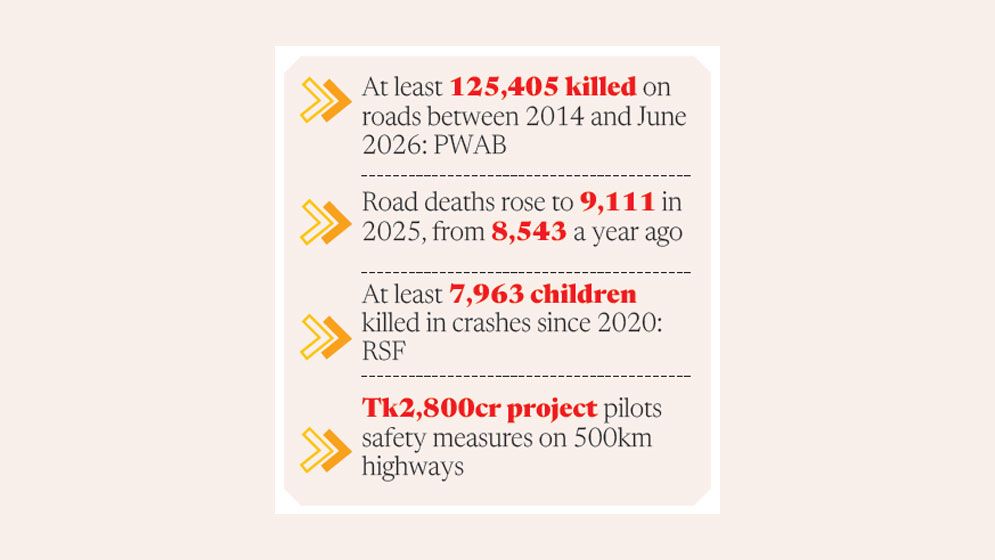
At least 125,405 people were killed in road crashes in Bangladesh between 2014 and June 2026, according to the Passengers Welfare Association of Bangladesh (PWAB), with annual deaths rising for a second consecutive year to 9,111 in 2025, up from 8,543 in 2024 and 7,902 in 2023.
The PWAB, a non-government organisation, said an average of 25 people died on the roads every day in 2025, compared with 23 in 2024.
Separately, the Road Safety Foundation (RSF) recorded at least 7,963 child deaths in road crashes between 2020 and June 2026. Experts say the figures show that government efforts to make roads safe have not been adequate.
The National Road Safety Day has been observed since 2017 in memory of Jahanara Kanchan, wife of actor Illias Kanchan, who was killed in a road crash on 22 October 1993.
A student-led road safety movement ran from 29 July to 10 August in 2018 after two students of Shaheed Ramiz Uddin Cantonment College, Dia Khanam Mim and Abdul Karim Rajib, were killed. The students put forward a nine-point set of demands, and the government agreed to them by approving the draft Road Transport Act 2018, which proposed up to five years' imprisonment for causing death by reckless driving.
The act came into effect on 1 November 2019 without the rules being framed. Transport owners and workers protested against several of its sections, forcing the government to relax them until June this year. The government has since invested in road safety through development projects. The Roads and Highways Department is implementing the Tk2,800 crore Bangladesh Road Safety Project, while the city corporation is carrying out a Tk336 crore traffic safety improvement project.
Abul Barkat, deputy project director of the Bangladesh Road Safety Project, told the Daily Sun that pilot safety measures were being introduced on 500 kilometres of highway. The routes are Joydevpur-Mymensingh, Hatikumrul-Rangpur, Dhaka-Tangail and Tangail-Rajshahi, with speed-calming measures at schools, markets and hospitals.
"We have handed over 60 basic life support ambulances, 40 motorcycle ambulances and 80 police patrol motorcycles for post-crash response," he said. "We are launching a hotline soon, and once it is working, victims will get care on the 500-kilometre highway." In a message for the day, Nirapad Sarak Chai Chairman Illias Kanchan said most crashes were caused by identifiable risks, including speeding, reckless driving, driver fatigue or incompetence, defective vehicles, unsafe roads, a lack of safe pedestrian crossings and delays in emergency medical care. "These risks can be reduced if individuals, institutions and the state fulfil their respective responsibilities," he said.
He called for speed limits near residential areas, schools, hospitals and markets, genuine vehicle fitness inspections, skills assessments and training before driving licences are issued, and enforcement of working-hour and rest-period rules for professional drivers.
Kazi Shifun Newaz, assistant professor at the Accident Research Institute of Bangladesh University of Engineering and Technology, said some fragmented efforts had been made but there was no discipline on the roads.
"We don't see any progress on bus route rationalisation, appointment and salary for drivers and their assistants, strong vehicle fitness monitoring, safety audits for highways, and training and awareness for drivers," he said.
He added that some interventions were under way but had not had a positive impact on overall management.