


 For all latest news, follow the Daily Sun's Google News channel.


Fuel import bill surges as oil climbs
Annual fuel bill could reach $18-20b, analysts say, while BPC says supplies are secure until December

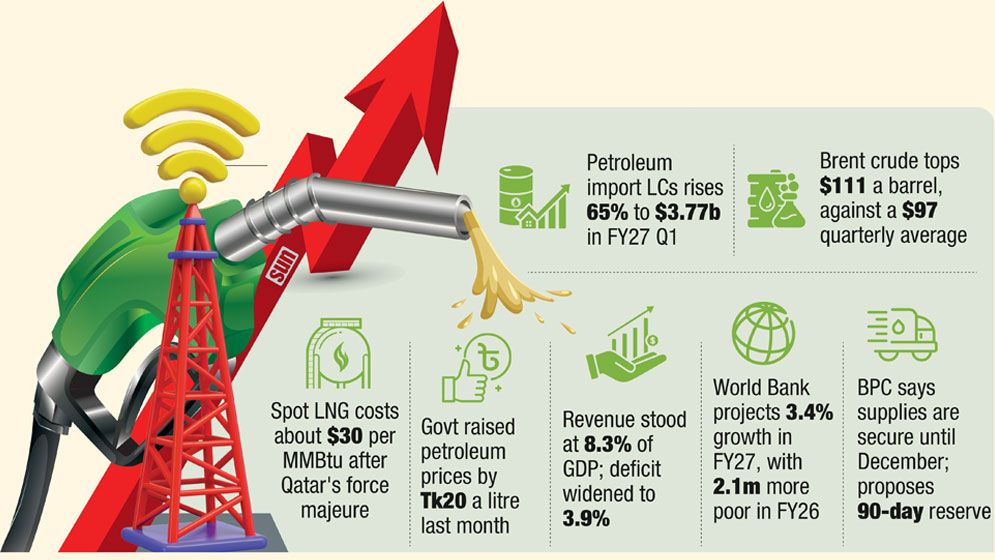
Bangladesh opened letters of credit (LCs) worth $3.77 billion for petroleum imports in July-September, up 65% from $2.28 billion a year earlier, as the Middle East crisis lifted global oil and gas prices, Bangladesh Bank data show.
The rise reflects higher prices rather than a significant increase in import volumes. Brent crude rose above $111 a barrel on Tuesday amid concerns over attacks on energy infrastructure and shipping in the Gulf. It averaged $97 in the quarter, against $69 a year earlier, according to international media.
The price shock comes as the economy is already under strain from sluggish growth, elevated inflation, limited fiscal space and weaknesses in the banking sector.
The World Bank's latest Bangladesh Development Update projects growth of 3.4% in both FY26 and FY27, citing persistent energy shortages, higher business costs and weak investment. Growth could reach 3.9% in FY28 if energy supplies ease and reforms accelerate.
Shafiqul Alam, lead analyst for Bangladesh Energy (South Asia) at the Institute for Energy Economics and Financial Analysis (IEEFA), said the annual fuel import bill could rise to $18 billion-$20 billion from $12 billion-$13 billion. "If the crisis becomes prolonged, the expenditure could rise further," he said.
Prime Minister's Adviser on Finance and Planning Rashed Al Mahmud Titumir said Bangladesh had spent an additional $4.12 billion on energy over the past eight months.
Import costs and reserves
LCs for crude oil tripled to $629 million in the first quarter of FY27 from $209 million a year earlier. LCs for other imports, mainly gas, rose to $2.42 billion from $1.13 billion, while those for refined products fell to $724 million from $946 million.
Settlements of petroleum import LCs increased 26% to $2.93 billion, reflecting the growing outflow of foreign currency.
The country needs more than 6.8 million tonnes of petroleum a year, with diesel accounting for over two-thirds of demand. It also imports more than a third of its natural gas.
After QatarEnergy declared force majeure, Bangladesh turned to the spot market for liquefied natural gas at around $30 per million British thermal units (MMBtu), nearly three times the pre-war price.
Shafiqul Alam said importing the same LNG volume as in 2025 could more than double spending on LNG alone, adding to the government's subsidy burden.
He said garment exports and remittances remain the main sources of foreign exchange, leaving the economy exposed if energy import costs keep rising.
A prolonged increase could force the government to borrow more and limit its ability to fund other priorities.
Inflation and growth risks
Higher oil and gas prices raise transport, electricity and production costs, which could feed into consumer prices and erode household purchasing power.
Last month, the government raised the prices of all four major petroleum products by Tk20 a litre, the biggest increase since the record adjustment in August 2022 after the Russia-Ukraine war.
Passing costs on to consumers adds to the burden on households and businesses, while absorbing them through subsidies would deepen the pressure on public finances.
Selim Raihan, executive director of the South Asian Network on Economic Modeling (SANEM), said higher import costs could increase subsidies, strain reserves, weaken the taka and push up inflation.
"This could force the government to divert funds from development and social spending," he said.
Fiscal room is limited.
The World Bank reported that government revenue stood at 8.3% of GDP in FY26, among the lowest levels globally, while the fiscal deficit widened to 3.9% of GDP from 3.5% in FY25.
The report also found that about 2.1 million more people fell into poverty in FY26, while job creation stalled and women lost jobs.
Shafiqul Alam said that if the government could not supply enough fuel to industries, growth and employment would suffer.
Fuel security
The available evidence does not establish that Bangladesh is heading towards a Sri Lanka-style crisis.
The World Bank has noted that the external sector has shown resilience, supported by strong remittance inflows and improving reserves, though this does not remove the risks of prolonged high import costs.
The Bangladesh Petroleum Corporation (BPC) said supplies remain adequate and are assured until December, with no immediate risk of shortage. It has proposed a fuel stabilisation fund, strategic reserves covering 90 days of demand, expanded domestic refining capacity and faster implementation of the Single Point Mooring project.
The proposed fund remains at the conceptual stage, with its operating arrangements yet to be finalised.
Raihan called for faster investment in renewable energy to reduce dependence on imported fuel, ease pressure on reserves and strengthen long-term energy security.