



 For all latest news, follow the Daily Sun's Google News channel.


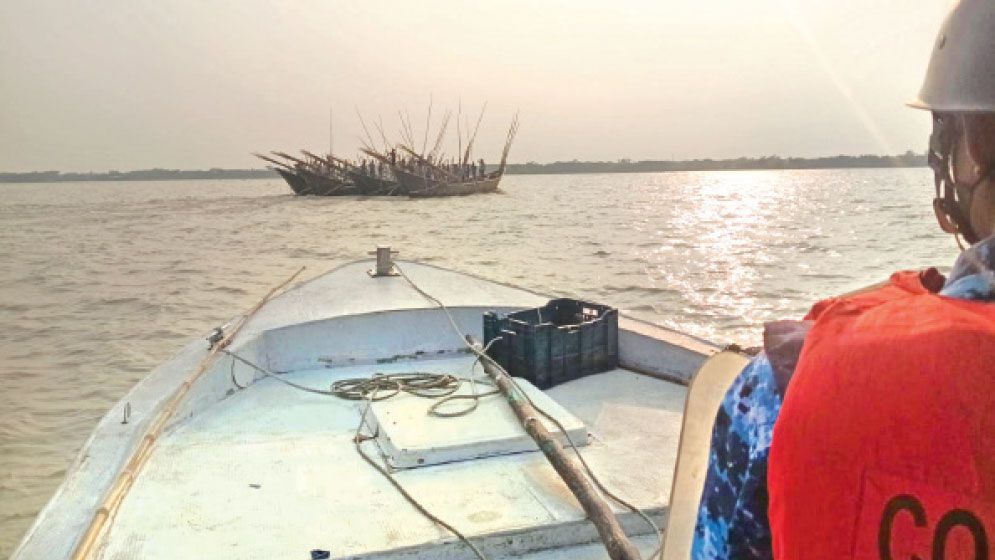
Organised fishing gangs are undermining the 22-day hilsa ban in southern region by evading raids through advance warnings and attacking enforcement teams, while illegal catches continue to reach local markets.
The ban, effective from 8 to 29 October, prohibits hilsa fishing, transportation, storage and sale across the country to protect mother hilsa during its breeding season.
However, fishing continues in the Padma, Meghna, Tentulia, Gazaria, Kalabadar, Arial Khan, Kirtankhola, Sandhya and Sugandha rivers, among others, while hilsa is being sold openly at several riverside markets in Barishal and Bhola.
The reported trading points include Shibpur, Dhania and Tulatali in Bhola, Bhasanchar and Lalganj in Mehendiganj, Hazirhat in South Ulania,  Shayestabad in Barisal Sadar and Charmonai. Locals allege that influential people are backing the illegal trade.
According to locals, people are stationed two to four kilometres from fishing spots to monitor the movement of law enforcement agencies and fisheries officials.
They reportedly alert fishermen by mobile phone, allowing them to pull in their nets and escape into narrow canals and river channels.
Organised groups are also fishing in the Meghna River sanctuary, according to sources. Members of these groups have allegedly resisted enforcement teams, with the Coast Guard and Naval Police facing attacks during operations.
Md Kamrul Hasan, director of the Barisal divisional fisheries department, said organised groups operating in remote parts of the Meghna become aggressive during raids and often engaged enforcement teams in chases.
This year, two launches have been deployed at key points in the Meghna, alongside several smaller boats, he said.
Surveillance is also being conducted using drones, while Bangladesh Air Force helicopters are expected to join operations. The helicopters will patrol the area stretching from Jajira Point in Shariatpur through the Meghna basin and the coastal districts of Bhola, Patuakhali and Barguna, he added.
Hilsa sold openly at varying prices
Locals said smaller fish weighing near one kilogram were being sold for Tk500–600 during afternoon trading, while other one-kilogram fish fetch Tk1,000–1,200. Fish weighing around 1.5 kilograms were selling for approximately Tk1,500 per kilogram.
There are also allegations that traders are buying and storing hilsa during the ban to sell at higher prices once restrictions are lifted.
The Department of Fisheries said Barisal division has around 423,000 registered fishermen, of whom 358,000 are receiving 25 kilograms of rice each under the Vulnerable Group Feeding (VGF) programme during the restriction period.
A fisherman, speaking on condition of anonymity, said he had caught little hilsa this season and was burdened with debt. He said he had continued fishing because he needed to repay his loans.
Another fisherman said 25 kilograms of rice was insufficient to support a family during the ban.
Professor Dr Md Sajedul Haque, dean of the Faculty of Fisheries Science at Patuakhali Science and Technology University, stressed the importance of raising awareness among fishermen about protecting mother hilsa, explaining that conservation during the breeding season would help increase future catches.