


 For all latest news, follow the Daily Sun's Google News channel.


Primary education struggles with five systemic challenges
Daily Sun Report, Dhaka
Published: 19 Oct 2026, 07:38 PM
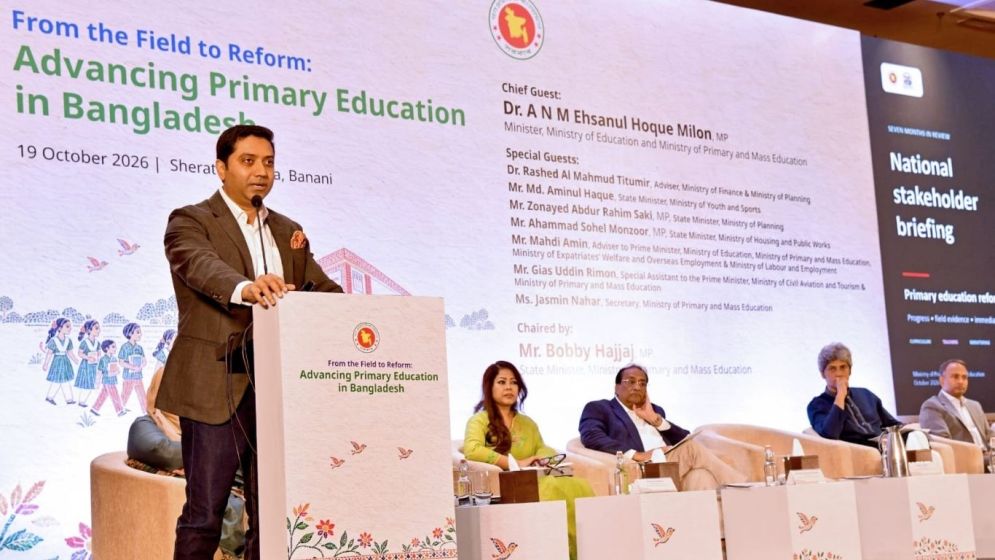
State Minister Bobby Hajjaj presents findings from nationwide stakeholder meetings at a dialogue in Dhaka on Monday. Photo: Courtesy
Field-level education officers identified five major problems facing Bangladesh’s primary education system, including excessive monitoring workloads, burdensome reporting requirements, unreliable student enrolment data, weak school leadership and unsafe school infrastructure.
State Minister for Primary and Mass Education Bobby Hajjaj, who conducted stakeholder meetings across the country from 26 July to 10 September, disclosed the findings at a national dialogue at the Sheraton Dhaka on Monday.
The event, titled “From the Field to Reform: Advancing Primary Education in Bangladesh,” was organised by the Ministry of Primary and Mass Education in partnership with the Directorate of Primary Education and UNICEF Bangladesh.
According to the findings presented at the event, 58.2% of field officers supervise more than 50 schools, while 86.3% said they could visit a maximum of 10 schools a month, highlighting the gap between their monitoring responsibilities and their capacity to conduct regular school visits.
The officers also pointed to excessive paperwork as a major obstacle to effective field-level supervision. Some 84.3% identified reducing duplicate and repetitive reporting formats as the priority for easing their workload and allowing them to devote more time to school visits.
Weak school leadership emerged as another concern. According to the findings, 49.2% of respondents identified weak headteacher leadership as the main reason for schools starting classes late, pointing to shortcomings in school-level supervision and accountability.
Infrastructure safety was identified as an urgent issue. Some 59.2% of officers ranked unsafe school buildings as the most urgent concern, while 69.7% reported major structural risks, including cracks in buildings, exposed reinforcement rods and sagging ceilings.
The findings highlight the need for reforms that strengthen field-level monitoring, simplify administrative procedures, improve education data verification, enhance school leadership and ensure safe learning environments for primary schoolchildren.
State Minister Bobby Hajjaj said the government was working to formulate an integrated teacher policy covering recruitment, pre-service training, posting, professional development and evaluation to ensure quality primary education.
He stressed that teachers should not conduct classroom lessons without proper training and underscored the need to improve subject-specific skills and ensure regular professional development. He also called for keeping teacher evaluation separate from school evaluation and making upazila-level teacher training centres more effective.
On the monitoring system, Bobby Hajjaj said school supervision needed to be strengthened by addressing manpower shortages at the field level and reducing excessive administrative workloads.
To this end, initiatives had been taken to improve the 11-step school inspection system and digital information management, he said.
He emphasised that monitoring should not be limited to preparing reports but should focus on ensuring teachers’ attendance, regular classroom teaching and students’ actual learning outcomes.
Planning State Minister Md Jonaed Abdur Rahim Saki, speaking as the chief guest, said improving infrastructure alone would not be enough to enhance the quality of primary education and prevent dropouts. Priority must also be given to teachers’ status, salaries and benefits, and professional skills, he said.
Director General of the Directorate of Primary Education Shahina Ferdousi delivered the welcome address.
Mohammad Moktar Ali, a member of the parliamentary standing committee on the Ministry of Primary and Mass Education; Reza Kibria and Bithika Binte Hossain, members of the parliamentary standing committee on the Ministry of Education; Gias Uddin, special assistant to the prime minister; and Rasheda K. Choudhury, executive director of Campaign for Popular Education (CAMPE), also attended the event.
Officials from different ministries, representatives of local and international development partners, and civil society representatives took part in the national dialogue.