


 For all latest news, follow the Daily Sun's Google News channel.


Three-day fair begins in Kushtia on Lalon’s 136th death anniversary
Daily Sun Report, Kushtia
Published: 16 Oct 2026, 05:12 PM
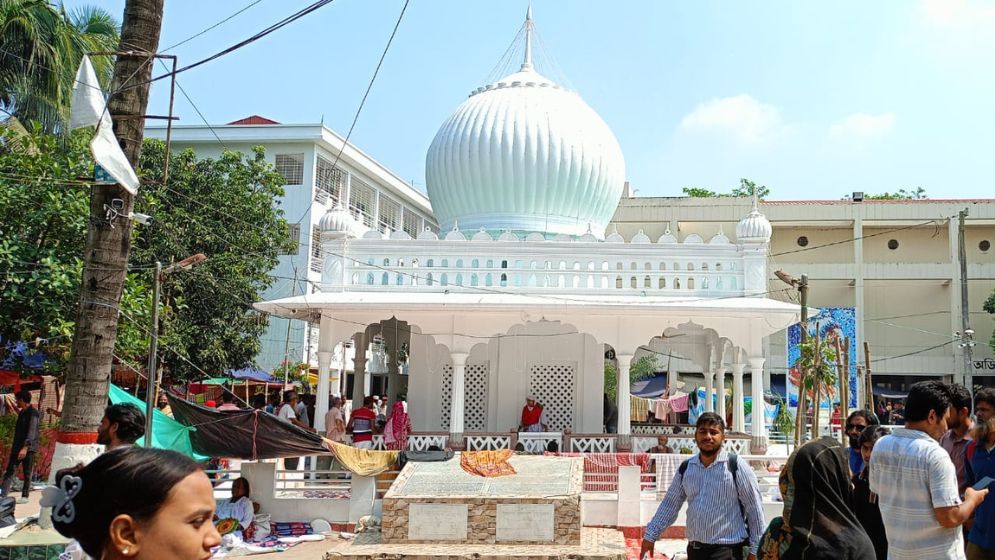
Fakir Lalon Shah's Mazar at Chheuria, Kushtia. Photo: Daily Sun
A three-day Lalon Fair and discussion programme will begin at Chheuria in Kushtia on Saturday (17 October) observing the 136th death anniversary of Baul King Fakir Lalon Shah and highlighting his enduring message of humanism: “Worship humanity and you will become a golden man.”
Lalon Academy usually is organising the event will run until
19 October on the premises of Lalon Academy, featuring an inaugural ceremony,
discussion sessions, speeches by distinguished personalities and Lalon music
performances every evening.
All out preparations have been taken for the fair, which is
expected to draw Lalon devotees, Baul followers and researchers, artists,
cultural activists and visitors from different parts of the country.
Through the melodies of Baul songs, exchanges of spiritual
thought and celebrations of folk traditions, the shrine complex at Chheuria is
expected to become a centre of cultural fellowship.
Organisers and admirers hope the fair will once again spread
Lalon’s messages of humanism, secular harmony and equality, fostering a spirit
of fraternity among people.
The fair will formally open with an inaugural ceremony and
discussion session at 3pm on Saturday, 17 October.
Nitai Roy Chowdhury, MP and minister for Cultural Affairs, will attend as the chief guest, while Dr Zahed Ur Rahman, adviser to the Ministry of Cultural Affairs, will attend as a special guest.
The programme will be chaired by Touhid Bin-Hasan, deputy
commissioner and district magistrate of Kushtia and president of Lalon Academy.
One of the day's main attractions will be a Lalon music
session at 5pm, offering visitors an opportunity to experience the timeless
songs of the mystic poet performed by artists from different parts of the
country.
Lalon Fair: An
inspiration for a society beyond divisions
Rooted in a long tradition, the Lalon Fair has for
generations brought people together at the shrine of Lalon in Chheuria.
Transcending distinctions of religion, caste, ethnicity and
social class, the gathering has evolved into a unique celebration of human
fellowship.
The spontaneous participation of Lalon's followers and
people from diverse walks of life transforms the shrine complex into a lively
meeting place for folk music, spiritual reflection and communal harmony.
At the heart of Lalon's philosophy lies the primacy of human
identity over religious and social divisions. His songs explore the mysteries
of the human body, self-discovery, love, equality and spiritual liberation,
encouraging people to seek the truth within themselves and build bonds of
humanity beyond conventional barriers.
The fair is therefore much more than a cultural event; it is
a profound celebration of Bengal's non-communal spirit, folk heritage and human
values.
In an increasingly divided world, Lalon's songs and
philosophy continue to remind people that no identity is greater than being
human and no truth more fundamental than humanity itself.
Drawn by this enduring message, thousands gather at the
shrine every year, seeking the Moner Manush—the person of the heart—through
music, spiritual contemplation and the joy of fellowship.
Through this three-day celebration, the shrine at Chheuriya
will once again become a meeting ground for music, philosophy and humanity.
The songs and reflections inspired by Lalon will renew his
timeless call to discover the human essence, recognise one's inner self and
seek truth through human relationships.
Lalon Shah was not merely a mystic practitioner or composer
of Baul songs; he was an extraordinary humanistic thinker in the history of
Bengali culture and philosophy.
By looking beyond institutional identities and social
divisions, he explored the inherent truth and dignity of human existence. His
enduring philosophy continues to offer a path towards harmony, equality and
self-realisation in a world marked by division and intolerance.
The annual fair commemorating his death is thus not simply
an occasion to remember a legendary figure. It is a living celebration of his
philosophy and a testament to the enduring power of music and humanity to bring
people together.