


 For all latest news, follow the Daily Sun's Google News channel.


‘Free child domestic workers, ensure education’
Daily Sun Report, Dhaka
Published: 11 Oct 2026, 07:54 PM
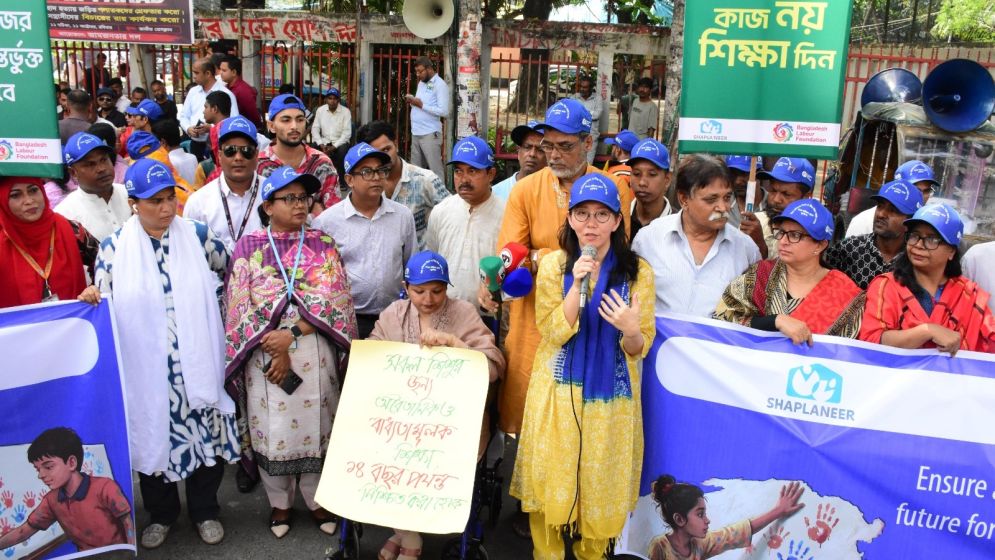
Photo: Courtesy
Experts on Sunday called for children under 14 engaged in
domestic work to be freed from child labour and given access to education.
They also urged the government to guarantee free and
compulsory education for all children up to age 14.
They made the remarks at a gathering following a human chain
organised by the “Bangladesh Labour Foundation (BLF)” and “Shapla Neer” in
front of the National Press Club in the capital on the occasion of Child Rights
Day and World Children’s Week 2026.
The programme aimed to build a child-friendly Bangladesh by
ensuring children’s rights and protection.
Representatives of the government, the Department of
Inspection for Factories and Establishments, the Sramik Karmachari Oikya
Parishad (SKOP), the Industrial Bangladesh Council (IBC), trade unions,
employers’ organisations, the International Labour Organization (ILO),
development partners, civil society and the media attended.
Citing preliminary results of the Bangladesh Multiple
Indicator Cluster Survey 2025, the speakers said that 9.2 per cent of children
aged 5 to 17 are engaged in child labour, up from 6.8 per cent in 2019.
Only 50.2 per cent of children aged 7 to 14 have acquired
foundational reading skills and 39.2 per cent foundational numeracy skills,
they added.
The speakers said the figures highlight persistent
challenges in protecting children from labour and exploitation and in ensuring
education and a safe childhood in line with the UN Convention on the Rights of
the Child. Child Rights Day and the related week are observed in Bangladesh on
the first Monday of October each year.
Syeda Monira Sultana, national project coordinator of the ILO,
urged the government to ensure free and compulsory education up to age 14. “If
each of us takes the initiative to free at least one child from child labour,
countless children can be freed through collective effort,” she said.
Dr Biswajit Roy of the Department of Inspection for
Factories and Establishments said the government is taking steps to
rehabilitate child labourers and is drafting a five-year National Plan of
Action for 2026–2030, which he said would make it possible to rehabilitate and
protect working and at-risk children by 2030.
Yumi Yagishita Masuda, country director of Shapla Neer, said
children’s rights and safety are not the responsibility of any one
organisation, and that families, society and the government must play
responsible roles together.
Naimul Ahsan Jewel, general secretary of Jatiya Sramik Jote
Bangladesh, said the minimum working age of 14 under ILO Convention 138 must be
enforced. He called for social protection for affected families, conditional on
children attending school, and vocational training for adolescents aged 14 to
18.
Nurul Amin, joint coordinator of SKOP, said employers must
be brought under the law, while jobs and minimum wages should be ensured for
parents so families can keep children in school.
Khadiza Rahman, women’s affairs secretary of IBC, stressed
equal participation of women and men and effective implementation of ILO
Conventions 138 and 182. She said poverty and social inequality push many
children into work early.
Speakers urged all stakeholders to work together for a
child-labour-free Bangladesh.