


 For all latest news, follow the Daily Sun's Google News channel.


Mahatma Gandhi’s relevance is profound amid geopolitical tensions, inequalities: Indian envoy
Daily Sun Report, Dhaka
Published: 11 Oct 2026, 06:58 PM
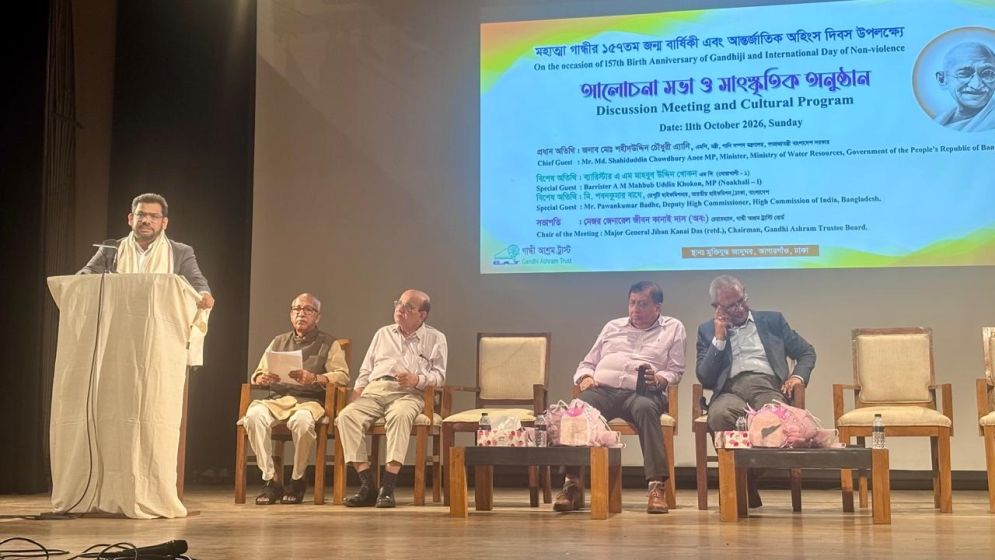
Photo: Courtesy
Non-violent leader Mahatma Gandhi’s relevance is profound in
the contemporary world marked by geopolitical tensions, armed conflicts,
environmental challenges and social inequalities, said Indian Deputy High
Commissioner Pawankumar Tulshidas Badhe
on Sunday.
“Gandhi’s belief in simple living, ethical leadership, truth
and service to the most vulnerable challenges us to measure progress not merely
by economic growth, but also by compassion, justice and human welfare. His life
reminds us that moral courage can be more powerful than physical force,” the Indian
envoy added.
Pawankumar Tulshidas Badhe
made the remarks at a discussion session organised on the occasion of the Indian
founding father’s 157th birth anniversary.
The Gandhi Ashram Trust, based in Noakhali, organised the
discussion at the auditorium of the Liberation War Museum, Agargaon in the
capital on Sunday afternoon.
The “International Day of Non-Violence” was also celebrated at
the event, which included cultural performances following the discussion session.
BNP leader and Noakhali-1 lawmaker Barrister AM Mahbub Uddin Khokon, and Gandhi Ashram Trust Chairman Maj Gen (retd) Jiban Kanai Das were present at the discussion session, among others.
Barrister Hamidul Mishbah, advocate of the Supreme Court and founder of the Bangladesh Intellectual Property Forum, delivered a speech titled ‘The Audacity of Truth: Mahatma Gandhi’s Idealism in the Age of Expediency.’ A scholar of Gandhi studies with over two decades in legal practice, he said the Mahatma’s ideals of truth and non-violence are as relevant as ever at a time of political polarisation, armed conflict and eroding public trust. Gandhi’s example, Barrister Mishbah said, teaches that those in power should resolve conflicts through dialogue rather than force.
Speaking on Satyagraha, he said true leadership draws its strength from moral authority, transparency and service to the people. Ahimsa, or non-violence, he added, is a courageous and practical way to confront injustice and build lasting peace. He also pointed to Gandhi’s influence on Martin Luther King Jr. and Nelson Mandela. Referring to Gandhi’s Talisman, the principle of weighing every decision by its effect on the poorest and weakest, he said a country’s progress should be judged by the dignity and security it ensures for its citizens, not just by economic figures.
At the discussion session, Pawankumar Tulshidas Badhe further said that according
to him three ideas of Mahatma Gandhi are extremely relevant in present tense
times.
“First, the discipline of non-violence. Gandhi never saw
non-violence as weakness. He called it the weapon of the strong, because it
takes more courage to hold your ground without hatred than to strike. In an age
of polarisation, his lesson is that we can disagree firmly and still remain
humane. The United Nations recognises his birth anniversary as the
International Day of Non-Violence, which shows how widely this idea is valued.
“Second, the primacy of truth. Gandhi called his
autobiography "The Story of My Experiments with Truth." He believed
that public life without honesty is hollow. Today, when a falsehood can circle
the globe before the truth has dressed, his insistence on integrity, in speech,
in politics, and in what we share online, is not old-fashioned. It is
essential.
“Third, restraint and responsibility toward nature. He
reminded us that the earth provides enough for everyone's need, but not for
everyone's greed. South Asia is among the regions most exposed to climate
change, from rising seas along our coasts to floods and cyclones that respect
no border. Gandhi's thinking about simple living, local self-reliance, and care
for shared resources speaks directly to the challenges both our nations face.
“Gandhiji also had deep ties to Bengal's intellectual world.
His relationship with Rabindranath Tagore, who is cherished equally in
Bangladesh and India, was one of mutual respect, and of friendly disagreement.
Tagore gave him the name ‘Mahatma.’ Their conversations show that two great
minds can differ and still enrich each other. That is a good model for our two
countries, and for the region.
“India and Bangladesh share a language of the heart: a
history, a culture, a river system, and a future. Our relationship is wide,
covering trade, connectivity, energy, education, health, and the bond between
our people. Gandhi's spirit of dialogue, mutual respect, and shared well-being
offers a guide for how we should keep building it. Strong India-Bangladesh
relations can contribute to regional peace, prosperity and people-to-people
understanding.”